

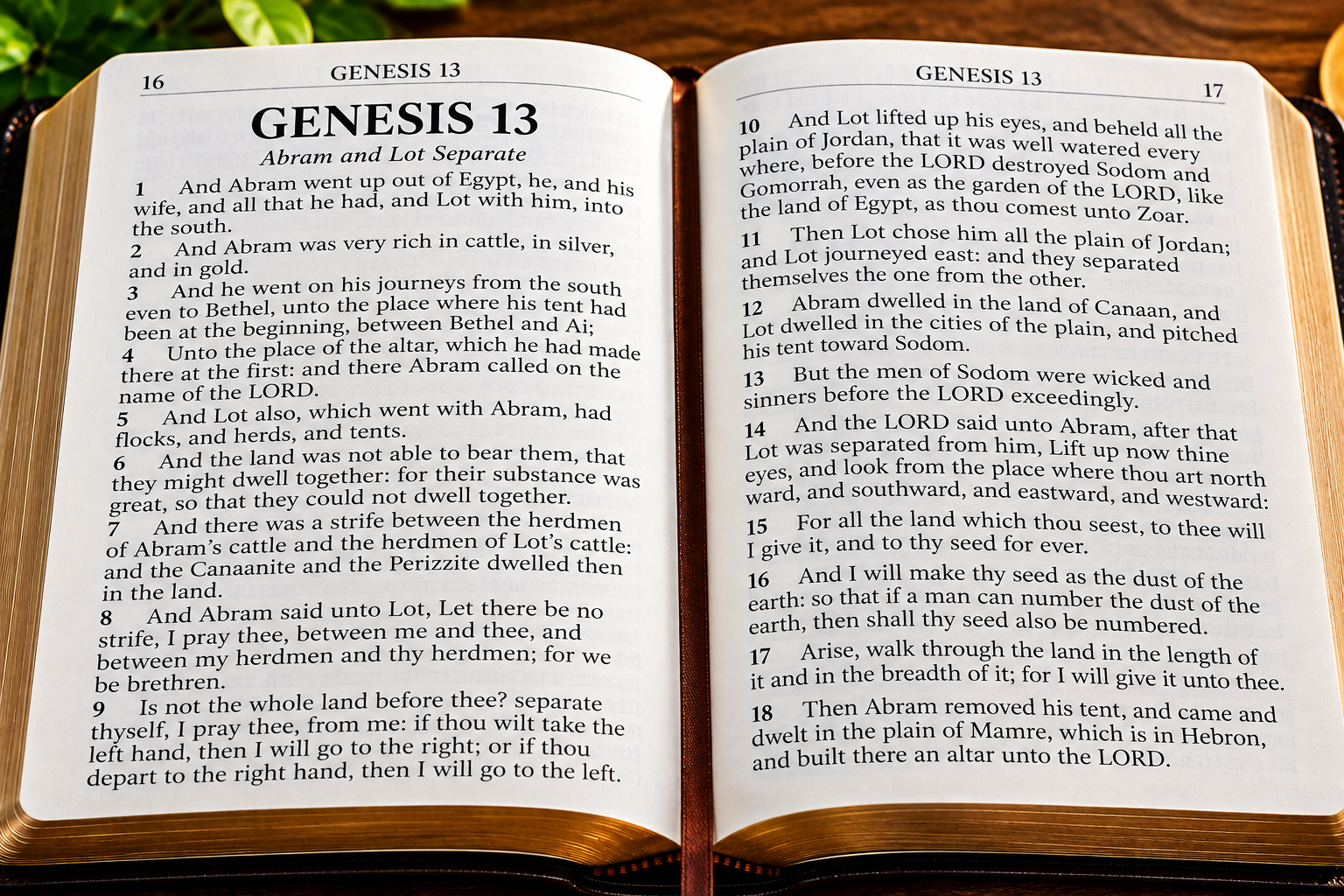
Book: Genesis
Chapter: 13
Content Category: Faith & Bible Study
Content Type: Biblical Chapter Overview and Interpretation
Primary Scripture: Genesis 13:1–18 Key
Theme: Abram demonstrates generosity by allowing Lot to choose his land first, while God reaffirms His promise to give Canaan to Abram and his descendants.
1. Introduction to Genesis 13
Genesis 13 continues the story of Abram after his journey to Egypt. Abram returns to Canaan with Sarai, Lot, and the possessions he has acquired. As their households grow, the land can no longer adequately support both groups of herdsmen together. Conflict develops between Abram’s herdsmen and Lot’s herdsmen, creating the need for separation.
Rather than allowing the disagreement to escalate, Abram proposes that they separate peacefully. He gives Lot the opportunity to choose the territory he prefers, even though Abram is the older relative and the recipient of God’s promises. Lot chooses the well-watered plain of Jordan, while Abram remains in Canaan.
After Lot separates from him, God reaffirms His promise to give Abram and his descendants the land. Abram then moves to Hebron and builds an altar to the LORD.
Genesis 13 teaches important lessons about conflict resolution, generosity, the danger of judging by appearances alone, the consequences of choices, and trust in God’s promises.
Key Verse — Genesis 13:8–9 (KJV)
“And Abram said unto Lot, Let there be no strife, I pray thee, between me and thee, and between my herdmen and thy herdmen; for we be brethren.
Is not the whole land before thee? separate thyself, I pray thee, from me: if thou wilt take the left hand, then I will go to the right; or if thou depart to the right hand, then I will go to the left.”
These verses reveal Abram’s desire for peace and his willingness to give Lot the first choice of land.
2. Chapter Overview: Genesis 13:1–18


5
A. Abram Returns from Egypt — Genesis 13:1–2
Abram leaves Egypt and travels into the southern region of Canaan, bringing Sarai, Lot, and all his possessions with him.
Genesis 13:2 states:
“And Abram was very rich in cattle, in silver, and in gold.” — Genesis 13:2 (KJV)
Abram has substantial material wealth. His possessions include livestock, silver, and gold. This wealth becomes important to the events that follow because both Abram and Lot have growing households and herds.
The chapter does not suggest that wealth is inherently wrong. Instead, it shows that managing possessions and resources can create practical challenges, particularly when different households depend on the same land.
Key lesson: Material resources can be a blessing, but they also require wisdom, responsibility, and peaceful management.
B. Abram Returns to Bethel and Calls on the LORD — Genesis 13:3–4
Abram travels from the south toward Bethel, returning to the area where he had previously pitched his tent and built an altar.
Genesis 13:4 records that he calls upon the name of the LORD.
This return to a familiar place of worship connects Genesis 13 with Genesis 12:8. Abram’s journey has included both God’s promise and the difficult experience in Egypt. Now he returns to a place associated with worship and dependence on God.
The passage emphasizes Abram’s continued relationship with the LORD. Although the text does not explicitly describe his private thoughts about the events in Egypt, it does show him returning to a place where he previously worshiped.
Key lesson: Maintaining a life of worship and dependence on God is important through changing circumstances.
C. Abram and Lot Become Too Wealthy to Remain Together — Genesis 13:5–6
Lot, who travels with Abram, also has flocks, herds, and tents. Their combined possessions are so extensive that the land cannot support both households together in one place.
The problem is not simply a personal disagreement. It involves the practical limits of available grazing land and water for their livestock.
Genesis 13:6 explains that the land was not able to bear them so that they might dwell together, because their possessions were great.
This detail shows how prosperity can create pressure when resources are limited. Even people who are related and share a common history may face conflict when their needs and interests overlap.
Key lesson: Growth and success require planning, cooperation, and sometimes changes in how responsibilities and resources are managed.
D. Conflict Develops Between Their Herdsmen — Genesis 13:7
The herdsmen of Abram and Lot begin to quarrel. The text also notes that the Canaanites and Perizzites were then dwelling in the land.
The mention of these peoples provides the setting for the dispute. The available land is shared with other inhabitants, making the pressure on resources even more significant.
The conflict involves the workers responsible for managing the herds, but Abram and Lot must address the situation because their households are connected.
This passage illustrates how unresolved disagreements among representatives, employees, or family members can threaten relationships at a broader level.
Key lesson: Leaders should address conflict before it damages relationships and creates greater division.
E. Abram Proposes a Peaceful Separation — Genesis 13:8–9
Abram takes the initiative to resolve the disagreement. He tells Lot:
“Let there be no strife, I pray thee, between me and thee, and between my herdmen and thy herdmen; for we be brethren.” — Genesis 13:8 (KJV)
Abram identifies their relationship as the reason to pursue peace. He does not insist on winning the argument or securing the best land for himself.
Instead, he offers Lot a choice. If Lot goes in one direction, Abram will go in the other.
Abram’s proposal demonstrates generosity and a willingness to surrender the advantage of choosing first. He values the relationship more than the opportunity to control the entire decision.
The passage does not mean that every conflict must be solved through separation. In this particular situation, however, dividing the land allows the two households to continue without the same competition for resources.
Key lesson: Peace sometimes requires giving up personal advantage and choosing a solution that allows others to flourish.
F. Lot Chooses the Well-Watered Plain of Jordan — Genesis 13:10–11
Lot looks toward the plain of Jordan and sees that it is well watered. Genesis compares its appearance to the garden of the LORD and the land of Egypt, before noting that this was before the LORD destroyed Sodom and Gomorrah.
Lot chooses the plain of Jordan and journeys eastward. The two men separate.
Lot’s decision is based on what he sees: the land appears fertile and suitable for supporting his livestock. His choice is understandable from an agricultural perspective because water and grazing land are important for a pastoral household.
However, the following verses introduce a significant detail about the area Lot chooses.
Important observation: Genesis 13 does not explicitly state that Lot chose the Jordan plain solely out of greed or that the land’s appearance alone proves his decision was sinful. The text describes his choice and then provides information about the character of the people living near his destination.
G. Lot Settles Near Sodom — Genesis 13:12–13
Lot settles in the cities of the plain and pitches his tent toward Sodom. Genesis 13:13 then states:
“But the men of Sodom were wicked and sinners before the LORD exceedingly.” — Genesis 13:13 (KJV)
This verse introduces a moral dimension to Lot’s choice. The land appears attractive, but the surrounding community is described as exceedingly wicked.
The contrast is important. A place may offer material opportunity while presenting spiritual or moral dangers. The narrative encourages readers to consider more than immediate benefits when making decisions.
At the same time, the passage does not say that Lot fully understood the future consequences of settling near Sodom. His later story in Genesis reveals how his relationship with the city develops.
Key lesson: Wise decisions consider not only what a choice offers materially but also the character, influences, and consequences associated with it.
H. God Reaffirms His Promise to Abram — Genesis 13:14–15
After Lot separates from Abram, God speaks to Abram and tells him to look in every direction: north, south, east, and west.
God declares:
“For all the land which thou seest, to thee will I give it, and to thy seed for ever.” — Genesis 13:15 (KJV)
This statement reaffirms the promise introduced in Genesis 12:7. God again connects the land with Abram and his descendants.
Abram had allowed Lot to choose first, but he had not lost the promise God made to him. The narrative emphasizes that Abram’s future depends on God’s word rather than on securing the most attractive piece of land through competition.
The promise also includes descendants. Abram, who does not yet have the promised child, is told that the land will belong to his offspring.
Key lesson: Trusting God’s promises can free a person from the need to grasp every immediate advantage.
I. God Promises Abram Numerous Descendants — Genesis 13:16
God tells Abram that his descendants will be like the dust of the earth, so numerous that they cannot be counted.
This imagery communicates abundance and the scale of God’s promise. Abram is being assured that his family line will become extraordinarily numerous.
The promise is especially significant because Abram and Sarai have not yet received the child through whom this promise will begin to unfold. God’s word points toward a future that Abram cannot yet see in its entirety.
The verse develops the promise of a great nation from Genesis 12:2 and prepares for later covenant passages, particularly Genesis 15 and 17.
J. Abram Walks Through the Land — Genesis 13:17
God instructs Abram to arise and walk through the length and breadth of the land because He will give it to him.
The instruction invites Abram to survey the land associated with God’s promise. He is living in the land as a sojourner, but the promise concerns a future inheritance for him and his descendants.
This creates a recurring theme in the patriarchal narratives: God’s promise is certain within the biblical account, but its full historical realization unfolds over time.
Key lesson: Faith involves living in the present while trusting God’s purposes for the future.
K. Abram Settles Near Hebron and Builds an Altar — Genesis 13:18
Abram moves his tent and dwells by the oaks of Mamre, which are in Hebron. There he builds an altar to the LORD.
The chapter ends as it began in relation to Abram’s worship: his journey is marked by altars and acknowledgment of God.
The altar at Hebron reinforces Abram’s relationship with the LORD and closes the chapter with worship rather than conflict or competition.
While Lot’s choice leads him toward the cities of the plain, Abram continues his journey in the land God has promised. The chapter prepares readers for the events of Genesis 14, in which Lot becomes involved in a regional conflict.
Key lesson: A life of faith is not defined only by the choices one makes about possessions or location, but also by one’s continuing relationship with God.
3. Major Themes in Genesis 13
| Theme | Scripture | Meaning |
|---|---|---|
| Worship and dependence on God | Genesis 13:3–4 | Abram returns to a place where he previously worshiped the LORD. |
| Wealth and responsibility | Genesis 13:2, 5–6 | Increasing possessions create practical challenges for both households. |
| Peaceful conflict resolution | Genesis 13:8–9 | Abram seeks peace instead of allowing the dispute to continue. |
| Generosity and humility | Genesis 13:9 | Abram gives Lot the first opportunity to choose the land. |
| The danger of judging by appearances | Genesis 13:10–13 | Lot chooses attractive land near a city whose people are described as exceedingly wicked. |
| God’s faithfulness | Genesis 13:14–17 | God reaffirms His promise to Abram after the separation. |
| The promise of descendants | Genesis 13:16 | God compares Abram’s future descendants to the dust of the earth. |
| Faith and patience | Genesis 13:15–17 | Abram must trust God’s promise while its fulfillment remains in the future. |
| Worship as a way of life | Genesis 13:4, 18 | Abram’s journey is marked by calling upon the LORD and building altars. |
4. Biblical Interpretation Note
Genesis 13 should be interpreted as part of the continuing account of God’s promises to Abram. It describes a practical conflict over resources, Abram’s response to that conflict, Lot’s decision, and God’s reaffirmation of the land promise.
The chapter offers important lessons about peace, generosity, discernment, and faith. However, careful interpretation requires distinguishing what the text explicitly states from conclusions that readers might draw from it.
A. Why Does Abram Give Lot the First Choice?
Scripture: Genesis 13:8–9
Abram proposes a peaceful separation because he does not want conflict between their households. He gives Lot the opportunity to choose the direction he prefers.
The passage presents Abram as taking a generous and peace-seeking approach. Although Abram could have insisted on his seniority or his position as the recipient of God’s promises, he allows Lot to choose first.
The text does not explicitly state that Abram made this offer because he knew God would subsequently reaffirm the land promise. That connection is a reasonable theological observation, but it should not be presented as a recorded motive.
Interpretive principle: The narrative highlights Abram’s initiative in pursuing peace, while the following verses emphasize God’s continued faithfulness to His promise.
B. Does Genesis 13 Teach That Wealth Is Bad?
Scripture: Genesis 13:2, 5–6
No. Abram is described as very wealthy, and Lot also possesses substantial livestock and other resources. The conflict arises because their combined possessions cannot be adequately supported in the same area.
The chapter does not condemn wealth itself. Instead, it illustrates that resources can create management problems and competing interests.
The relevant question is not simply whether someone possesses wealth, but how that person manages resources, treats others, and responds when conflicts arise.
Application: Wealth and success should be accompanied by responsibility, wise planning, and concern for peaceful relationships.
C. Was Lot’s Choice Sinful?
Scripture: Genesis 13:10–13
Lot chooses the well-watered plain of Jordan because it appears suitable for his household and livestock. The text describes the land’s appearance before mentioning the wickedness of the people of Sodom.
The narrative invites readers to notice the contrast between the land’s material attractiveness and the moral condition of its inhabitants. However, Genesis 13 does not explicitly say that Lot chose the plain because he was greedy or that he fully understood the spiritual dangers associated with Sodom.
The later narrative provides additional information about Lot’s relationship with Sodom, particularly in Genesis 19.
Interpretive principle: Do not confuse a reasonable inference from the story with an explicit statement of Scripture. The text supports reflection on discernment without requiring us to invent Lot’s motives.
D. Why Does the Bible Mention the Wickedness of Sodom?
Scripture: Genesis 13:13
The description of Sodom prepares readers for the events of Genesis 18–19, when God judges the city and its wickedness becomes central to the narrative.
This detail also creates a contrast between the attractiveness of the Jordan plain and the moral condition of Sodom’s inhabitants. A decision that appears advantageous in material terms may bring a person into contact with harmful influences.
The text does not establish that every person who lives near a wicked community automatically shares its sins. Rather, it introduces a setting whose moral significance becomes clearer as the story progresses.
E. Why Does God Repeat the Promise of the Land?
Scripture: Genesis 12:7; 13:14–17
God had already promised Abram that his descendants would receive the land of Canaan. After Lot separates from him, God reaffirms that promise.
The repetition emphasizes continuity: the separation does not cancel God’s commitment to Abram. God also expands the imagery of the promise by comparing Abram’s descendants to the dust of the earth.
The passage should be understood within the biblical narrative of the patriarchs and the covenant promises that follow. It is not a general guarantee that every believer will receive a particular piece of land or achieve every personal ambition.
F. What Does “To Thee Will I Give It” Mean?
Scripture: Genesis 13:15
God promises the land to Abram and his descendants. The immediate context concerns the land of Canaan and the future of Abram’s family.
The word seed in the KJV refers here to Abram’s descendants. The promise is developed in later chapters, including Genesis 15 and 17.
Christian interpretation may also consider how the New Testament develops the broader promise to Abraham, especially Galatians 3. However, the original meaning of Genesis 13 must first be understood in its historical and literary context.
G. What Is the Significance of Abram’s Altar at Hebron?
Scripture: Genesis 13:18
Abram builds an altar to the LORD at Hebron. This continues the pattern of worship established in Genesis 12.
The altar is a sign of Abram’s devotion and acknowledgment of God. The text does not provide a detailed description of the ceremony or establish that this altar was identical in function to the later altar system under the Mosaic Law.
The significance lies in the recurring portrayal of Abram as a traveler whose life includes worship and dependence on the LORD.
H. How Does Genesis 13 Connect to the Rest of the Bible?
Genesis 13 contributes to several major biblical themes:
- God’s covenant promises: The land and descendants promised to Abram are developed in Genesis 15 and 17.
- The consequences of choices: Lot’s movement toward Sodom prepares for the later account of the city’s judgment.
- Peace and generosity: Abram’s response to conflict provides an example of seeking reconciliation.
- Faith in God’s word: Abram remains in the land while trusting God’s promise concerning its future.
- The wider promise of blessing: The Abrahamic narrative eventually connects to the blessing of the nations, a theme developed in Genesis 12:3 and Galatians 3.
5. Character Study: Abram and Lot

1. Abram — The Peacemaker
Genesis 13:8–9
Abram takes the initiative to resolve the conflict. He emphasizes their relationship and offers Lot the first choice of land. His conduct illustrates generosity and a willingness to seek peace instead of insisting on personal advantage.

2. Lot — The Man Who Chooses by What He Sees
Genesis 13:10–13
Lot evaluates the land’s appearance and selects the well-watered plain of Jordan. His choice makes practical sense for a household dependent on livestock, but the narrative also draws attention to Sodom’s wickedness. The story invites readers to consider both material benefits and moral surroundings when making decisions.

3. Abram — The Worshiper Who Trusts God’s Promise
Genesis 13:14–18
After Lot leaves, God reaffirms His promise to Abram. Abram continues his journey and builds an altar at Hebron. The narrative links God’s promise with Abram’s continuing life of worship and trust.
6. Theological Significance of Genesis 13
1. Peace Can Be More Important Than Winning
Abram does not allow a dispute over land to become a permanent conflict between relatives. He takes practical steps toward peace, demonstrating that maintaining a relationship can be more important than securing the first choice.
2. Generosity Does Not Mean Abandoning God’s Purpose
Abram allows Lot to choose first, yet God’s promise to Abram remains in place. The narrative shows that Abram does not need to secure every immediate advantage for God’s promise to continue.
3. Outward Appearance Is Not the Whole Story
The Jordan plain looks fertile and desirable, but the text also identifies the wickedness of Sodom. The passage encourages readers to look beyond immediate benefits and consider the wider consequences of their decisions.
4. God’s Promises Require Patience
Abram receives a renewed promise concerning land and descendants, but its complete fulfillment lies in the future. His life demonstrates the difference between trusting a promise and immediately possessing everything promised.
5. Worship Should Continue Through Life’s Changes
Abram builds altars at different points in his journey. His circumstances change, but his worship of God remains a recurring feature of his life.
7. Practical Applications for Christian Living
- Resolve conflicts early. Address disagreements before they grow into lasting division.
- Pursue peace without surrendering integrity. Look for solutions that reduce unnecessary conflict while remaining truthful and responsible.
- Practice generosity. Consider when giving others an opportunity can produce a better outcome than insisting on personal advantage.
- Look beyond appearances. Evaluate the moral environment, long-term consequences, and responsibilities associated with an opportunity.
- Manage resources wisely. Growth in business, family life, or ministry may require better planning and clearer arrangements.
- Trust God’s promises without trying to control every outcome. Abram’s experience reminds readers that faith does not require winning every immediate advantage.
- Maintain a life of worship. Continue seeking God during transitions, disagreements, and periods of uncertainty.
- Take responsibility for leadership. Abram does not ignore the quarrel between the herdsmen. He addresses it and proposes a practical resolution.
- Distinguish biblical promises from personal expectations. Genesis 13 concerns God’s particular promise to Abram; it should not be used to guarantee that every personal plan will succeed.
- Consider how your choices affect others. Decisions about money, work, relationships, and where to live can influence both individuals and their households.
8. Key Questions for Bible Study
These questions can be used for personal study, family devotion, a church class, or a small-group discussion.
A. Observation Questions — What Does the Text Say?
- Where does Abram go after leaving Egypt?
- What does Genesis 13:2 tell us about Abram’s possessions?
- Why can Abram and Lot no longer remain together comfortably?
- Who begins to quarrel, according to Genesis 13:7?
- What solution does Abram propose to Lot?
- Which area does Lot choose, and what makes it attractive?
- What does Genesis 13:13 say about the people of Sodom?
- What does God tell Abram to look at in Genesis 13:14?
- What comparison does God use to describe Abram’s future descendants?
- Where does Abram settle at the end of the chapter, and what does he build there?
B. Interpretation Questions — What Does the Text Mean?
- Why does the size of Abram’s and Lot’s possessions contribute to their conflict?
- What does Abram’s proposal in Genesis 13:8–9 reveal about his priorities?
- Why is the mention of the Canaanites and Perizzites relevant to the setting?
- What does the description of the Jordan plain teach us about the role of appearances in decision-making?
- Why does the narrative mention Sodom’s wickedness immediately after describing the land’s attractiveness?
- Does the text explicitly say that Lot was greedy? What can we conclude confidently from the passage?
- How does God’s reaffirmation of the land promise relate to Abram and Lot’s separation?
- What does the comparison to the dust of the earth communicate about Abram’s descendants?
- What is the significance of Abram’s altar at Hebron?
- How does Genesis 13 prepare readers for the events involving Lot and Sodom in later chapters?
C. Application Questions — How Should We Respond?
- What can you learn from Abram’s approach to resolving conflict?
- How can you pursue peace when another person disagrees with you?
- Are there situations in which you need to value a relationship more than winning an argument?
- How can you evaluate opportunities without being guided by appearances alone?
- What practical steps can help prevent conflict over shared resources?
- How can you practice generosity without neglecting your responsibilities?
- What can Abram’s response teach you about trusting God rather than grasping for every advantage?
- How can you maintain worship and prayer through periods of change?
- What moral or spiritual influences should you consider when making major decisions?
- How can you become a peacemaker in your family, workplace, church, or community?
D. Deeper Reflection Questions
- How does Genesis 13 distinguish between material prosperity and spiritual wisdom?
- Why might peaceful separation be a better solution than continuing a damaging conflict?
- What is the relationship between Abram’s generosity and God’s reaffirmation of His promise?
- How should Christians apply the principles of Genesis 13 without claiming that every detail is a direct command for every believer?
- How does this chapter contribute to the biblical theme of God’s covenant with Abraham and his descendants?
9. Related Bible Verses for Further Study
| Bible reference | Connection to Genesis 13 |
|---|---|
| Genesis 12:1–3 | God calls Abram and promises to bless him and the nations through him. |
| Genesis 12:7–8 | God first promises the land to Abram’s descendants; Abram builds an altar. |
| Genesis 15:1–7 | God develops His promises concerning Abram’s descendants and the land. |
| Genesis 17:1–8 | God establishes His covenant with Abraham. |
| Genesis 18:20–33 | The wickedness of Sodom and Abraham’s appeal concerning the city. |
| Genesis 19:1–29 | The judgment of Sodom and the consequences for Lot’s household. |
| Psalm 34:14 | A call to depart from evil and seek peace. |
| Proverbs 15:1 | A reminder that a gentle answer can turn away wrath. |
| Matthew 5:9 | Jesus pronounces a blessing on peacemakers. |
| Romans 12:18 | An instruction to live peaceably with others as far as it depends on us. |
| Philippians 2:3–4 | A call to humility and consideration for the interests of others. |
| James 3:17–18 | Wisdom from above is associated with peace and righteousness. |
10. Chapter Summary
Genesis 13 describes Abram’s return to Canaan, the conflict between the herdsmen of Abram and Lot, and their eventual separation. Abram chooses peace and allows Lot to select his territory first. Lot chooses the well-watered Jordan plain and settles near Sodom, whose inhabitants are described as exceedingly wicked. After the separation, God reaffirms His promise to give the land to Abram and his descendants and promises descendants as numerous as the dust of the earth. Abram settles near Hebron and builds an altar to the LORD.
The chapter teaches that peaceful relationships, wise decision-making, generosity, and trust in God’s promises are important themes in the life of faith. It also warns readers not to evaluate opportunities solely by their outward attractiveness.
One-sentence summary: Genesis 13 teaches that Abram pursues peace rather than personal advantage, Lot chooses the attractive Jordan plain, and God reaffirms His promise to Abram concerning the land and his future descendants.