

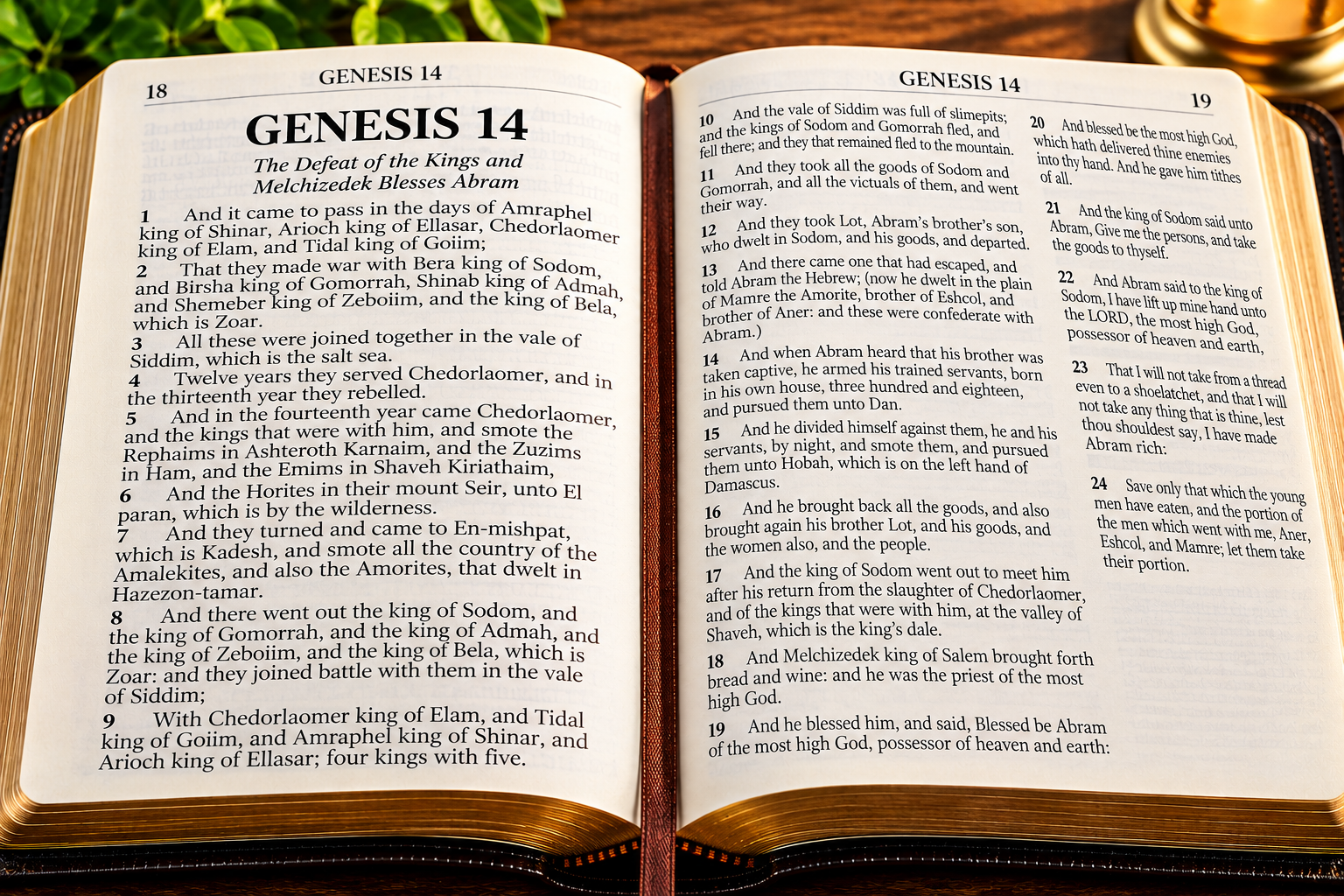
Book: Genesis
Chapter: 14
Content Category: Faith & Bible Study
Content Type: Biblical Chapter Overview and Interpretation
Primary Scripture: Genesis 14:1–24 Key
Theme: Abram rescues Lot from captivity, refuses to enrich himself through the king of Sodom, and receives a blessing from Melchizedek, priest of the most high God.
1. Introduction to Genesis 14
Genesis 14 records a regional war involving several kings in the land surrounding Canaan. During the conflict, the armies of Sodom and its allies are defeated by a coalition of invading kings. Lot, who has settled near Sodom, is captured along with his possessions.
When Abram hears that Lot has been taken captive, he gathers 318 trained men from his household and pursues the victorious kings. With the assistance of his men and allies, Abram defeats the raiders, rescues Lot, and recovers the people and possessions that were taken.
After Abram returns, two kings meet him. Melchizedek, king of Salem and priest of the most high God, brings bread and wine, blesses Abram, and praises God for delivering his enemies into his hand. Abram responds by giving Melchizedek a tenth of everything. The king of Sodom then offers Abram the recovered goods, but Abram refuses to enrich himself from the king’s possessions.
Genesis 14 develops several important biblical themes: courage, loyalty, deliverance, worship, priesthood, giving, and integrity. It also introduces Melchizedek, a figure who receives further theological attention in Psalm 110 and Hebrews 7.
Key Verse — Genesis 14:20 (KJV)
“And blessed be the most high God, which hath delivered thine enemies into thy hand. And he gave him tithes of all.”
This verse summarizes Melchizedek’s declaration that Abram’s victory ultimately came from God. It also records Abram’s gift of a tenth to Melchizedek.
2. Chapter Overview: Genesis 14:1–24


7
A. A Coalition of Kings Goes to War — Genesis 14:1–4
The chapter begins by naming four kings involved in a conflict against five kings associated with the region around the Dead Sea.
The four kings are:
- Amraphel, king of Shinar.
- Arioch, king of Ellasar.
- Chedorlaomer, king of Elam.
- Tidal, king of nations.
They fight against the five kings, including the kings of Sodom and Gomorrah. The passage explains that these five kings had served Chedorlaomer for twelve years but rebelled in the thirteenth year.
This opening establishes the political circumstances behind the conflict. The war is not initially described as a personal dispute between Abram and another ruler. It is a regional struggle involving kings, territories, tribute, and rebellion.
The details also establish the setting for Lot’s capture. Because Lot lives near Sodom, he becomes vulnerable to the consequences of the war.
Key lesson: Decisions and conflicts involving larger communities can affect people who are not directly responsible for starting them.
B. The Invading Kings Defeat Their Opponents — Genesis 14:5–9
The coalition led by Chedorlaomer defeats several peoples and rulers before confronting the kings of the Jordan plain.
Genesis names various territories and peoples, including the Rephaim, Zuzim, Emim, Horites, Amalekites, and Amorites.
The invading coalition eventually faces the five kings in the Valley of Siddim. These kings include the rulers of Sodom and Gomorrah.
The passage portrays the conflict as a substantial military campaign rather than a brief local skirmish. The victorious coalition has already defeated other groups before reaching the cities associated with Lot.
The historical identities and exact locations of some of the ancient peoples and places mentioned are debated. Readers should distinguish the biblical account from modern attempts to identify every location with certainty.
C. The Kings of Sodom and Gomorrah Are Defeated — Genesis 14:10–12
The Valley of Siddim is described as being full of slimepits, or pits containing bitumen. When the kings of Sodom and Gomorrah flee, some fall into the pits, while others escape toward the mountain region.
The victorious armies take the possessions and food supplies of Sodom and Gomorrah. They also capture Lot, Abram’s nephew, along with his possessions, and depart.
Lot’s capture connects the regional conflict directly to Abram’s family. In Genesis 13, Lot chose the well-watered plain and settled near Sodom. Now he suffers the consequences of living in a region affected by warfare.
The text does not state that Lot was captured because God was punishing him for his choice. It simply records that he was living in Sodom’s territory when the city was defeated.
Key lesson: A decision about where to live can expose a person and household to risks that may not be immediately apparent.
D. Abram Hears That Lot Has Been Captured — Genesis 14:13–14
A man who escaped from the conflict brings news to Abram, who is identified as a Hebrew and is living near the oaks of Mamre the Amorite.
Mamre and his brothers, Eshcol and Aner, are allies of Abram. When Abram hears that Lot has been taken captive, he gathers 318 trained men born in his household and pursues the invading forces.
This detail shows that Abram has an established household with enough trained men to organize a military response. He is not merely a solitary traveler; he has resources, leadership responsibilities, and relationships with local allies.
Abram’s response also reveals his concern for Lot. Although they separated in Genesis 13, Abram does not abandon his nephew when he is in danger.
Key lesson: Peaceful separation does not have to mean indifference. Concern for others can continue even when households or paths diverge.
E. Abram Pursues the Invading Kings — Genesis 14:15–16
Abram divides his men and attacks the opposing forces at night. He pursues them as far as Hobah, north of Damascus, and recovers the goods. He also brings back Lot, the women, and the other people who had been taken.
The account emphasizes Abram’s decisive action. He mobilizes his household, works with allies, and pursues the raiders rather than simply expressing concern from a distance.
The text attributes no direct supernatural sign to the military operation itself. The explicit statement about God’s role in the victory comes through Melchizedek’s blessing in verses 18–20.
Abram’s actions show courage and practical leadership. His rescue also prevents Lot and the other captives from remaining in the hands of the victorious kings.
Key lesson: Helping others in danger can require courage, preparation, cooperation, and decisive action.
F. The King of Sodom Comes to Meet Abram — Genesis 14:17
After Abram returns from defeating Chedorlaomer and the kings who were with him, the king of Sodom comes out to meet him in the Valley of Shaveh, identified as the King’s Valley.
The king of Sodom is not the only ruler to meet Abram after the battle. Melchizedek also appears in the next verses.
The meeting introduces two contrasting responses to Abram’s victory. Melchizedek emphasizes God’s role in the deliverance, while the king of Sodom subsequently offers Abram the recovered goods.
The narrative places Abram in a position where he must respond to both a religious blessing and a political offer.
G. Melchizedek, King of Salem and Priest of God Most High — Genesis 14:18
Genesis introduces Melchizedek:
“And Melchizedek king of Salem brought forth bread and wine: and he was the priest of the most high God.” — Genesis 14:18 (KJV)
Melchizedek holds two offices: he is king of Salem and priest of the most high God. He brings bread and wine to Abram, a gesture associated in the immediate narrative with his meeting with Abram after the battle.
The text does not explicitly explain whether the bread and wine are intended as a meal, provisions, or a ceremonial act. It is safest to begin with what the passage says: Melchizedek brings them as he meets Abram.
Melchizedek is a distinctive figure in the Bible because he is both a king and a priest. His appearance is brief in Genesis, but Psalm 110:4 later refers to a priest “after the order of Melchizedek.” Hebrews 5–7 develops the comparison between Melchizedek and the priesthood of Jesus Christ.
Key lesson: Genesis 14 introduces a priestly figure whose significance becomes clearer through later biblical revelation.
H. Melchizedek Blesses Abram — Genesis 14:19–20
Melchizedek blesses Abram and declares:
“Blessed be Abram of the most high God, possessor of heaven and earth.” — Genesis 14:19 (KJV)
He then blesses God, the possessor of heaven and earth, who has delivered Abram’s enemies into his hand.
This blessing interprets the victory in theological terms. Abram has acted courageously and strategically, but Melchizedek directs attention to God as the ultimate source of deliverance.
Abram responds by giving Melchizedek a tenth of everything. In this narrative, the gift follows the blessing and acknowledgment of God’s role in the victory.
The passage is important to biblical discussions of tithing. However, it records an event involving Abram and Melchizedek; it does not, by itself, set out a complete command concerning the frequency, calculation, or administration of tithes for every later community.
Key lesson: The biblical account connects Abram’s victory with gratitude, recognition of God’s sovereignty, and the giving of a tenth.
I. Abram Refuses to Enrich Himself Through the King of Sodom — Genesis 14:21–23
The king of Sodom tells Abram to give him the people and keep the goods. Abram refuses the offer, declaring that he has lifted his hand to the LORD, the most high God, the possessor of heaven and earth.
Abram explains that he will take nothing belonging to the king of Sodom—not even a thread or a shoe latchet—so that the king cannot claim to have made Abram rich.
Abram’s refusal demonstrates a concern for integrity. He does not want his prosperity to be credited to the king of Sodom, nor does he want to become indebted to him through the offer.
This decision is especially significant because Abram has just won a battle and recovered the possessions taken by the raiders. He could potentially gain considerable wealth, but he chooses to decline the king’s offer.
Abram does make an exception for the food his young men have eaten and acknowledges the portions belonging to his allies. His refusal is therefore specific to his own decision about the king’s goods; he does not claim authority to deny his allies what belongs to them.
Key lesson: Integrity may require refusing benefits that could compromise one’s independence, reputation, or commitments.
J. Abram Honors the Rights of His Allies — Genesis 14:24
Abram concludes by distinguishing his own refusal from the rights of his companions. Aner, Eshcol, and Mamre should receive their portion.
This final detail shows that Abram’s decision is not a demand that everyone involved follow the exact same arrangement. He makes a personal commitment while recognizing the legitimate claims of others.
The chapter ends by emphasizing both Abram’s integrity and his fairness toward his allies.
Key lesson: Personal convictions should be upheld without disregarding the legitimate rights and responsibilities of others.
3. Major Themes in Genesis 14
| Theme | Scripture | Meaning |
|---|---|---|
| Conflict and its consequences | Genesis 14:1–12 | Regional warfare affects cities, households, and innocent people. |
| Family loyalty | Genesis 14:13–16 | Abram acts to rescue Lot despite their earlier separation. |
| Courage and leadership | Genesis 14:14–16 | Abram organizes a rescue operation with his trained men and allies. |
| God’s sovereignty | Genesis 14:19–20 | Melchizedek credits God with delivering Abram’s enemies into his hand. |
| Priesthood | Genesis 14:18 | Melchizedek appears as both king of Salem and priest of God Most High. |
| Blessing and gratitude | Genesis 14:19–20 | Melchizedek blesses Abram and praises God for the victory. |
| Tithing | Genesis 14:20 | Abram gives Melchizedek a tenth of everything. |
| Integrity | Genesis 14:21–23 | Abram refuses the king of Sodom’s offer to enrich himself. |
| Fairness toward others | Genesis 14:24 | Abram recognizes the rights and portions of his allies. |
4. Biblical Interpretation Note
Genesis 14 contains historical narrative, military details, and theological themes that require careful interpretation. The chapter describes Abram’s rescue of Lot, his encounter with Melchizedek, and his refusal to take the king of Sodom’s goods. It also introduces a priestly figure who becomes important in later biblical teaching.
A. Is Genesis 14 a Historical Account?
Genesis 14 presents its events as a narrative involving kings, territories, warfare, and named individuals. The chapter names rulers and describes a campaign that affects the cities of the Jordan plain.
However, the precise identification of some kings, the chronology of the conflict, and the locations of certain ancient places remain subjects of scholarly discussion. Readers should distinguish what the biblical text states from proposed modern reconstructions of the events.
Interpretive principle: Read the chapter according to its narrative details without claiming certainty about historical identifications that remain disputed.
B. Why Does Abram Rescue Lot?
Scripture: Genesis 14:13–16
Lot has been captured during the defeat of Sodom and Gomorrah. When Abram receives the news, he gathers his trained men and pursues the raiders.
Genesis 13 had recorded the separation between Abram and Lot, but that separation does not end Abram’s concern for his nephew. Abram acts decisively to rescue him and the other captives.
The text does not explicitly state all of Abram’s motives. Nevertheless, his response demonstrates a willingness to take responsibility and accept risk to help someone in danger.
Application: Family disagreements or differences in direction do not necessarily remove the responsibility to show compassion when someone needs help.
C. What Does the Number 318 Mean?
Scripture: Genesis 14:14
The text specifies that Abram had 318 trained men born in his household. This number emphasizes the size and organization of Abram’s household force.
Some readers may associate the number with symbolic meanings, but Genesis 14 does not assign it a symbolic interpretation. Its clearest function in the narrative is to describe the men Abram mobilized for the rescue.
Interpretive principle: Do not assign hidden spiritual meanings to specific numbers unless the text or a well-grounded biblical connection supports that interpretation.
D. Who Was Melchizedek?
Scripture: Genesis 14:18–20
Melchizedek is identified as the king of Salem and priest of the most high God. He meets Abram after the battle, brings bread and wine, blesses Abram, and praises God for the victory.
The name Melchizedek is commonly understood as related to “king of righteousness,” while Salem is traditionally associated with Jerusalem. Hebrews 7:2 explicitly gives the interpretations “King of righteousness” and “King of peace.”
Genesis itself does not provide a genealogy for Melchizedek or explain his ancestry. His brief appearance makes him an unusual figure within the patriarchal narrative.
Christians should distinguish the account in Genesis from the later theological interpretation found in Psalm 110 and Hebrews 7.
E. What Is the Meaning of “The Most High God”?
Scripture: Genesis 14:18–22
Melchizedek refers to God as El Elyon, translated in the KJV as “the most high God.” Abram also uses this title when responding to the king of Sodom.
The expression emphasizes God’s supreme authority. Melchizedek describes Him as the possessor of heaven and earth, affirming that God’s authority extends beyond one city, kingdom, or territory.
Abram’s use of the same title demonstrates his agreement with the central declaration that the victory ultimately belongs to God.
Theological significance: The chapter presents God as sovereign over the affairs of kings and nations, not merely as a local deity associated with one place.
F. Why Does Abram Give Melchizedek a Tenth?
Scripture: Genesis 14:20
After Melchizedek blesses Abram and praises God for the victory, Abram gives him a tenth of everything.
The passage records an act of giving, but it does not specify whether Abram’s gift was calculated from all his possessions, the recovered goods, or a particular portion of the spoils. Interpretations differ on the precise scope of “all” in this context.
The New Testament refers to this event in Hebrews 7:1–10 when discussing Melchizedek and the priesthood. The episode is therefore important to biblical discussions of tithing.
However, Genesis 14 alone does not establish every detail of a universal tithing requirement. Broader teachings about tithing and Christian giving should consider other relevant passages and their covenant contexts.
Interpretive principle: Distinguish the event Genesis records from the broader theological conclusions later readers may draw from it.
G. Does Melchizedek’s Bread and Wine Symbolize Communion?
Scripture: Genesis 14:18
Melchizedek brings bread and wine when he meets Abram. Some Christian traditions see a connection between these elements and the bread and wine of the Lord’s Supper.
Nevertheless, Genesis 14 does not explicitly identify this event as a celebration of Communion or state that the bread and wine symbolize Christ’s body and blood. The immediate narrative simply records what Melchizedek brought.
A Christian devotional reading may explore possible theological associations, but it should not present them as the explicit meaning given by Genesis.
H. How Does Melchizedek Point to Jesus Christ?
Scripture: Psalm 110:4; Hebrews 5:5–10; 6:19–20; 7:1–28
Melchizedek receives special attention in the New Testament, especially in Hebrews 7. The writer uses the Genesis account and Psalm 110:4 to explain the priesthood of Jesus Christ.
Hebrews emphasizes that Jesus’ priesthood is associated with the order of Melchizedek rather than the hereditary priesthood established through Aaron. It also highlights the enduring significance of Christ’s priestly ministry.
The text does not require readers to conclude that Melchizedek was literally Jesus appearing before the incarnation. Hebrews presents Melchizedek as a figure whose biblical portrayal provides a pattern or comparison for understanding Christ’s priesthood.
Interpretive principle: Read Genesis 14 in its original context and then consider how Hebrews develops its significance within Christian theology.
I. Why Does Abram Refuse the King of Sodom’s Goods?
Scripture: Genesis 14:21–24
Abram refuses to take the king of Sodom’s possessions because he does not want the king to claim that he made Abram rich.
The passage emphasizes Abram’s commitment to the LORD and his concern for his independence and integrity. He has received God’s promises and does not want his prosperity attributed to the king of Sodom.
The text does not establish that accepting payment or property from every nonbeliever is wrong. Abram’s refusal is connected to this particular offer and the reason he gives for rejecting it.
Application: Believers should evaluate opportunities in light of their commitments, the conditions attached to them, and the possible effects on their integrity.
5. Character Study: Abram, Melchizedek, and the King of Sodom

1. Abram — The Courageous Rescuer
Genesis 14:13–16
Abram responds to the news of Lot’s captivity by mobilizing his trained men and pursuing the raiders. His conduct shows courage, preparation, leadership, and concern for others.

2. Melchizedek — The Priest Who Blesses Abram
Genesis 14:18–20
Melchizedek is both king of Salem and priest of God Most High. He blesses Abram and directs attention to God’s role in the victory. His brief appearance becomes important in later biblical teaching about Christ’s priesthood.

3. The King of Sodom — The Ruler Offering the Spoils
Genesis 14:17, 21–23
The king of Sodom offers Abram the recovered goods in exchange for the people. Abram declines the offer. The passage highlights Abram’s determination not to let the king claim credit for his prosperity.
6. Theological Significance of Genesis 14
1. God Is Sovereign Over Nations and Kings
The chapter begins with a conflict among earthly rulers and ends with Melchizedek praising God as the possessor of heaven and earth. The narrative directs attention beyond military power to God’s supreme authority.
2. Faith Can Include Practical Action
Abram’s rescue of Lot involves planning, trained men, alliances, and decisive action. The chapter does not portray faith as passivity. Abram acts, while Melchizedek acknowledges God as the ultimate source of deliverance.
3. Godly Leadership Includes Concern for Others
Abram risks his resources and safety to rescue Lot and the other captives. His response illustrates the importance of using one’s influence and abilities to help people in danger.
4. Worship Includes Acknowledging God’s Role
Melchizedek attributes the victory to God, and Abram responds with a tenth. The encounter connects deliverance with recognition of God’s sovereignty and gratitude.
5. Integrity Can Require Refusing an Advantage
Abram refuses the king of Sodom’s goods because he does not want the king to claim credit for making him wealthy. His decision demonstrates that not every available benefit must be accepted.
6. Melchizedek Provides a Biblical Pattern for Understanding Christ’s Priesthood
Genesis 14 introduces Melchizedek, while Psalm 110 and Hebrews 7 develop his significance. In Christian interpretation, the comparison helps explain the distinctive and enduring priesthood of Jesus Christ.
7. Practical Applications for Christian Living
- Help others when they are in danger. Abram responds to Lot’s captivity with action rather than indifference.
- Prepare before facing challenges. Abram’s trained men and alliances demonstrate the importance of preparation and cooperation.
- Give credit to God without denying human responsibility. Abram acts courageously, while Melchizedek praises God for the victory.
- Practice generosity thoughtfully. Abram’s gift to Melchizedek is a significant biblical example of giving, but its context should be considered when applying it to modern questions about tithing.
- Protect your integrity. Abram refuses the king of Sodom’s offer because of the implications he sees for his reputation and commitments.
- Be fair to others. Abram acknowledges that his allies are entitled to their portions, even though he refuses his own share.
- Do not confuse success with independence from God. The chapter directs attention to God as the ultimate authority over the outcome of the conflict.
- Seek peace when possible, but act decisively when necessary. Abram previously pursued peace with Lot; in Genesis 14, he acts to rescue captives from an active threat.
- Study biblical figures in their full context. Melchizedek’s role becomes clearer when Genesis 14 is read alongside Psalm 110 and Hebrews 7.
- Evaluate offers carefully. Consider not only what an opportunity provides but also the conditions, obligations, and consequences associated with it.
8. Key Questions for Bible Study
These questions can be used for personal study, family devotion, church teaching, or a small-group discussion.
A. Observation Questions — What Does the Text Say?
- Which kings are involved in the conflict described in Genesis 14:1–2?
- How long had the kings of the Jordan plain served Chedorlaomer before rebelling?
- What happens to the kings of Sodom and Gomorrah in the Valley of Siddim?
- What happens to Lot and his possessions when Sodom is defeated?
- Who brings Abram the news of Lot’s captivity?
- How many trained men does Abram gather from his household?
- How does Abram recover Lot and the other captives?
- Who is Melchizedek, and what two offices does he hold?
- What does Melchizedek declare about God in Genesis 14:19–20?
- What does Abram refuse to take from the king of Sodom?
B. Interpretation Questions — What Does the Text Mean?
- Why does the author begin the chapter with a detailed account of the kings and their conflict?
- What does Abram’s response to Lot’s captivity reveal about his character?
- Why does Melchizedek attribute Abram’s victory to God?
- What is the significance of Melchizedek being both king and priest?
- What does the title “possessor of heaven and earth” communicate about God’s authority?
- What does Abram’s gift of a tenth to Melchizedek mean in the immediate narrative?
- How does Hebrews 7 develop the biblical significance of Melchizedek?
- Why should Genesis 14:18 not automatically be interpreted as an explicit account of the Lord’s Supper?
- What reason does Abram give for refusing the king of Sodom’s goods?
- How does Abram’s treatment of his allies in verse 24 demonstrate fairness?
C. Application Questions — How Should We Respond?
- How can you help someone who is facing a serious problem, even if you have had disagreements in the past?
- What can Abram’s preparation and leadership teach you about responding to emergencies?
- How can you recognize God’s role in a successful outcome without ignoring the effort of the people involved?
- What principles should guide your decisions about giving?
- Have you ever needed to refuse an opportunity because of the conditions attached to it?
- How can you protect your integrity when financial gain or recognition is available?
- What can you learn from Abram’s willingness to acknowledge the rights of his allies?
- How can you use your influence or resources to help people who are vulnerable?
- What is the difference between trusting God and assuming that you do not need to prepare or act responsibly?
- How can the example of Abram encourage you to combine courage with humility?
D. Deeper Reflection Questions
- How does Genesis 14 balance Abram’s military action with the declaration that God delivered his enemies into his hand?
- What does the encounter with Melchizedek contribute to the larger biblical story?
- What conclusions about tithing can be drawn directly from Genesis 14, and which conclusions require consideration of other biblical passages?
- Why is it important to distinguish Abram’s personal decision from a universal command to every believer?
- How does Hebrews 7 use Melchizedek to explain the priesthood of Jesus Christ?
- What does Abram’s refusal of the king of Sodom’s goods reveal about the relationship between faith, prosperity, and integrity?
9. Related Bible Verses for Further Study
| Bible reference | Connection to Genesis 14 |
|---|---|
| Genesis 12:1–3 | God’s call and promises to Abram. |
| Genesis 13:8–13 | Abram and Lot separate, and Lot settles near Sodom. |
| Genesis 15:1–6 | God reaffirms His promises to Abram. |
| Leviticus 27:30–33 | Tithes within the law given to Israel. |
| Numbers 18:21–32 | The provision of tithes for the Levites under the Mosaic covenant. |
| Psalm 110:4 | The declaration concerning a priest after the order of Melchizedek. |
| Proverbs 11:3 | The connection between integrity and guidance. |
| Matthew 5:16 | A call to live so that others may glorify God. |
| Luke 6:38 | Jesus’ teaching concerning giving. |
| Hebrews 5:5–10 | Jesus’ priesthood and the order of Melchizedek. |
| Hebrews 6:19–20 | Jesus as high priest after the order of Melchizedek. |
| Hebrews 7:1–28 | A detailed explanation of Melchizedek and Christ’s priesthood. |
10. Chapter Summary
Genesis 14 recounts a war among regional kings in which Sodom and Gomorrah are defeated and Lot is taken captive. Abram gathers 318 trained men, pursues the victorious armies, and rescues Lot and the other captives. After the victory, Melchizedek, king of Salem and priest of God Most High, blesses Abram and praises God for delivering his enemies into his hand. Abram gives Melchizedek a tenth of everything. He then refuses the king of Sodom’s offer of the recovered goods, explaining that he does not want the king to claim credit for making him wealthy. Abram also recognizes the rightful portions of his allies.
The chapter highlights courage, loyalty, divine sovereignty, worship, giving, and integrity. It also introduces Melchizedek, whose priesthood becomes significant in the New Testament’s explanation of Jesus Christ.
One-sentence summary: Genesis 14 teaches that Abram courageously rescues Lot, acknowledges God’s role in his victory, honors Melchizedek with a tenth, and refuses the king of Sodom’s goods to preserve his integrity.