

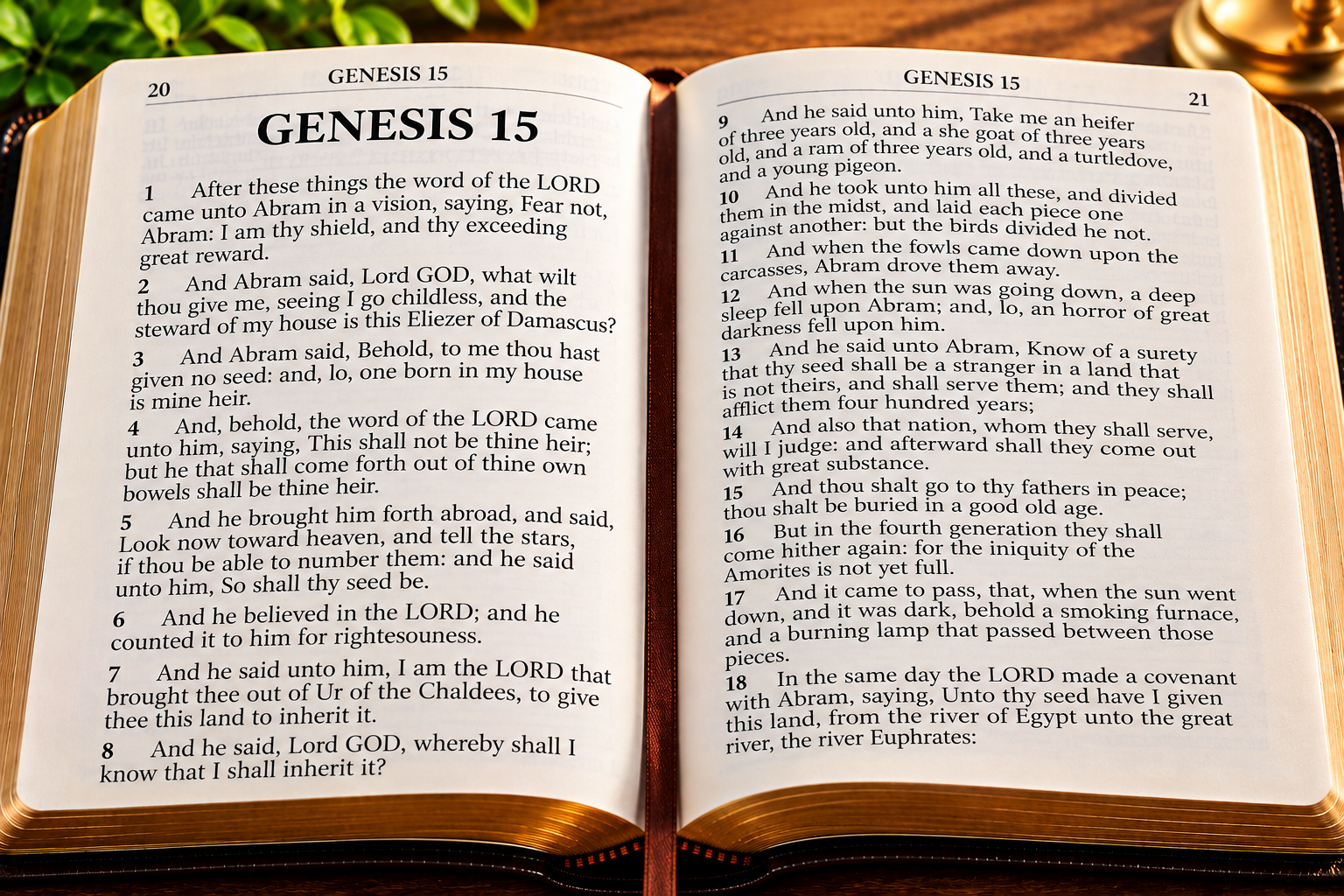
Book: Genesis
Chapter: 15
Content Category: Faith & Bible Study
Content Type: Biblical Chapter Overview and Interpretation
Primary Scripture: Genesis 15:1–21 Key
Theme: God reassures Abram that he will have an heir, promises numerous descendants, and establishes a covenant confirming that his descendants will inherit the land.
1. Introduction to Genesis 15
Genesis 15 is one of the most significant chapters in the biblical account of Abraham. In Genesis 12, God called Abram to leave his homeland and promised to make him a great nation. In Genesis 13, God reaffirmed His promise concerning the land and Abram’s descendants. In Genesis 14, Abram rescued Lot and received a blessing from Melchizedek.
Now, in Genesis 15, Abram faces a question that remains unresolved: How will God’s promises be fulfilled when he has no child of his own?
God addresses Abram’s concern by promising that his own offspring will become his heir. He then brings Abram outside and tells him to look toward the heavens and count the stars, if he is able. God declares that Abram’s descendants will be just as numerous.
Genesis 15:6 records a foundational statement about faith and righteousness:
“And he believed in the LORD; and he counted it to him for righteousness.” — Genesis 15:6 (KJV)
The chapter continues with a covenant ceremony in which God confirms His promise concerning the land. God also reveals that Abram’s descendants will experience oppression in a foreign land before returning to inherit the promised territory.
Genesis 15 therefore addresses faith, divine grace, covenant, the promise of descendants, the inheritance of land, and God’s faithfulness across generations.
Key Verse — Genesis 15:6 (KJV)
“And he believed in the LORD; and he counted it to him for righteousness.”
This verse is central to biblical teaching about faith. Abram trusts God’s promise, and God counts his faith to him for righteousness. The New Testament later refers to this passage when explaining the relationship between faith, righteousness, and God’s promise.
2. Chapter Overview: Genesis 15:1–21


A. God Reassures Abram: “Fear Not” — Genesis 15:1
The chapter begins with the word of the LORD coming to Abram in a vision.
God says:
“Fear not, Abram: I am thy shield, and thy exceeding great reward.” — Genesis 15:1 (KJV)
This statement contains two important assurances.
- “I am thy shield” — God presents Himself as Abram’s protector.
- “Thy exceeding great reward” — God assures Abram that his relationship with Him and God’s commitment are of supreme significance.
The opening follows the events of Genesis 14, in which Abram defeated a coalition of kings and refused the king of Sodom’s offer of wealth. Although Abram has demonstrated courage, God begins this chapter by addressing him with reassurance.
The passage does not explicitly state every reason Abram might have felt afraid. However, the context allows readers to recognize that the aftermath of conflict and the uncertainty surrounding God’s promises form the setting for God’s reassurance.
Key lesson: God’s promises provide a foundation for trust when circumstances remain uncertain.
B. Abram Asks About His Heir — Genesis 15:2–3
Abram responds by asking what God will give him since he remains childless.
He refers to Eliezer of Damascus, a man associated with his household, as someone who may inherit his possessions. Abram then explains that he has no child of his own.
This question exposes the tension between God’s promise and Abram’s present circumstances. God has promised to make Abram a great nation, but Abram still has no son through whom his family line can continue.
Abram does not hide the difficulty from God. He speaks honestly about the apparent gap between what God has promised and what he can presently see.
The passage shows that biblical faith is not the same as pretending that unanswered questions do not exist. Abram brings his concern into his conversation with God.
Key lesson: Faith can include honest questions while continuing to look to God for the fulfillment of His word.
C. God Promises Abram an Heir From His Own Body — Genesis 15:4
God answers Abram by declaring that Eliezer will not be his heir in the promised sense. Instead, a son who comes from Abram himself will be his heir.
This statement clarifies the earlier promise. Abram’s future does not depend on a household servant becoming the heir through whom God’s covenant promise will be fulfilled.
The promise points forward to the birth of Isaac, whose arrival is recorded in Genesis 21. At this point in the story, however, Abram and Sarai are still waiting for the promised child.
God’s answer does not provide an immediate timetable for the birth. It gives Abram a more specific assurance about the identity of his heir.
Key lesson: God’s promises may become clearer over time, even when their fulfillment has not yet arrived.
D. God Compares Abram’s Descendants to the Stars — Genesis 15:5
God brings Abram outside and tells him to look toward heaven and count the stars, if he is able.
He then declares:
“So shall thy seed be.” — Genesis 15:5 (KJV)
The stars provide an image of abundance. Abram’s descendants will be too numerous for him to count.
This promise expands the assurance given in Genesis 12:2 and Genesis 13:16. It also reinforces the contrast between Abram’s current situation and God’s promised future: he has no son at this point, yet God promises descendants beyond what Abram can count.
The imagery emphasizes the scale of God’s promise rather than providing a mathematical prediction about the exact number of descendants.
Key lesson: God’s promises may exceed what present circumstances seem to make possible.
E. Abram Believes God — Genesis 15:6
Genesis 15:6 states:
“And he believed in the LORD; and he counted it to him for righteousness.” — Genesis 15:6 (KJV)
This verse is one of the Bible’s most important statements about faith and righteousness.
Abram believes the LORD’s promise concerning his descendants. The verse then declares that God counts this faith to him for righteousness.
The passage places emphasis on Abram’s trust in God rather than on his ability to bring the promise to fulfillment through his own strength.
The verse does not mean that Abram never struggles with doubt or makes mistakes elsewhere in Genesis. His story includes both trust and weakness. Rather, Genesis 15:6 identifies his belief in God’s promise as a defining moment in his relationship with the LORD.
The New Testament later uses this verse to explain the relationship between faith and righteousness, especially in Romans 4 and Galatians 3.
Key lesson: Biblical faith rests on God’s word and trusts Him to do what He has promised.
F. Abram Asks How He Will Know He Will Inherit the Land — Genesis 15:7–8
God identifies Himself as the LORD who brought Abram out of Ur of the Chaldees to give him the land as an inheritance.
Abram responds:
“Lord GOD, whereby shall I know that I shall inherit it?” — Genesis 15:8 (KJV)
Abram’s question shifts the focus from descendants to the promised land. God has assured him of an heir, but Abram also seeks assurance concerning the inheritance.
The text presents Abram asking God for confirmation. It does not explicitly describe this question as unbelief or rebellion. In the narrative, God responds by establishing a covenant ceremony.
This distinction matters because the Bible portrays faith as compatible with seeking understanding and assurance from God. The specific form of confirmation in this chapter, however, belongs to the covenant narrative and should not be treated as a requirement that every believer must receive the same kind of sign.
G. God Instructs Abram to Prepare the Animals — Genesis 15:9–11
God tells Abram to bring a heifer, a female goat, a ram, a turtledove, and a young pigeon.
Abram takes the animals, divides the larger ones, and lays the pieces opposite one another. He does not divide the birds.
Birds of prey descend on the carcasses, and Abram drives them away.
These actions prepare the setting for the covenant ceremony that follows. In the ancient world, covenant-making could involve formal symbolic acts. The divided animals in this passage form part of the ceremony through which God confirms His promise to Abram.
The text does not explicitly explain every detail of the ritual at this point. Readers should therefore avoid assigning a definite symbolic meaning to every animal or action without further textual support.
Key lesson: God’s covenant with Abram is presented as a serious and solemn commitment, not merely a passing statement.
H. Abram Experiences Deep Darkness — Genesis 15:12
As the sun is going down, a deep sleep falls upon Abram, and a horror of great darkness comes upon him.
This moment introduces the solemn atmosphere of the covenant revelation. It also prepares Abram to receive God’s explanation of what will happen to his descendants in the future.
The darkness should be read in connection with the revelation that follows. The text does not require readers to identify it with a particular modern psychological or medical condition.
The scene marks a transition from the promise of descendants to a broader revelation about their history.
I. God Reveals the Future of Abram’s Descendants — Genesis 15:13–16
God tells Abram that his descendants will be strangers in a land that is not theirs. They will serve another people and experience affliction for four hundred years.
God also promises to judge the nation they serve and declares that Abram’s descendants will eventually come out with great substance.
The passage then states that Abram himself will go to his fathers in peace and be buried at a good old age.
God further explains that Abram’s descendants will return in the fourth generation because the iniquity of the Amorites is not yet complete.
These verses introduce a long period of suffering before the fulfillment of the land promise. They anticipate the Israelites’ later oppression in Egypt and their eventual deliverance, as described in Exodus.
The reference to the Amorites indicates that the timing of the inheritance is connected to God’s judgment and to the moral condition of the peoples already inhabiting the land. The text presents the fulfillment as occurring according to God’s timing, not merely according to Abram’s immediate desires.
Key lesson: God’s promises may involve a long historical process, including hardship, deliverance, and judgment.
J. God Confirms His Covenant With Abram — Genesis 15:17–18
After the sun goes down and darkness falls, a smoking furnace and a burning lamp pass between the divided pieces.
The text then records that the LORD makes a covenant with Abram, declaring that He will give the land to Abram’s descendants.
The smoking furnace and burning lamp are central elements in the covenant scene. The passage does not explicitly define every aspect of their symbolism, but their appearance marks the solemn divine confirmation of the promise.
A significant feature of the narrative is that the symbols associated with God’s presence pass between the pieces. Abram has prepared the animals, but the text portrays the divine action as central to the covenant ceremony.
This has led many interpreters to emphasize God’s initiative and commitment in the covenant. Such an interpretation should remain grounded in the narrative rather than extending to unsupported claims about every ritual detail.
K. God Identifies the Boundaries and Peoples of the Promised Land — Genesis 15:18–21
God describes the land promised to Abram’s descendants in terms of geographical boundaries, from the river of Egypt to the great river, the Euphrates.
The passage then names several peoples whose territories are associated with the promise, including the Kenites, Kenizzites, Kadmonites, Hittites, Perizzites, Rephaim, Amorites, Canaanites, Girgashites, and Jebusites.
The list situates the promise in a specific geographical and historical setting. The land is not described as an abstract spiritual concept; it is a territory inhabited by identifiable peoples.
The precise interpretation of the boundaries, particularly the expression “the river of Egypt,” is discussed by biblical scholars. Readers should recognize the importance of the geographical language while avoiding claims of certainty where interpretations differ.
The chapter ends with God’s covenant promise concerning the land. Its fulfillment will unfold through the later biblical history of Abram’s descendants.
3. Major Themes in Genesis 15
| Theme | Scripture | Meaning |
|---|---|---|
| God’s protection | Genesis 15:1 | God reassures Abram that He is his shield and reward. |
| Faith in God’s promises | Genesis 15:4–6 | Abram believes God’s promise concerning his descendants. |
| Righteousness through faith | Genesis 15:6 | God counts Abram’s belief to him for righteousness. |
| The promise of an heir | Genesis 15:2–5 | God promises Abram a son from his own body. |
| The promise of land | Genesis 15:7–8, 18–21 | God confirms His commitment to give land to Abram’s descendants. |
| Covenant | Genesis 15:9–18 | God establishes a solemn covenant confirming His promise. |
| Suffering before deliverance | Genesis 15:13–14 | Abram’s descendants will experience oppression before being delivered. |
| God’s timing and judgment | Genesis 15:16 | The promised inheritance unfolds according to God’s purposes. |
| Divine faithfulness | Genesis 15:17–21 | God confirms that His commitment extends beyond Abram’s lifetime. |
4. Biblical Interpretation Note
Genesis 15 is foundational for understanding the biblical concepts of faith, righteousness, covenant, and God’s promises to Abraham. It must be read in its immediate context and in light of the later biblical passages that refer to it.
A. What Does It Mean That God Is Abram’s Shield and Reward?
Scripture: Genesis 15:1
God reassures Abram by identifying Himself as his shield and exceeding great reward. The imagery of a shield communicates protection, while the language of reward emphasizes God’s generous commitment to Abram.
This assurance follows the events of Genesis 14, where Abram participated in a military rescue and refused the king of Sodom’s offer of wealth. God directs Abram’s attention toward His own faithfulness rather than merely toward material possessions.
The verse should not be interpreted as a guarantee that believers will never experience physical danger or loss. Within the narrative, it is God’s specific reassurance to Abram as part of the unfolding covenant story.
B. Why Does Abram Ask God About an Heir?
Scripture: Genesis 15:2–4
Abram has received promises concerning descendants, but he remains childless. His question reveals the apparent tension between God’s promise and his circumstances.
God responds by clarifying that Abram’s heir will come from his own body. This prepares the reader for the later birth of Isaac in Genesis 21.
The passage shows that Abram’s faith develops within a real human experience of waiting. His question does not prevent God from answering or reaffirming the promise.
Interpretive principle: Honest questions about God’s promises can be brought before Him. However, this narrative does not mean that every question will receive an immediate or equally specific answer.
C. What Does Genesis 15:6 Mean by Righteousness Through Faith?
Scripture: Genesis 15:6
The verse states that Abram believed the LORD and that God counted it to him for righteousness.
In this context, Abram trusts God’s word concerning his future descendants. The verse emphasizes God’s response to Abram’s faith rather than describing righteousness as something Abram earns by producing the promised child himself.
The New Testament develops this statement in important ways:
- Romans 4:1–5: Paul uses Abraham to explain that righteousness is not earned as a wage through works.
- Romans 4:18–22: Paul emphasizes Abraham’s trust in God’s promise despite circumstances that appeared to make fulfillment impossible.
- Galatians 3:6–9: Paul connects Abraham’s faith with the blessing of those who believe.
- James 2:21–24: James discusses Abraham’s faith in connection with his actions, emphasizing that genuine faith is demonstrated through obedience.
These passages should be read together rather than treated as though they contradict one another. Paul addresses the basis on which a person is counted righteous before God, while James challenges a claim to faith that produces no corresponding action.
Key principle: Biblical faith is trust in God, and the New Testament connects this faith with a life that responds to Him.
D. What Is a Covenant in Genesis 15?
Scripture: Genesis 15:9–18
A covenant is a solemn relationship or commitment established between parties. In Genesis 15, God confirms His promise to Abram through a formal ceremony involving divided animals and symbols associated with God’s presence.
The ceremony takes place after Abram asks how he can know that he will inherit the land. God responds by confirming the promise in a covenant setting.
Many interpreters understand the ceremony as reflecting ancient covenant practices in which passing between divided animal pieces signified the seriousness of a commitment. The text itself does not explain every element of the ritual, so detailed reconstructions should be presented cautiously.
The narrative places particular emphasis on God’s action in confirming the covenant. The promise rests on God’s commitment, even though Abram is the recipient of it.
E. Why Does God Tell Abram About Four Hundred Years of Affliction?
Scripture: Genesis 15:13–14
God tells Abram that his descendants will be strangers in a foreign land, where they will be subjected to oppression. God also promises to judge the nation that oppresses them and bring them out with great possessions.
The passage anticipates the later account of Israel’s enslavement and deliverance from Egypt. It explains that the fulfillment of the promise concerning the land will not occur immediately.
The reference to four hundred years should be read in the context of the biblical chronology and the related passages in Exodus and Acts 7. The precise relationship between the different chronological expressions used in these passages is discussed by interpreters.
Interpretive principle: The central point is that God’s promise involves a period of suffering followed by deliverance, rather than immediate possession of the land.
F. What Does “The Iniquity of the Amorites Is Not Yet Full” Mean?
Scripture: Genesis 15:16
God explains that Abram’s descendants will return in the fourth generation because the iniquity of the Amorites is not yet complete.
This statement connects the timing of the land promise with God’s judgment and the moral condition of the peoples living in the land. The narrative indicates that the promised inheritance will not take place immediately.
The verse is significant because it portrays God’s judgment as part of a larger historical process rather than as an unexplained or instantaneous event. It also reminds readers that the biblical narrative describes real conflicts involving peoples and territories.
This verse should not be used to justify personal hostility or violence against modern groups. It belongs to the specific covenant and historical context of Genesis.
G. What Do the Smoking Furnace and Burning Lamp Represent?
Scripture: Genesis 15:17
The smoking furnace and burning lamp pass between the divided animal pieces as the covenant is confirmed.
The text does not provide an explicit explanation of each symbol. Many interpreters understand them as manifestations associated with God’s presence and action in the covenant ceremony.
The important narrative point is that God confirms His promise through a solemn act. Abram is the recipient of the covenant, and the divine action is central to the scene.
Readers should avoid assigning a definite, separate meaning to every detail unless that interpretation is supported by the biblical text or a clear biblical connection.
H. What Land Does God Promise to Abram’s Descendants?
Scripture: Genesis 15:18–21
God describes the promised territory by reference to geographical boundaries and a list of peoples living in the region.
The passage refers specifically to land promised to Abram’s descendants. Its meaning should first be understood within the historical and covenant context of Genesis.
Later biblical passages develop the land promise in connection with Israel’s history. Christian interpretations may also consider the broader biblical themes of inheritance, covenant, and redemption, but these later connections should not erase the original geographical meaning of the passage.
I. How Does Genesis 15 Connect to Jesus Christ?
Genesis 15 is important to Christian theology primarily because of its teaching about faith and righteousness and its place in the Abrahamic covenant.
In Romans 4, Paul uses Abraham’s belief in God as an example when explaining righteousness through faith. In Galatians 3, Paul connects the promise to Abraham with the blessing of the nations through faith in Christ.
These New Testament connections show how Christians understand the Abrahamic narrative as part of God’s wider plan of redemption.
However, Genesis 15 does not explicitly mention Jesus by name. Its immediate focus is God’s promises to Abram concerning an heir, descendants, and land. The connection to Christ is developed through the later biblical interpretation of Abraham’s faith and covenant.
5. Character Study: Abram in Genesis 15

1. Abram — The Man Who Brings His Questions to God
Genesis 15:1–3
Abram asks how God’s promise will be fulfilled while he remains childless. His questions reveal the tension between the promise he has received and the circumstances he experiences.

2. Abram — The Believer Who Trusts God’s Word
Genesis 15:4–6
Abram believes God’s promise concerning his descendants. Genesis 15:6 identifies this belief as the basis on which God counts him righteous, a principle later discussed by Paul and James.

3. Abram — The Recipient of God’s Covenant
Genesis 15:7–21
Abram asks for assurance concerning the land, and God confirms His promise through a covenant ceremony. Abram receives a revelation about both the future inheritance and the hardships his descendants will experience before receiving it.
6. Theological Significance of Genesis 15
1. God Is Faithful to His Promises
Abram’s circumstances appear inconsistent with the promise of a great nation, yet God reaffirms His word. The chapter emphasizes that God’s commitment is not limited by Abram’s present circumstances.
2. Faith Is Central to the Relationship Between God and Abram
Genesis 15:6 establishes faith as a central theme in the biblical account of Abraham. Abram trusts God concerning the future, and God counts that faith to him for righteousness.
3. God’s Covenant Is a Serious Commitment
The covenant ceremony underscores the solemn nature of God’s promise. It confirms that the land promise is central to the continuing story of Abram and his descendants.
4. God’s Plan Unfolds Across Generations
God reveals that Abram’s descendants will experience oppression before being delivered and receiving the promised inheritance. The chapter therefore presents God’s purpose as a long historical process.
5. God’s Judgment and Timing Are Part of the Narrative
The reference to the Amorites indicates that the inheritance will occur according to God’s timing. The narrative connects the future of Abram’s descendants with God’s judgment of the peoples already inhabiting the land.
6. God’s Promises Extend Beyond Abram’s Lifetime
Abram will not personally witness every aspect of the promises made to him. The chapter nevertheless confirms that God’s commitment concerns his descendants and the generations that follow.
7. Practical Applications for Christian Living
- Trust God while waiting. Abram has received promises but has not yet seen their fulfillment. His story encourages patient faith.
- Bring honest questions to God. Abram speaks openly about his childlessness and uncertainty. Believers can bring their concerns to God without pretending they have no struggles.
- Build faith on God’s word. Genesis 15 emphasizes Abram’s belief in what God has promised. Faith should be grounded in Scripture rather than in unsupported assumptions about what God must do.
- Understand righteousness through faith. Genesis 15:6 is foundational to the New Testament’s teaching about God’s grace and the role of faith.
- Recognize that God’s timing may differ from personal expectations. Abram’s descendants will experience hardship before the promised inheritance.
- Avoid interpreting every delay as rejection. The narrative shows that God’s promise can remain in place even when its fulfillment is not immediate.
- Study covenant promises in their original context. The land promise concerns Abram and his descendants. Applying it responsibly requires attention to the rest of Scripture.
- Remember that faith and action belong together. Abram trusts God’s word, and the New Testament also emphasizes that genuine faith is expressed through a life of obedience.
- Consider the long-term effects of decisions. Genesis 15 reveals that God’s purposes involve generations, not only immediate results.
- Hold to hope during uncertainty. God’s assurance to Abram demonstrates the importance of looking beyond present limitations while remaining attentive to what God has actually promised.
8. Key Questions for Bible Study
These questions can be used for personal reflection, family devotion, a church class, or a small-group Bible study.
A. Observation Questions — What Does the Text Say?
- What does God tell Abram at the beginning of Genesis 15?
- What concern does Abram express in verses 2–3?
- Who does Abram think may become his heir?
- What does God say about Abram’s future heir?
- What image does God use to describe the number of Abram’s descendants?
- What does Genesis 15:6 say about Abram’s belief?
- What question does Abram ask about inheriting the land?
- Which animals does God instruct Abram to bring for the covenant ceremony?
- What does God reveal about the future suffering of Abram’s descendants?
- What passes between the divided animal pieces when the covenant is confirmed?
B. Interpretation Questions — What Does the Text Mean?
- Why does God reassure Abram by calling Himself his shield and reward?
- What tension exists between God’s promise and Abram’s childlessness?
- Why is Genesis 15:6 important to the biblical teaching about faith and righteousness?
- What is the significance of God comparing Abram’s descendants to the stars?
- Why does God confirm His promise through a covenant ceremony?
- What does the passage reveal about the relationship between God’s promise and Abram’s questions?
- Why will Abram’s descendants experience oppression before inheriting the land?
- What does the statement about the iniquity of the Amorites indicate about the timing of the inheritance?
- How does Genesis 15 connect with the later biblical account of the Exodus?
- How do Romans 4, Galatians 3, and Hebrews 7 help readers understand the wider biblical significance of the promises made to Abram?
C. Application Questions — How Should We Respond?
- What promise or biblical truth can help you remain faithful during a season of uncertainty?
- How can you bring your questions to God while continuing to trust Him?
- What does Abram’s example teach you about waiting for something important?
- How can you distinguish between a promise explicitly stated in Scripture and a personal expectation?
- What does Genesis 15:6 teach you about the relationship between faith and righteousness?
- How can you respond when God’s timing differs from your own plans?
- What can you learn from the fact that God’s plan for Abram’s descendants unfolds over generations?
- How can studying Scripture help you develop a more grounded understanding of faith?
- What is the difference between trusting God and assuming that every personal desire is a promise from Him?
- How can you maintain hope without ignoring present difficulties?
D. Deeper Reflection Questions
- Why is Genesis 15:6 such an important verse in both the Old and New Testaments?
- How do Paul and James use Abraham’s faith to address different aspects of the relationship between faith and works?
- What does the covenant ceremony reveal about God’s commitment to Abram?
- How should Christians interpret the promise of land in its original context while considering its place in the wider biblical narrative?
- What does Genesis 15 teach about the relationship between divine sovereignty and human uncertainty?
- How does the chapter prepare readers for the birth of Isaac and the later history of Israel?
- What does the revelation about future oppression teach about the difference between God’s promises and immediate circumstances?
9. Related Bible Verses for Further Study
| Bible reference | Connection to Genesis 15 |
|---|---|
| Genesis 12:1–3 | God calls Abram and promises to make him a great nation. |
| Genesis 13:14–17 | God reaffirms the promise of land and numerous descendants. |
| Genesis 17:1–8 | God establishes and develops His covenant with Abraham. |
| Genesis 21:1–7 | The birth of Isaac fulfills the promise of a son. |
| Exodus 1:8–14 | Israel experiences oppression in Egypt. |
| Exodus 12:31–42 | God delivers Israel from Egypt. |
| Psalm 105:8–11 | The psalm recalls God’s covenant and promise to Abraham. |
| Romans 4:1–5 | Paul explains righteousness and faith using Abraham’s example. |
| Romans 4:18–22 | Abraham trusts God’s promise despite difficult circumstances. |
| Galatians 3:6–9 | Abraham’s faith is connected with the blessing of believers. |
| Galatians 3:16–18 | Paul discusses the promise made to Abraham and its relationship to Christ. |
| Hebrews 11:8–12 | Abraham and Sarah are remembered for their faith. |
10. Chapter Summary
Genesis 15 begins with God reassuring Abram that He is his shield and great reward. Abram expresses concern about remaining childless, but God promises that his heir will come from his own body and that his descendants will be as numerous as the stars. Abram believes the LORD, and God counts his faith to him for righteousness. God then confirms His promise concerning the land through a covenant ceremony and reveals that Abram’s descendants will experience oppression in a foreign land before being delivered and receiving their inheritance.
The chapter establishes faith, righteousness, covenant, divine faithfulness, and the unfolding of God’s promises across generations as central biblical themes. It also prepares readers for the birth of Isaac, the Exodus, and the later development of the covenant promises.
One-sentence summary: Genesis 15 teaches that Abram believes God’s promise and is counted righteous, while God confirms His covenant concerning Abram’s descendants and the land they will inherit.