

Chapter Overview
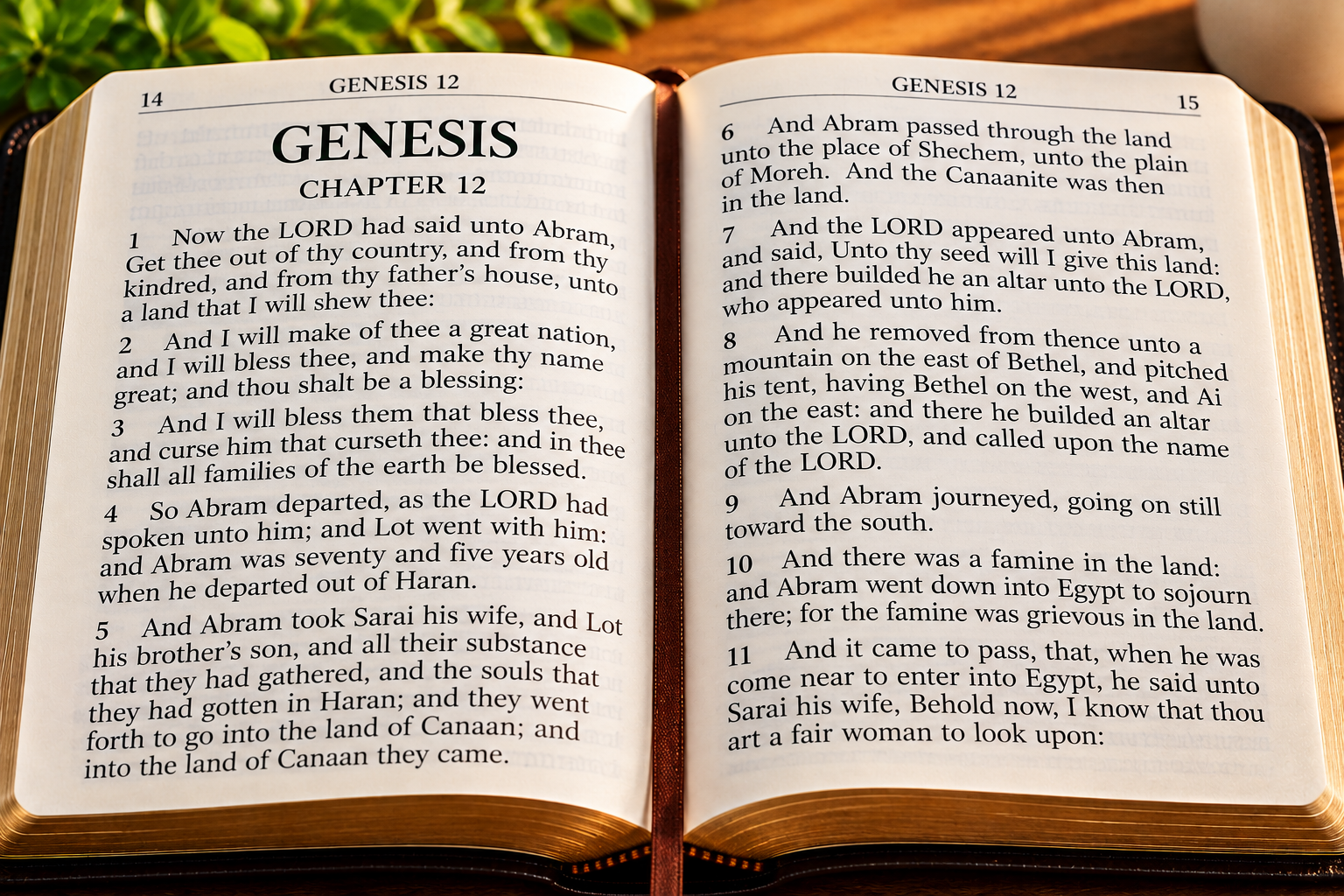
Scripture: Genesis 12:1–20 Key
Theme: God calls Abram to leave his homeland, promises to make him a great nation, and declares that all families of the earth will be blessed through him.
1. Introduction to Genesis 12
Genesis 12 marks a major turning point in the book of Genesis. The first eleven chapters describe creation, humanity’s fall into sin, the Flood, and the scattering of nations at Babel. Beginning in Genesis 12, the biblical narrative focuses more closely on one man, Abram, and God’s plan to work through his family.
God calls Abram to leave his country, his relatives, and his father’s household and travel to a land that God will show him. In return, God makes promises concerning land, descendants, a great name, protection, and blessing. These promises become central to the rest of Genesis and to the Bible’s broader story of redemption.
Genesis 12 also presents an important contrast. Abram responds to God’s call by traveling in faith, but when famine brings him to Egypt, fear influences his decisions. The chapter therefore introduces Abram as a man who trusts God but whose faith will also be tested and developed.
Key Verse — Genesis 12:2–3 (KJV)
“And I will make of thee a great nation, and I will bless thee, and make thy name great; and thou shalt be a blessing:
And I will bless them that bless thee, and curse him that curseth thee: and in thee shall all families of the earth be blessed.”
These verses summarize God’s promises to Abram and introduce the biblical theme of blessing extending beyond one individual or family to all the families of the earth.
2. Chapter Overview: Genesis 12:1–20


8
A. God Calls Abram to Leave His Homeland — Genesis 12:1
God commands Abram to leave three familiar settings:
- His country: The land where he had lived.
- His kindred: His extended family and relatives.
- His father’s house: His immediate household and established family environment.
God tells Abram to go to a land that He will show him. At this point, Abram is not given every detail of the journey. He must respond to God’s direction without knowing the complete outcome.
The command requires a significant act of trust. Abram is being asked to leave the security of familiar relationships and surroundings and place his future in God’s hands.
Key lesson: Faith sometimes requires obedience before the full plan is visible.
B. God Makes Seven Promises to Abram — Genesis 12:2–3
God’s call is accompanied by promises that establish the foundation of His covenant relationship with Abram.
| God’s promise | Meaning in the narrative |
|---|---|
| “I will make of thee a great nation” | Abram’s descendants will become a people of great significance. |
| “I will bless thee” | God will show Abram favor and provide for His purposes. |
| “And make thy name great” | Abram’s name will become widely recognized. |
| “And thou shalt be a blessing” | Abram is called not merely to receive blessing but also to become a means of blessing to others. |
| “I will bless them that bless thee” | God promises to favor those who treat Abram in accordance with His purpose. |
| “And curse him that curseth thee” | God declares His opposition to those who oppose Abram in the context of His promise. |
| “In thee shall all families of the earth be blessed” | The blessing associated with Abram will ultimately extend beyond his own family. |
These promises connect personal faith with God’s larger purpose. Abram is not called simply to improve his own circumstances. His life and descendants will play a significant role in the biblical account of God’s work among the nations.
The final promise is especially important. Genesis 12 introduces a purpose that reaches beyond Abram, Canaan, and Israel to the families of the earth.
C. Abram Obeys God’s Call — Genesis 12:4–5
Genesis 12:4 records Abram’s response:
“So Abram departed, as the LORD had spoken unto him; and Lot went with him.”
Abram was seventy-five years old when he left Haran. He traveled with Sarai his wife, Lot his nephew, their possessions, and the people associated with their household.
Abram’s obedience demonstrates that his faith was expressed through action. He did not merely hear the command; he began the journey.
The passage also introduces Lot, whose relationship with Abram will become important in the chapters that follow.
Key lesson: Biblical faith involves responding to God’s word, even when obedience requires change, uncertainty, and sacrifice.
D. Abram Travels Through Canaan — Genesis 12:6
Abram travels through the land of Canaan as far as the place of Sichem, near the plain of Moreh. The text notes that the Canaanites were then in the land.
This detail matters because God’s promise concerns a land already inhabited by other peoples. Abram has received a promise, but he does not immediately possess the entire land as his own.
The narrative therefore introduces a difference between receiving a promise and seeing its complete fulfillment. Abram must live in the land while trusting the God who promised it.
E. God Appears to Abram and Promises the Land — Genesis 12:7
The LORD appears to Abram and declares:
“Unto thy seed will I give this land.” — Genesis 12:7 (KJV)
The promise now specifically includes Abram’s offspring, or descendants. In response, Abram builds an altar to the LORD who appeared to him.
The altar is an act of worship and marks the place where Abram acknowledges God’s presence and promise. His journey is not simply a movement from one geographical location to another; it is a journey shaped by his relationship with God.
This verse also introduces a theme that continues throughout Genesis: God makes promises to the patriarchs concerning descendants and land, while their fulfillment unfolds over time.
F. Abram Builds Another Altar — Genesis 12:8–9
Abram moves to a mountain east of Bethel, pitches his tent, and builds another altar. The text says that he calls upon the name of the LORD.
Abram’s life is characterized by movement. He travels from place to place, pitches his tent, and establishes temporary places of residence. Yet he repeatedly pauses to worship God.
His altars distinguish his journey as one marked by dependence on God rather than by geographical movement alone.
Important observation: Genesis 12 does not portray Abram as someone who already possesses everything God has promised. He lives as a traveler in the land, worshiping while awaiting the unfolding of God’s purposes.
G. A Famine Forces Abram to Go to Egypt — Genesis 12:10
A famine develops in Canaan, and Abram travels to Egypt to live there temporarily because the famine is severe.
This episode introduces hardship soon after God’s promises. Abram has obeyed God’s call, but obedience does not mean that every circumstance will immediately become easy.
The text does not explicitly condemn Abram for going to Egypt. It presents the famine as the reason for his move. The moral difficulty becomes clearer in the next verses, when Abram fears for his life because of Sarai’s beauty.
Key lesson: Difficult circumstances can test faith, even after a person has taken an important step of obedience.
H. Abram Asks Sarai to Say She Is His Sister — Genesis 12:11–13
As Abram approaches Egypt, he tells Sarai that he fears the Egyptians will kill him because she is beautiful. He asks her to say that she is his sister so that he may be treated well and his life may be spared.
Abram’s concern is personal safety. However, his proposed solution places Sarai in a vulnerable position and creates a risk to their marriage.
The passage presents a troubling contrast between Abram’s earlier obedience and his present fear. The man who trusted God enough to leave his homeland now attempts to protect himself through a misleading account of his relationship with Sarai.
This does not mean Abram’s entire journey of faith was false. Rather, the narrative shows a believer whose trust is imperfect and whose decisions can be influenced by fear.
Key lesson: Fear can tempt people to rely on self-protection instead of acting with truthfulness and trust.
I. Sarai Is Taken into Pharaoh’s House — Genesis 12:14–16
When the Egyptians see Sarai’s beauty, Pharaoh’s officials praise her to Pharaoh, and she is taken into his house. Pharaoh treats Abram well because of Sarai and gives him livestock and servants.
Abram receives material benefits, but the circumstances that produce these benefits are morally troubling. Sarai’s safety and the integrity of their marriage are placed at risk.
The narrative does not present Abram’s wealth as proof that his actions were right. Material gain is not the same as moral approval.
The episode also creates a serious tension: God has promised to build a great nation through Abram’s descendants, yet Abram’s actions have placed the family through whom the promise will continue in a vulnerable situation.
J. God Intervenes Against Pharaoh’s Household — Genesis 12:17
The LORD sends great plagues upon Pharaoh and his household because of Sarai, Abram’s wife.
God’s intervention prevents the situation from proceeding without consequence. Although Abram’s conduct has created the crisis, God remains active in protecting the future connected to His promise.
The text does not provide the precise nature of the plagues. It simply identifies them as serious afflictions sent by the LORD.
This part of the story emphasizes divine intervention, but it should not be interpreted as approval of Abram’s deception. God’s faithfulness to His purpose does not make every decision made by His people morally correct.
K. Pharaoh Confronts Abram — Genesis 12:18–19
Pharaoh calls Abram and asks why he did not disclose that Sarai was his wife. Pharaoh explains that he had taken her believing she was Abram’s sister.
His questions expose the consequences of Abram’s misleading statement. Pharaoh then asks why Abram said, “She is my sister,” and announces that he might have taken Sarai as his wife.
Abram’s attempt to protect himself has created a crisis that affects other people. Pharaoh, rather than Abram, voices the central ethical objection to the deception.
The scene reminds readers that dishonesty can damage trust, endanger others, and produce consequences beyond the person who initiates it.
L. Abram Leaves Egypt — Genesis 12:20
Pharaoh commands his men to send Abram away with Sarai and all that belongs to him. Abram leaves Egypt, bringing his household and possessions with him.
The chapter ends without a recorded apology from Abram or a direct statement that he repented of his actions. Readers should not invent details that the text does not provide.
Instead, the narrative closes with Abram leaving Egypt after divine intervention and Pharaoh’s confrontation. The story prepares readers for the continuing account of Abram’s life, including further tests, failures, and demonstrations of faith.
Key lesson: God’s promises remain central to the biblical narrative, but the actions of those who receive His promises still matter.
3. Major Themes in Genesis 12
| Theme | Scripture | Explanation |
|---|---|---|
| Divine calling | Genesis 12:1 | God initiates Abram’s journey and directs him toward a new future. |
| Faith and obedience | Genesis 12:4 | Abram responds to God’s command by leaving Haran. |
| Divine blessing | Genesis 12:2–3 | God promises to bless Abram and make him a blessing to others. |
| The promise of land | Genesis 12:7 | God promises Canaan to Abram’s descendants. |
| Worship and dependence | Genesis 12:7–8 | Abram builds altars and calls upon the name of the LORD. |
| Faith tested by hardship | Genesis 12:10 | Famine challenges Abram soon after his arrival in Canaan. |
| Fear and deception | Genesis 12:11–13 | Abram’s fear leads him to misrepresent his relationship with Sarai. |
| Divine faithfulness | Genesis 12:17–20 | God intervenes in the crisis involving Sarai and Pharaoh’s household. |
| The blessing of the nations | Genesis 12:3 | God’s purpose through Abram extends beyond his immediate family. |
4. Biblical Interpretation Note
Genesis 12 should be interpreted within the broader narrative of Genesis and the Bible’s unfolding account of God’s promises. The chapter introduces Abram as a central figure in that story, but it also presents his actions with enough complexity to prevent an overly idealized reading.
A. What Does God’s Call to Abram Mean?
Scripture: Genesis 12:1
God calls Abram to leave his country, relatives, and father’s household for a land that He will show him. This is a specific command within the biblical narrative, not simply a general instruction that every believer must leave home or abandon family relationships.
The passage establishes the importance of trusting God’s direction. Its application today should emphasize faithful obedience to God rather than encouraging people to make major decisions based on untested impressions or claims of divine instruction.
B. What Is the Significance of God’s Promises?
Scripture: Genesis 12:2–3
God promises Abram a great nation, blessing, a great name, protection, and a role in blessing all the families of the earth.
These promises are foundational to the biblical story. They develop further through God’s covenant with Abram in Genesis 15 and Genesis 17 and through the later history of Abraham’s descendants.
The promise concerning all families of the earth also has significance in the New Testament. Galatians 3:8 connects the promise that the nations would be blessed with the gospel, while Galatians 3:16 relates the promise to Christ.
Interpretive principle: Genesis 12 begins a promise that unfolds across Scripture. Its original setting should be respected while recognizing its later biblical development.
C. Does Genesis 12 Teach That Believers Will Always Prosper?
Scripture: Genesis 12:2, 10–20
No. God promises to bless Abram, but the chapter also describes famine, danger, fear, and a serious moral failure.
Abram’s experience does not support the claim that everyone who obeys God will always enjoy financial prosperity, freedom from hardship, or immediate success. The famine occurs after Abram has obeyed God’s call.
The chapter instead demonstrates that God’s purposes continue through uncertain circumstances. Divine blessing should not be reduced to material wealth or interpreted as a guarantee that believers will never suffer.
D. Why Does Abram Build Altars?
Scripture: Genesis 12:7–8
Abram builds altars in response to God’s appearance and promise. He also calls upon the name of the LORD.
These actions express worship and acknowledgment of God. The text does not establish that every altar represents a separate covenant or that Abram’s worship follows every detail of a later Israelite religious system.
The altars are best understood in the context of the patriarchal narrative as visible expressions of Abram’s devotion to God.
E. Was Abram Right to Go to Egypt?
Scripture: Genesis 12:10
The text says that Abram went to Egypt because of the famine. It does not directly condemn the decision to seek refuge there.
The more explicit ethical problem arises when Abram asks Sarai to identify herself as his sister because he fears being killed. This distinction matters: readers should avoid declaring that the journey itself was sinful when the narrative does not say so.
The account invites careful consideration of how people respond to hardship and whether fear leads them to act dishonestly.
F. Why Did Abram Say Sarai Was His Sister?
Scripture: Genesis 12:11–13
Abram feared that the Egyptians would kill him to take Sarai because of her beauty. He therefore asked her to present herself as his sister.
Genesis 20:12 later records Abram explaining that Sarai was his half-sister as well as his wife. This makes the statement more complicated than a completely fabricated relationship, but it does not remove the deception in Genesis 12. Abram uses the partial truth to conceal the more important fact that Sarai is his wife.
The passage illustrates how a technically true statement can still mislead when it is used to conceal essential information.
G. Does God’s Intervention Mean He Approved of Abram’s Actions?
Scripture: Genesis 12:17–20
God sends plagues upon Pharaoh’s household, and Sarai is returned. This intervention protects the situation connected to God’s promise.
However, the text does not say that God approved of Abram’s deception. Nor does it record Abram receiving a direct commendation for his conduct in Egypt.
A careful reading distinguishes God’s faithfulness from the moral perfection of the people through whom He works. The biblical narrative often presents individuals who are genuinely important to God’s purposes while still showing serious weaknesses in their character.
H. How Does Genesis 12 Connect to Jesus Christ?
Scripture: Genesis 12:3; Galatians 3:8, 16
Genesis 12 promises that all the families of the earth will be blessed through Abram. The New Testament develops this theme by connecting the promise to the gospel and to Jesus Christ.
In Galatians 3:16, Paul identifies Christ as the promised seed in his explanation of the Abrahamic promise. Christians therefore understand Genesis 12 as part of the larger biblical account that leads to the blessing of the nations through Christ.
This connection should be made in light of the New Testament’s interpretation rather than by treating every detail of Abram’s journey as a direct prediction about Jesus.
5. Character Study: Abram in Genesis 12
Genesis 12 introduces Abram as a man of faith whose life is still developing. The chapter reveals both commendable responses and serious weaknesses.

1. Abram, the obedient traveler
Genesis 12:1–5
Abram responds to God’s command and leaves his homeland. His obedience demonstrates a willingness to trust God without knowing every detail of the future.

2. Abram, the worshiper
Genesis 12:6–9
Abram builds altars and calls upon the name of the LORD. Worship remains a significant part of his journey.

3. Abram, the fearful man
Genesis 12:10–13
Faced with danger, Abram prioritizes his safety and asks Sarai to conceal their marriage. His conduct reveals the difference between trusting God in principle and relying on Him under pressure.

4. Abram, the imperfect recipient of God’s promise
Genesis 12:14–20
Abram’s failure does not end the biblical account of God’s purposes through him. God intervenes, and Abram’s story continues. The passage does not excuse his actions; it reveals the tension between human weakness and divine faithfulness.
6. Theological Significance of Genesis 12
1. God Initiates the Relationship
The chapter begins with God speaking to Abram. Abram’s journey begins because God calls him and establishes the promises that will shape his future.
2. Faith Is Demonstrated Through Obedience
Abram’s departure from Haran shows that faith is more than intellectual agreement. In this passage, faith involves responding to God’s command through action.
3. God’s Promise Extends Beyond One Family
The promise to bless all families of the earth establishes an international dimension to God’s purpose. Abram’s calling is not presented as an end in itself but as part of a larger plan of blessing.
4. God’s Promises Unfold Over Time
Abram does not immediately receive everything promised. He travels through Canaan, faces famine, and lives with uncertainty. The chapter establishes the distinction between a promise being given and its complete fulfillment.
5. Human Failure Does Not Make Wrongdoing Acceptable
Abram’s deception is a real failure with consequences for Sarai and Pharaoh’s household. God’s intervention does not transform that deception into righteous behavior.
6. God’s Faithfulness Is Central to the Story
The chapter ends with God’s intervention in a dangerous situation. The narrative emphasizes that God’s purposes are not dependent on Abram’s flawless conduct.
7. Practical Applications for Christian Living
- Trust God when the future is uncertain. Abram begins his journey without knowing the complete destination. His example encourages believers to seek God’s direction and act faithfully.
- Respond to God’s word with obedience. Faith becomes visible through choices and conduct, not merely through words.
- Understand blessing as responsibility. Abram is blessed so that he may become a blessing. Christians can apply this principle through generosity, service, compassion, and care for others.
- Worship God during life’s transitions. Abram builds altars while moving through unfamiliar places. Worship can help believers maintain their focus on God during change.
- Do not assume obedience prevents hardship. The famine occurs after Abram obeys God’s call. Difficult circumstances do not automatically mean that a person has acted wrongly.
- Do not let fear justify dishonesty. Abram’s attempt to protect himself puts Sarai at risk. Fear should not become an excuse for misleading others.
- Recognize that good outcomes do not justify every method. Abram receives material possessions in Egypt, but those benefits do not make his deception right.
- Remember that spiritual growth includes confronting failure. Abram’s story contains both faith and weakness. His example encourages honest self-examination rather than pretending that faithful people never make serious mistakes.
8. Key Questions for Bible Study
These questions can be used for personal reflection, family devotion, a small group, or a church Bible study.
A. Observation Questions — What Does the Text Say?
- What three things does God tell Abram to leave in Genesis 12:1?
- What promises does God make to Abram in verses 2–3?
- How old is Abram when he leaves Haran?
- Who travels with Abram from Haran?
- Which land does God promise to Abram’s descendants?
- Why does Abram build altars in Canaan?
- What circumstance causes Abram to travel to Egypt?
- What does Abram ask Sarai to say about their relationship?
- What happens to Sarai after the Egyptians see her?
- How does God intervene in the situation involving Pharaoh’s household?
B. Interpretation Questions — What Does the Text Mean?
- Why was leaving his homeland a significant act of faith for Abram?
- What is the relationship between God’s promises to Abram and the blessing of all families of the earth?
- Why does the narrative mention that the Canaanites were already in the land?
- What do Abram’s altars reveal about his relationship with God?
- Does Genesis 12 condemn Abram’s decision to travel to Egypt, or does it focus its criticism elsewhere? Explain from the text.
- How does Abram’s request that Sarai conceal their marriage reveal the influence of fear?
- Why should God’s intervention in Egypt not be interpreted as approval of Abram’s deception?
- What does this chapter teach about the difference between God’s faithfulness and human perfection?
- How does Genesis 12:3 connect with Galatians 3:8 and 3:16?
- How does Genesis 12 prepare readers for the covenant promises developed in Genesis 15 and 17?
C. Application Questions — How Should We Respond?
- Is there an area of your life where you need to trust God without knowing every detail of the future?
- How can you respond faithfully when obedience requires leaving a familiar or comfortable situation?
- In what practical ways can you become a blessing to your family, church, workplace, or community?
- How can worship help you remain focused on God during uncertain seasons?
- What can Abram’s response to the famine teach you about handling pressure?
- Have you ever been tempted to use a partial truth to protect yourself? What does this passage teach about honesty?
- How can fear influence decisions in ways that harm other people?
- Why is it important to evaluate the methods used to achieve a desired outcome, rather than focusing only on the result?
- How can you respond constructively when your actions reveal weaknesses in your faith?
- What does this chapter teach you about trusting God while taking responsibility for your own choices?
D. Deeper Reflection Questions
- What does Genesis 12 reveal about God’s initiative in the biblical story of redemption?
- Why is the promise to bless all families of the earth important to the whole Bible?
- How does the chapter balance Abram’s obedience with his failure in Egypt?
- What can Christians learn from the fact that God’s promises unfold over time?
- How should believers distinguish between a biblical promise made to a particular person and a general principle that can be applied today?
9. Related Bible Verses for Further Study
| Bible reference | Connection to Genesis 12 |
|---|---|
| Genesis 15:1–6 | God reaffirms His promises to Abram, including the promise of descendants. |
| Genesis 17:1–8 | God establishes and explains His covenant with Abraham. |
| Genesis 22:15–18 | God reaffirms the promise concerning Abraham’s descendants and the nations. |
| Exodus 19:5–6 | Israel’s covenant calling is described in the context of God’s relationship with His people. |
| Isaiah 49:6 | God’s servant is associated with bringing salvation to the ends of the earth. |
| Matthew 1:1 | Jesus’ genealogy identifies Him as the son of David and the son of Abraham. |
| Luke 1:54–55 | Mary’s song recalls God’s mercy and His promises to Abraham and his descendants. |
| Acts 3:25–26 | Peter refers to the promise that all families of the earth will be blessed through Abraham’s offspring. |
| Galatians 3:8–9 | Paul connects Abraham’s blessing with the gospel and faith. |
| Galatians 3:16 | Paul relates the promise concerning Abraham’s seed to Christ. |
10. Chapter Summary
Genesis 12 records God’s call to Abram and the beginning of a journey that will shape the rest of the biblical narrative. God promises to make Abram a great nation, give his descendants the land of Canaan, and use him as a means of blessing all the families of the earth. Abram responds in faith, travels through Canaan, and builds altars to worship the LORD.
The chapter also shows that Abram’s faith is imperfect. When famine drives him to Egypt, fear leads him to misrepresent his relationship with Sarai. God intervenes in the resulting crisis, and Abram leaves Egypt with his household. The narrative holds together two important truths: God remains faithful to His purposes, and human decisions still carry moral significance.
One-sentence summary: Genesis 12 teaches that God calls Abram into a life of faith, promises to bless the nations through him, and remains active in the unfolding of His purposes even as Abram struggles with fear and imperfect judgment.