

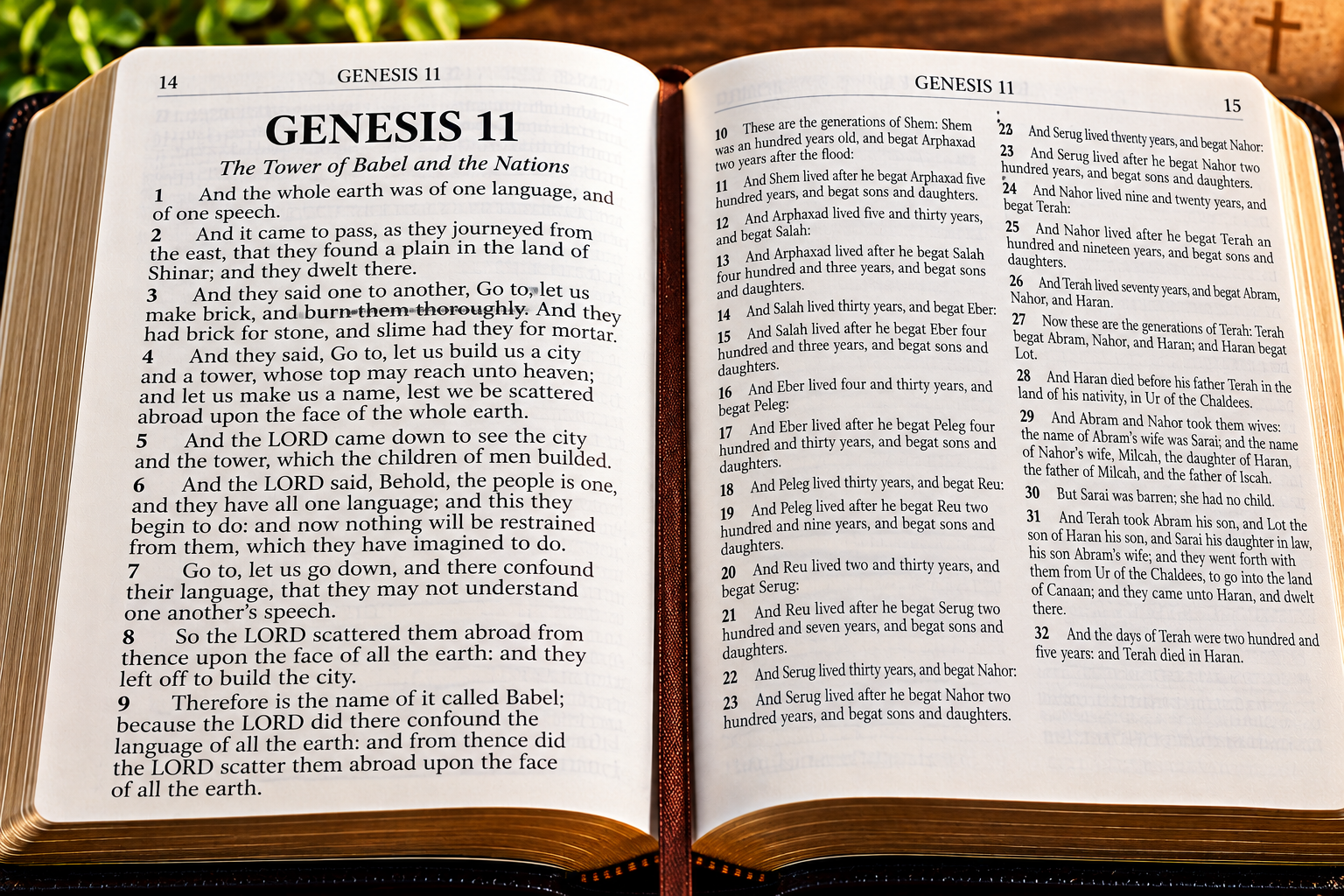
Chapter Overview
Main Scripture: Genesis 11:1–32
Central Theme: Human pride, rebellion against God, divine judgment, the diversity of languages, and God’s continuing purpose through the family line leading to Abraham.
Key Verse: Genesis 11:9 (KJV)
“Therefore is the name of it called Babel; because the LORD did there confound the language of all the earth: and from thence did the LORD scatter them abroad upon the face of all the earth.”
Introduction
Genesis 11 marks another major turning point in the early history of humanity. The chapter begins with the account of the Tower of Babel, where people unite to build a city and a tower reaching toward heaven. Their stated purpose is to make a name for themselves and prevent their scattering across the earth.
God intervenes by confusing their language, making communication difficult and bringing their construction project to an end. The people are then scattered across the earth, fulfilling the geographical movement that has been anticipated in earlier chapters.
The chapter subsequently shifts from the account of the nations to the genealogy of Shem, tracing the family line through several generations to Terah and his son Abram, later known as Abraham.
Genesis 11 contrasts humanity’s attempt to establish greatness independently of God with God’s continuing purpose to work through the family line that leads to Abraham.
Part One: The Tower of Babel
1. One Language and a Common Vocabulary
Genesis 11:1–2
The chapter begins by describing the whole earth as having one language and a common vocabulary.
As the people migrate, they settle in a plain in the land of Shinar.
The shared language allows them to communicate and coordinate their activities without the linguistic barriers that later characterize human society.
Shinar is generally associated with the region of southern Mesopotamia, an area connected with ancient urban centers and early civilization.
Key Observation
The people possess the ability to cooperate on a large scale. Their common language allows them to organize a significant construction project.
However, the chapter will show that cooperation and technological ability do not automatically mean that a community’s goals are consistent with God’s purposes.
Key Lesson
Human unity can accomplish extraordinary things, but the moral direction of that unity matters.
2. The People Decide to Build a City and a Tower
Genesis 11:3–4
The people encourage one another to make bricks and use them in construction.
They propose building a city and a tower whose top reaches toward heaven.
Their stated objectives are:
- To build a great city.
- To construct a tower reaching toward heaven.
- To make a name for themselves.
- To avoid being scattered across the earth.
Their declaration includes the words:
“Let us make us a name.” — Genesis 11:4 (KJV)
This statement reveals an important motivation: the people seek collective greatness and a lasting reputation.
Their desire not to be scattered also contrasts with God’s command to humanity to multiply and fill the earth in Genesis 9:1 and 9:7.
Major Theme: Human Pride
The problem in the narrative is not simply that people build a city or develop construction technology. The text draws attention to their stated objectives and their resistance to being scattered.
Their project becomes a picture of human ambition organized around self-glorification.
Key Lessons
- Human achievement can become an expression of pride.
- Cooperation is not automatically righteous.
- A desire for security and recognition can become problematic when it takes precedence over God’s purposes.
Interpretive note: Genesis 11 does not explicitly say that constructing a tall building is inherently sinful. Its criticism concerns the people’s stated ambitions and the larger context of their actions.
3. The People Use Bricks and Bitumen
Genesis 11:3
The people decide to make bricks and burn them thoroughly. They use brick instead of stone and bitumen for mortar.
This detail provides a glimpse of ancient construction methods.
The narrative describes the materials because they make the project possible and demonstrate the people’s ability to organize labor and resources.
Historical Significance
The use of baked bricks and bitumen is consistent with construction practices associated with ancient Mesopotamia.
The detail also helps establish the setting for the city and tower.
Key Lesson
Human creativity and technical knowledge are powerful, but the use of those abilities must be considered in relation to the purposes they serve.
4. God Comes Down to See the City and Tower
Genesis 11:5
The text states:
“And the LORD came down to see the city and the tower, which the children of men builded.” — KJV
The language is striking because the people are constructing a tower intended to reach toward heaven, yet the narrative describes the LORD as coming down to see it.
This creates a contrast between human ambition and divine greatness.
The tower may appear impressive to its builders, but it does not threaten God’s sovereignty.
Biblical Interpretation
The description of God coming down is commonly understood as anthropomorphic language: Scripture describes God’s action in human terms to communicate a theological point.
The passage does not suggest that God lacks knowledge of what happens on earth.
Instead, the wording emphasizes the contrast between humanity’s grand ambitions and God’s supreme authority.
Key Lesson
No human achievement can place humanity beyond God’s authority or make God dependent on human power.
5. God Recognizes the Power of Human Cooperation
Genesis 11:6
God observes that the people are united, share one language, and have begun their project.
He declares that their common language and cooperation make it possible for them to undertake what they have planned.
The passage emphasizes the effectiveness of collective action.
Yet God’s response makes clear that unity alone is not the ultimate measure of righteousness.
Major Theme: Unity and Responsibility
Genesis 11 presents a community capable of coordinated action, but its stated ambition is centered on making a name for itself and resisting dispersion.
The problem is not that human beings can work together. The problem is the direction and purpose of their cooperation within the narrative.
Key Lesson
A united community still needs moral direction. Shared goals and collective strength do not guarantee that its actions are right.
6. God Confuses Their Language
Genesis 11:7–8
God declares:
“Go to, let us go down, and there confound their language, that they may not understand one another’s speech.” — Genesis 11:7 (KJV)
The confusion of language disrupts the people’s ability to coordinate their construction project.
The city is no longer completed according to their original plan, and the people are scattered across the earth.
This event directly reverses the unity described at the beginning of the chapter.
The Significance of the Confusion
Before the intervention:
- The people share one language.
- Communication is easy.
- They cooperate on a common project.
- They intend to remain together.
After the intervention:
- Their language is confused.
- Communication becomes difficult.
- The project is abandoned.
- The people are scattered.
Key Lesson
Human plans remain subject to God’s authority. The people’s attempt to secure their own future does not override God’s purposes.
7. The City Is Called Babel
Genesis 11:9
The chapter explains that the city is called Babel because the LORD confused the language of the earth there.
The name is associated in the narrative with the Hebrew word for confusing or confounding.
Babel is also the Hebrew form of the name Babylon, an important city and empire in later biblical history.
The narrative’s wordplay emphasizes the connection between the place and the confusion of language.
Key Lesson
The name Babel becomes a lasting reminder of the limits of human pride and the consequences of pursuing collective ambitions without regard for God’s purposes.
Important distinction: The explanation of the name in Genesis is a theological wordplay. It should not automatically be treated as a complete linguistic account of the historical origin of the name Babylon.
Part Two: The Genealogy from Shem to Abram
8. The Descendants of Shem
Genesis 11:10–26
After the Tower of Babel account, the chapter returns to genealogy.
It traces the line of Shem through successive generations, eventually reaching Terah and his sons, including Abram.
The genealogy includes:
- Shem
- Arphaxad
- Shelah
- Eber
- Peleg
- Reu
- Serug
- Nahor
- Terah
Abram, Nahor, and Haran are identified as Terah’s sons in verse 26.
Why Is This Genealogy Important?
Genesis 10 presented the development of the nations through Noah’s sons. Genesis 11 now narrows its focus to the family line through which Abraham enters the narrative.
This is a major structural transition in Genesis.
The earlier chapters focus on humanity as a whole. The story now moves toward one family through whom God will develop the covenant promises described in Genesis 12 and beyond.
Key Lesson
Biblical genealogies often establish continuity between major events and prepare the reader for the next stage of God’s purposes.
9. The Birth and Death of Generations
Genesis 11:10–26
The genealogy records the ages of several individuals when their sons are born and the additional years they live afterward.
The lifespans listed in Genesis 11 are generally shorter than those recorded in Genesis 5.
This gradual reduction in recorded longevity is a noticeable feature of the genealogies.
Key Observation
Genesis 11 continues the theme of human mortality while moving the narrative toward the patriarchs.
The genealogy is not merely a list of names; it also connects the generations after the Flood with the family history that follows.
Key Lesson
Human generations continue to pass, but the biblical narrative traces God’s purposes through successive families.
10. Terah’s Family
Genesis 11:27–30
The narrative introduces Terah and his sons: Abram, Nahor, and Haran.
Haran becomes the father of Lot and dies in Ur of the Chaldees during the lifetime of his father, Terah.
Abram marries Sarai, while Nahor marries Milcah.
The passage also introduces an important difficulty: Sarai is described as barren and without a child.
This detail becomes central to the story of Abraham because God’s promises will eventually involve descendants despite the couple’s initial childlessness.
Key Lessons
- The family of Terah becomes central to the remainder of Genesis.
- Lot is introduced as an important relative in the coming narrative.
- Sarai’s barrenness establishes a challenge that becomes significant in the Abraham story.
11. Terah’s Journey Toward Canaan
Genesis 11:31–32
Terah takes Abram, Sarai, and Lot from Ur of the Chaldees with the intention of going to the land of Canaan.
They arrive in Haran and settle there.
Terah eventually dies in Haran at the age of 205.
This movement introduces the geographical setting for the next major stage of Genesis.
The family has begun traveling toward Canaan, but the journey is not completed in this chapter.
Key Lesson
Genesis 11 ends with a family in transition. The narrative prepares for Genesis 12, where God calls Abram and gives him a specific promise concerning land, descendants, and blessing.
Major Themes in Genesis 11
| Theme | Meaning |
|---|---|
| Human pride | The builders seek to make a name for themselves. |
| Collective ambition | A united population organizes a major construction project. |
| Divine sovereignty | God intervenes and limits the people’s plans. |
| Language | The confusion of speech disrupts human cooperation. |
| Dispersion | The people are scattered across the earth. |
| Human mortality | The genealogy continues to record the passing of generations. |
| Family lineage | The genealogy connects Shem with Terah and Abram. |
| God’s continuing purposes | The narrative shifts from the nations to Abraham’s family. |
| Hope and promise | Abram’s introduction prepares the reader for Genesis 12. |
Character Study: The Builders of Babel
Primary Scripture: Genesis 11:1–9
The builders are described collectively rather than as individually named characters.
1. They Are United
The people share a common language and coordinate their efforts.
2. They Are Resourceful
They manufacture bricks and use bitumen to construct their city and tower.
3. They Seek Recognition
Their stated ambition is to make a name for themselves.
4. They Resist Dispersion
They express a desire to remain together rather than spread across the earth.
5. Their Plans Are Interrupted
God confuses their language, disrupting the cooperation on which the project depends.
Character lesson: Genesis 11 warns against allowing collective ambition, pride, and the pursuit of recognition to become more important than obedience to God.
Biblical Interpretation Note: Genesis 11
1. Read the Chapter in Its Literary Context
Genesis 11 should be interpreted alongside the chapters that precede and follow it.
- Genesis 9: God’s covenant with Noah and the command to multiply.
- Genesis 10: The Table of Nations and the spread of peoples.
- Genesis 11: The Tower of Babel and the genealogy leading to Abram.
- Genesis 12: God’s call of Abram and the beginning of the patriarchal narrative.
This sequence shows that Genesis 11 connects the universal history of humanity with the more specific story of Abraham.
2. Understand the Meaning of the Tower of Babel
The text states that the builders want to make a name for themselves and avoid being scattered across the earth.
These stated motivations are essential to interpretation.
The chapter does not explicitly say that all cities, towers, technological developments, or large construction projects are sinful.
Instead, it portrays a specific project whose stated aims reflect human ambition and resistance to dispersion.
Interpretive principle: Identify the motives and actions emphasized by the passage rather than condemning activities that the text does not explicitly condemn.
3. Consider the Relationship Between Babel and God’s Command to Fill the Earth
In Genesis 9:1 and 9:7, God commands Noah and his sons to multiply and fill the earth.
In Genesis 11:4, the builders express their desire not to be scattered.
This contrast supports an interpretation in which the Babel project represents resistance to the broader direction established earlier in Genesis.
The relationship should be stated carefully: Genesis 11 does not explicitly quote the earlier command, but the literary connection is significant.
4. Interpret God’s “Coming Down” Appropriately
Genesis 11:5 describes the LORD coming down to see the city and tower.
This is commonly understood as anthropomorphic language, in which God is described in human terms.
The wording creates an ironic contrast between the builders’ attempt to construct a tower reaching heaven and the LORD’s action of coming down to examine it.
Interpretive principle: Recognize the literary and theological force of the language without assuming that God is physically limited or lacks knowledge.
5. Understand the Confusion of Languages
The narrative directly attributes the confusion of language to God’s intervention.
The result is the disruption of the construction project and the scattering of the people.
Genesis 10 already describes nations with different languages, while Genesis 11 provides the Babel account associated with linguistic division.
Interpreters differ on how the literary relationship between these chapters should be understood. One common approach is to read Genesis 10 as a broad overview of the nations and Genesis 11 as a focused account explaining a major event associated with dispersion.
The passage should not be treated as a scientific account of every stage of historical language development unless additional arguments are supplied.
6. Understand Babel as a Theological Wordplay
Genesis 11:9 connects the name Babel with the confusion of language.
The wordplay emphasizes the theological message of the narrative.
Although Babel corresponds to Babylon, the Hebrew explanation in Genesis should not automatically be treated as a complete historical or linguistic derivation of the city’s name.
Interpretive principle: Distinguish the narrative’s theological wordplay from claims about historical etymology.
7. Recognize the Significance of the Shem Genealogy
The genealogy from Shem to Terah connects the Table of Nations with the story of Abraham.
Its function is both genealogical and literary.
The chapter narrows its focus from the many nations of the earth to a particular family through which the covenant story will continue.
This transition prepares the reader for the promises of land, descendants, and blessing in Genesis 12.
8. Handle the Chronology Carefully
Genesis 11 provides ages and generational information, but questions remain about how the genealogy should be used to establish an exact chronology of ancient history.
Some readers interpret the genealogical figures as providing a direct chronological sequence. Others recognize that ancient genealogies can serve literary and theological purposes in addition to recording descent.
The text’s central function in this chapter is to connect successive generations and lead the narrative toward Abram.
Interpretive principle: Do not make claims about exact historical dates or a complete chronology without explaining the assumptions used.
9. Understand the Significance of Sarai’s Barrenness
Genesis 11:30 states that Sarai has no child.
This detail prepares for the promise of descendants that becomes central in Genesis 12–21.
The tension is important: Abram will be called to become the father of a great nation, but his wife is initially unable to bear children.
The narrative thus prepares the reader for a story in which God’s promise cannot be understood merely through ordinary expectations about family growth.
Theological Significance of Genesis 11
Genesis 11 teaches several important theological principles.
1. Human pride has limits. The builders seek to establish their own greatness, but their plans remain subject to God’s authority.
2. Unity must be directed toward righteous purposes. Cooperation and collective strength are not sufficient if the objectives are wrong.
3. God remains sovereign over human history. The confusion of language and the scattering of the people demonstrate that human plans cannot override God’s purposes.
4. Human diversity develops within the biblical account of a common ancestry. The chapter presents the division of language and the scattering of peoples as part of the story of humanity after the Flood.
5. Genealogies connect the major movements of Scripture. The line from Shem to Abram leads the narrative toward the patriarchs.
6. God’s purposes continue beyond human failure. The chapter ends by preparing for God’s call of Abram, which introduces a new stage in the biblical story.
Practical Applications for Bible Study
Genesis 11 invites readers to reflect on several principles:
- Examine your motives: Are your goals driven by service and faithfulness or by pride and personal recognition?
- Use cooperation responsibly: Working together is valuable, but the purpose of collective action matters.
- Recognize human limitations: Success, technology, and organization do not place people beyond moral accountability.
- Respect God’s purposes: Personal ambition should not become more important than obedience.
- Value human diversity: Differences in language and culture do not erase humanity’s shared origin in the biblical narrative.
- Understand the importance of genealogies: Biblical family records often connect major events and prepare for later promises.
- Look toward God’s continuing work: The failure of Babel does not end the biblical narrative; it leads toward the call of Abram.
These applications should be grounded in the chapter rather than used to suggest that every large project, ambitious goal, or effort at unity is necessarily opposed to God.
Key Questions for Bible Study
Use these questions for personal reflection, group discussion, or a church Bible study.
Observation Questions
- What does Genesis 11:1 say about the language of the whole earth?
- Where do the people settle before beginning construction?
- What materials do the builders use?
- What are the people’s stated reasons for building the city and tower?
- What does God do in response to their project?
- What happens to the people’s ability to communicate?
- Why is the city called Babel?
- Through which descendants does Genesis 11 trace the line from Shem to Abram?
- Who are Terah’s sons?
- Where does Terah’s family settle while traveling toward Canaan?
Interpretation Questions
- Why do the builders want to make a name for themselves?
- How does their desire not to be scattered relate to God’s command to fill the earth?
- What is the significance of the LORD coming down to see the city and tower?
- Does Genesis 11 condemn technological development itself, or does it focus on the builders’ motives and objectives?
- How should the relationship between Genesis 10 and Genesis 11 be understood?
- What does the confusion of language accomplish within the narrative?
- What is the theological significance of the name Babel?
- Why does the genealogy move from Shem to Terah and Abram?
- What role does Sarai’s barrenness play in preparing the reader for Genesis 12?
- How does Genesis 11 connect the universal history of humanity with the story of Abraham?
Application Questions
- How can ambition become an expression of pride?
- What distinguishes healthy cooperation from collective action driven by improper motives?
- How can individuals and communities evaluate whether their goals are consistent with their moral and spiritual responsibilities?
- What can the Babel narrative teach about the limits of human power?
- How should Christians approach differences in language, culture, and nationality?
- Why is it important to read biblical genealogies in their larger narrative context?
- What does the transition from Babel to Abram teach about God’s continuing purposes despite human failure?
Chapter Summary
Genesis 11 records the Tower of Babel, where people with one language unite to build a city and tower, seeking to make a name for themselves and avoid being scattered. God confuses their language, disrupts their project, and scatters them across the earth.
The chapter then traces the descendants of Shem to Terah and Abram. It introduces Sarai’s barrenness and concludes with Terah’s family settling in Haran while traveling toward Canaan.
The chapter emphasizes the limits of human pride, the sovereignty of God, the development of different peoples, and the transition from the universal history of humanity to the story of Abraham.
Genesis 11 in One Sentence
Genesis 11 describes the Tower of Babel, God’s intervention in human ambition, the confusion of languages and scattering of peoples, and the genealogy from Shem to Abram that prepares the way for God’s covenant promises in Genesis 12.