

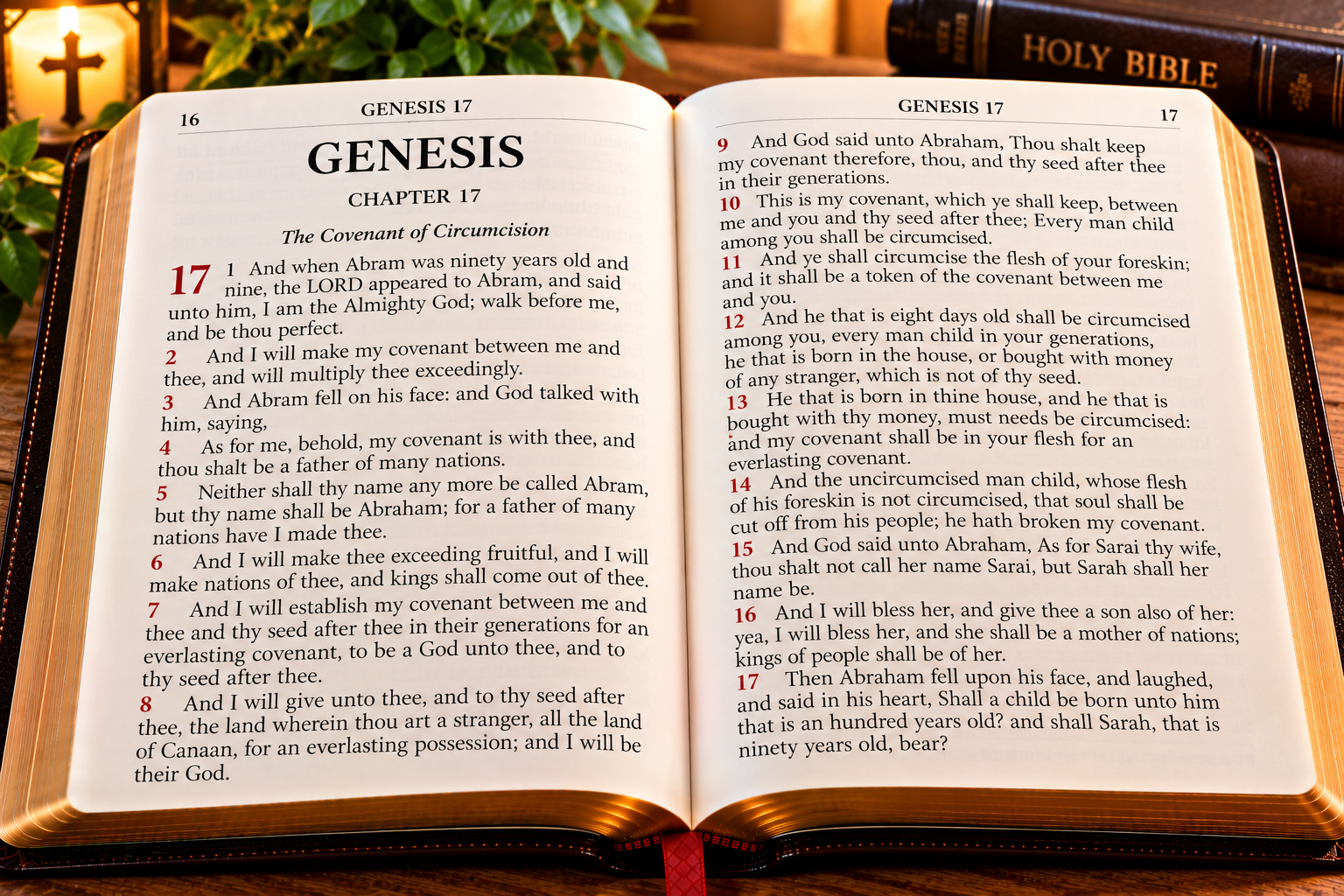
Book: Genesis Chapter: 17 Content Category: Faith & Bible Study Content Type: Biblical Chapter Overview and Interpretation Primary Scripture: Genesis 17:1–27 Key Theme: God establishes His covenant with Abram, changes his name to Abraham and Sarai’s name to Sarah, institutes circumcision as the covenant sign, and promises that Sarah will bear Isaac.
1. Introduction to Genesis 17
Genesis 17 is a pivotal chapter in the story of Abraham and God’s covenant promises. In Genesis 12, God called Abram and promised to make him a great nation. In Genesis 15, God confirmed His covenant concerning descendants and land. In Genesis 16, Abram and Sarai attempted to address their childlessness through Hagar, and Ishmael was born.
Now, thirteen years after Ishmael’s birth, God appears to Abram when he is ninety-nine years old. God identifies Himself as the Almighty God and calls Abram to walk before Him and be blameless. He then confirms His covenant, promises that Abram will become the father of many nations, and changes his name from Abram to Abraham.
God also changes Sarai’s name to Sarah and declares that she will bear a son named Isaac. Abraham responds with laughter, wondering how a son can be born to a man who is one hundred years old and a woman who is ninety. Nevertheless, God confirms that Isaac—not Ishmael—will be the son through whom the covenant line continues. God also promises to bless Ishmael and make him fruitful.
The chapter concludes with Abraham obeying God’s instruction concerning circumcision. Abraham, Ishmael, and the males of his household are circumcised that very day.
Genesis 17 highlights God’s faithfulness, covenant, obedience, identity, the promise of Isaac, and the importance of understanding God’s promises within their biblical context.
Key Verse — Genesis 17:7 (KJV)
“And I will establish my covenant between me and thee and thy seed after thee in their generations for an everlasting covenant, to be a God unto thee, and to thy seed after thee.”
This verse expresses the enduring relationship God establishes with Abraham and his descendants. The covenant concerns more than the promise of a child; it establishes a relationship between God and Abraham’s family and continues to shape the biblical narrative.
2. Chapter Overview: Genesis 17:1–27

5
A. God Appears to Abram as the Almighty God — Genesis 17:1
When Abram is ninety-nine years old, the LORD appears to him and says:
“I am the Almighty God; walk before me, and be thou perfect.” — Genesis 17:1 (KJV)
God identifies Himself as El Shaddai, traditionally translated in the KJV as “the Almighty God.” The title emphasizes God’s power and sufficiency in the context of His covenant promises.
God also commands Abram to walk before Him and be blameless. This instruction concerns Abram’s manner of life and relationship with God. It calls him to live faithfully in the presence of the One who has made the covenant.
The word perfect in the KJV does not necessarily mean that Abram must achieve absolute moral perfection in every respect. In this context, it conveys the idea of being blameless, whole-hearted, or faithful in his walk with God.
Key lesson: God’s promises are accompanied by a call to live in faithfulness and obedience.
B. God Establishes His Covenant With Abram — Genesis 17:2–4
God declares that He will establish His covenant with Abram and multiply him exceedingly.
Abram falls on his face as God speaks. God then explains that Abram will become the father of many nations.
This promise develops the earlier declarations in Genesis 12 and 15. God had promised Abram descendants, but Genesis 17 makes the scope of the promise more explicit: Abram’s family will become connected with many nations.
The covenant is not presented as a reward Abram has earned through flawless behavior. Rather, it is God’s commitment, which calls Abram to faithful living.
Key lesson: God’s covenant purposes unfold over time, and His promises can be greater than the immediate circumstances suggest.
C. Abram’s Name Is Changed to Abraham — Genesis 17:5–6
God declares:
“Neither shall thy name any more be called Abram, but thy name shall be Abraham; for a father of many nations have I made thee.” — Genesis 17:5 (KJV)
The name Abram is commonly understood to mean “exalted father,” while Abraham is explained in the verse in connection with becoming the father of many nations.
God’s renaming of Abram marks a significant development in the covenant story. His new name reflects the future God has promised, even though Abraham does not yet have the promised son through Sarah.
God further promises that Abraham will be exceedingly fruitful and that nations and kings will come from him.
The name change therefore communicates both identity and calling. Abraham’s future is defined not simply by his present household but by God’s covenant promise.
Key lesson: In the biblical narrative, a new name can mark a significant change in a person’s role within God’s purposes.
D. God Confirms an Everlasting Covenant — Genesis 17:7–8
God declares that His covenant will be established between Himself, Abraham, and Abraham’s descendants throughout their generations.
He promises to be their God and confirms that the land of Canaan will be given to Abraham and his descendants as an everlasting possession.
Two central elements of the covenant are emphasized:
- Relationship: God promises to be God to Abraham and his descendants.
- Land: God promises the land of Canaan as an inheritance for Abraham’s descendants.
The covenant therefore concerns both the relationship between God and Abraham’s family and the specific land promise established earlier in Genesis.
The expression “everlasting covenant” emphasizes the enduring significance of God’s commitment within the biblical narrative. Later passages develop how the covenant relates to Israel’s history and the wider biblical story of redemption.
E. God Commands Circumcision as the Sign of the Covenant — Genesis 17:9–14
God instructs Abraham and his male descendants to observe circumcision as the sign of the covenant.
Every male in Abraham’s household is to be circumcised, including those born in the household and those acquired from others. The practice is to be carried out when a male child is eight days old.
Circumcision is presented as a specific covenant sign given to Abraham and his household. It identifies their participation in the covenant relationship established by God.
The passage also describes the consequences of refusing the covenant sign. Within this context, circumcision is not merely a private custom; it is a commanded sign associated with belonging to the covenant community.
Christians should interpret this passage alongside later biblical teaching, particularly Romans 4, Acts 15, Galatians 5–6, and Colossians 2. The New Testament discusses how the Abrahamic promise relates to faith in Christ and how Gentile believers are included in God’s people.
Key lesson: The covenant sign in Genesis 17 belongs to a particular biblical covenant and must be understood in that context when considering its application today.
F. Sarai’s Name Is Changed to Sarah — Genesis 17:15–16
God tells Abraham that his wife is no longer to be called Sarai but Sarah.
God promises to bless her and give Abraham a son by her. He also declares that Sarah will become the mother of nations and that kings of peoples will come from her.
The name Sarah is commonly understood as meaning “princess.” In the passage, her new name is connected with the promise that she will become the mother of nations.
This announcement is significant because Sarah has been childless throughout the earlier narrative. In Genesis 16, Hagar gave birth to Ishmael, but God now explicitly promises that Sarah herself will bear the son through whom the covenant line will continue.
The chapter thus brings Sarah into clearer focus as a recipient of God’s promise, not merely as Abraham’s wife.
Key lesson: God’s covenant promise concerns Sarah as well as Abraham, and her role in the unfolding story is essential.
G. Abraham Laughs at the Promise of a Son — Genesis 17:17–18
Abraham falls on his face and laughs. He wonders whether a child can be born to a man who is one hundred years old and a woman who is ninety.
He then asks God to let Ishmael live before Him.
Abraham’s reaction reflects the apparent impossibility of the promise from a human perspective. His age and Sarah’s age make the promised birth seem extraordinary.
The text does not require readers to conclude that Abraham’s laughter has only one possible emotional meaning. It records his response and the question that follows.
His concern for Ishmael also reveals that the boy matters to him. Abraham desires God’s favor for the son he already has, even as God announces the birth of another son.
H. God Promises the Birth of Isaac — Genesis 17:19–21
God responds that Sarah will bear Abraham a son and that his name will be Isaac. God declares that He will establish His covenant with Isaac and his descendants.
The name Isaac is associated with laughter, making it especially meaningful in light of Abraham’s reaction in verse 17 and Sarah’s laughter in Genesis 18:12.
God also addresses Abraham’s request concerning Ishmael. He promises to bless Ishmael, make him fruitful, multiply him greatly, and make him the father of twelve princes and a great nation.
However, God distinguishes the two sons’ roles in the covenant:
“But my covenant will I establish with Isaac, which Sarah shall bear unto thee at this set time in the next year.” — Genesis 17:21 (KJV)
This distinction is central to understanding the chapter. Ishmael is not forgotten or excluded from God’s concern, but Isaac is identified as the son through whom the specific covenant line will continue.
Key lesson: God’s care for Ishmael and His covenant promise through Isaac are both affirmed in the same passage.
I. God Finishes Speaking With Abraham — Genesis 17:22
After God finishes speaking with Abraham, He goes up from him.
The verse marks the conclusion of the divine encounter. What follows is Abraham’s response through action.
The narrative moves from promise and instruction to obedience, showing that the covenant encounter is followed by a practical response.
J. Abraham Obeys the Covenant Command — Genesis 17:23–27
Abraham takes Ishmael, every male born in his household, and every male acquired by him, and circumcises them as God has commanded.
The text emphasizes the immediacy of Abraham’s obedience. He carries out the instruction on the same day God speaks to him.
Abraham is ninety-nine years old when he is circumcised, and Ishmael is thirteen. The chapter also notes that all the males of Abraham’s household are circumcised with him.
This conclusion highlights Abraham’s response to God’s covenant command. The chapter began with God’s instruction to walk before Him and be blameless; it ends with Abraham carrying out a specific command connected to the covenant.
Key lesson: In Genesis 17, faith is expressed not only through belief in God’s promises but also through obedience to the instructions God gives within the covenant.
3. Major Themes in Genesis 17
| Theme | Scripture | Meaning |
|---|---|---|
| God’s power | Genesis 17:1 | God identifies Himself as Almighty God. |
| Faithful living | Genesis 17:1 | Abraham is commanded to walk before God and be blameless. |
| Covenant | Genesis 17:2–8 | God confirms His enduring commitment to Abraham and his descendants. |
| Identity and calling | Genesis 17:5, 15 | Abram becomes Abraham, and Sarai becomes Sarah. |
| The promise of descendants | Genesis 17:4–6 | Abraham will become the father of many nations. |
| The promise of land | Genesis 17:8 | God confirms the land of Canaan as an inheritance for Abraham’s descendants. |
| Circumcision | Genesis 17:9–14 | Circumcision is established as the sign of God’s covenant with Abraham’s household. |
| God’s promise to Sarah | Genesis 17:15–16 | Sarah will bear a son and become the mother of nations. |
| Isaac and the covenant line | Genesis 17:19–21 | God identifies Isaac as the son through whom the covenant will continue. |
| God’s care for Ishmael | Genesis 17:18–20 | God promises to bless Ishmael and make him a great nation. |
| Obedience | Genesis 17:23–27 | Abraham carries out God’s command concerning circumcision. |
4. Biblical Interpretation Note
Genesis 17 is foundational for understanding the Abrahamic covenant, circumcision, the promised birth of Isaac, and the relationship between God’s promises and human obedience. Because the chapter is frequently referenced in discussions of faith, covenant, and Christian practice, its original context must be distinguished from its later biblical development.
A. What Does “Walk Before Me, and Be Thou Perfect” Mean?
Scripture: Genesis 17:1
God calls Abraham to walk before Him and be blameless. The KJV word perfect should not automatically be understood as requiring absolute sinlessness.
In this context, the command emphasizes integrity, wholehearted devotion, and faithful conduct before God. Abraham is called to live in accordance with the relationship God has established with him.
The verse also demonstrates that God’s covenant promise does not make Abraham’s conduct irrelevant. God remains committed to His promise while calling Abraham to faithful living.
Interpretive principle: God’s grace and covenant faithfulness do not eliminate the importance of obedience and integrity.
B. What Is the Abrahamic Covenant?
Scripture: Genesis 17:2–8
The Abrahamic covenant is God’s covenant with Abraham and his descendants. Genesis 17 highlights several elements:
- Abraham will become the father of many nations.
- His descendants will become exceedingly numerous.
- God will establish an enduring covenant with Abraham and his descendants.
- God will be their God.
- The land of Canaan will be given to Abraham’s descendants as an inheritance.
These promises develop the declarations made in Genesis 12 and 15. Genesis 17 adds greater detail concerning the covenant relationship, the sign of circumcision, and the roles of Abraham and Sarah in the birth of Isaac.
The covenant is rooted in God’s initiative. Abraham receives the promises and is called to respond faithfully to God’s commands.
C. Why Did God Change Abram’s Name to Abraham?
Scripture: Genesis 17:4–6
God changes Abram’s name to Abraham in connection with the promise that he will become the father of many nations.
The name change signifies a new stage in the covenant narrative. Abraham’s identity is connected with God’s promised future, even though the promised son has not yet been born.
The verse explains the name through its relationship to the covenant promise. Although the names have traditional meanings, the primary interpretive focus should remain on the explanation given in the passage.
The name change also prepares readers for the later development of Abraham’s family and the nations associated with his descendants.
D. Why Was Circumcision the Sign of the Covenant?
Scripture: Genesis 17:9–14
God commands circumcision as a sign of the covenant with Abraham and his household. The command includes Abraham, his male descendants, and the other males belonging to his household.
In this chapter, circumcision is not presented merely as a cultural custom. It is a specific sign commanded by God in connection with the covenant.
The practice subsequently becomes important in the history of Israel and in New Testament discussions about the inclusion of Gentiles in God’s people.
For Christians, the meaning and application of circumcision must be considered alongside the New Testament:
- Romans 4:9–12: Paul explains that Abraham was counted righteous before he received circumcision. Circumcision became a sign and seal of the righteousness associated with his faith.
- Acts 15:1–29: The early church considers whether Gentile believers must be circumcised and keep the Mosaic Law.
- Galatians 5:2–6: Paul argues that circumcision is not the basis of justification in Christ.
- Colossians 2:11–12: Paul uses circumcision language in explaining spiritual transformation through Christ.
These passages show why Genesis 17 should not be interpreted in isolation when discussing Christian practice. The covenant sign had a particular role in the Abrahamic narrative, while the New Testament explains how God’s promises extend to believers in Christ.
E. Why Does God Promise Isaac but Also Bless Ishmael?
Scripture: Genesis 17:18–21
Abraham asks God to let Ishmael live before Him. God responds by promising to bless Ishmael, multiply his descendants, and make him a great nation.
At the same time, God states that the covenant will be established with Isaac, the son Sarah will bear.
The distinction is important. God’s choice of Isaac for the covenant line does not mean that Ishmael is ignored or that God makes no promises concerning him.
The chapter presents two truths together: Isaac will carry the specific covenant line forward, and Ishmael will also receive God’s blessing.
Interpretive principle: Distinguish between the particular role God assigns to Isaac in the covenant and the promise of blessing He gives to Ishmael.
F. What Does Isaac’s Name Mean?
Scripture: Genesis 17:17–19
The name Isaac is associated with the Hebrew word for laughter. This meaning becomes significant because Abraham laughs when he hears that Sarah will bear a son.
Sarah also laughs when she hears the promise in Genesis 18:12. In Genesis 21:6, Sarah connects the birth of Isaac with laughter and joy.
The name therefore connects the initial human reaction to the promise with the eventual birth of the child. What initially seems astonishing becomes a source of joy in the later narrative.
G. Does Abraham’s Laughter Mean He Did Not Believe God?
Scripture: Genesis 17:17–19
Abraham laughs and asks how a child can be born when he is one hundred years old and Sarah is ninety. He also asks God to bless Ishmael.
The passage records both his laughter and his concern about the possibility of having a son through Sarah. It does not explicitly state that Abraham completely rejects God’s promise.
Genesis 18 later records Sarah laughing at the announcement of Isaac’s birth, and Genesis 21 describes the fulfillment of the promise.
The chapter therefore invites readers to recognize the tension between the apparent impossibility of the promise and the certainty of God’s declaration.
H. Does “Everlasting Covenant” Mean the Covenant Has No Historical Development?
Scripture: Genesis 17:7–8
The phrase “everlasting covenant” emphasizes the enduring significance of God’s commitment to Abraham and his descendants.
However, the biblical narrative develops the covenant through later events and additional passages. Genesis 17 emphasizes the relationship between God and Abraham’s descendants and the land promise. Later Scripture discusses the covenant in relation to Israel’s history and the wider biblical story of redemption.
Christian interpretations may differ on how the land promise and the covenant’s enduring features relate to later biblical developments. A careful reading should acknowledge the original meaning of Genesis 17 and then consider the relevant passages that develop its themes.
I. How Does Genesis 17 Connect to Jesus Christ?
Genesis 17 does not explicitly name Jesus. Its immediate subject is God’s covenant with Abraham, the promise of Isaac, circumcision, and the land of Canaan.
Nevertheless, the Abrahamic covenant is important to the New Testament’s explanation of God’s plan of redemption.
- Matthew 1:1 identifies Jesus as the son of David and the son of Abraham.
- Luke 1:54–55 recalls God’s mercy and His promises to Abraham and his descendants.
- Galatians 3:8–16 connects the Abrahamic promise with the blessing of the nations through faith and with Christ.
- Romans 4:9–17 explains Abraham’s relationship to faith, righteousness, and the promise that he would become the father of many nations.
These connections allow Christians to understand Genesis 17 as part of the broader biblical story that leads to Christ, while preserving the chapter’s original focus on God’s covenant with Abraham.
5. Character Study: Abraham, Sarah, and Ishmael

1. Abraham — The Recipient of God’s Covenant
Genesis 17:1–14, 23–27
Abraham receives God’s promise that he will become the father of many nations. His name is changed, and he is commanded to observe circumcision as the covenant sign. The chapter ends with his immediate obedience.

2. Sarah — The Promised Mother of Nations
Genesis 17:15–16
Sarah receives a new name and a specific promise that she will bear a son. Her role in the covenant story is made explicit, and the future birth of Isaac becomes central to the narrative.

3. Ishmael — The Son Who Receives God’s Promise of Blessing
Genesis 17:18–20, 25
Ishmael is not identified as the son through whom the covenant will continue, but God promises to bless him and make him a great nation. The passage distinguishes his role from Isaac’s without denying God’s promise concerning his future.
6. Theological Significance of Genesis 17
1. God Is Faithful to His Covenant
God reaffirms His commitment to Abraham and his descendants. The chapter demonstrates that the covenant is central to the biblical story and continues beyond Abraham’s lifetime.
2. God’s Promises Can Exceed Human Expectations
The promise that Sarah will bear a son appears extraordinary because of her age and long experience of childlessness. The chapter emphasizes God’s power to fulfill what He has promised.
3. Identity Is Connected With God’s Calling
The name changes from Abram to Abraham and from Sarai to Sarah mark important developments in the covenant narrative. Their identities are connected with God’s promises concerning their family and future.
4. Covenant Involves Both Promise and Response
God establishes the covenant and gives Abraham promises. Abraham is also commanded to walk before God and observe circumcision. The chapter therefore connects divine commitment with human obedience.
5. God’s Blessing Extends Beyond the Covenant Line
God promises to bless Ishmael even while identifying Isaac as the son through whom the covenant will continue. This distinction demonstrates that God’s specific covenant choice does not erase His stated concern for Ishmael’s future.
6. God’s Purposes Unfold Over Time
The covenant promises concerning descendants, nations, and land will develop through later generations. Genesis 17 encourages readers to understand the biblical story as an unfolding narrative rather than as a series of isolated events.
7. Practical Applications for Christian Living
- Walk faithfully before God. Genesis 17:1 emphasizes integrity and wholehearted devotion.
- Trust God’s ability rather than relying only on present circumstances. Abraham and Sarah’s ages make the promised birth appear impossible, yet God reaffirms His word.
- Respond to God’s instructions with obedience. Abraham’s actions at the end of the chapter demonstrate the practical response expected within the covenant narrative.
- Understand promises in their biblical context. God’s covenant with Abraham should not be turned into an unsupported guarantee that every personal goal will succeed.
- Recognize the importance of identity and calling. Abraham and Sarah’s new names mark significant developments in their role within God’s purposes.
- Treat people fairly, even when their roles differ. The distinction between Ishmael and Isaac should not be used to justify contempt or mistreatment toward others.
- Read the Old Testament alongside the New Testament. This is especially important when considering circumcision, righteousness through faith, and the relationship between Abraham’s covenant and Christian belief.
- Avoid assuming that every unusual event is impossible for God. The chapter emphasizes God’s power, but applications should remain grounded in what Scripture actually promises.
- Remember that God’s promises can span generations. Some biblical promises concern a future that extends beyond the lifetime of the original recipient.
- Distinguish God’s commitment from human perfection. The covenant story continues through people who have weaknesses and need to respond to God’s direction.
8. Key Questions for Bible Study
These questions can be used for personal study, family devotion, church teaching, or a small-group discussion.
A. Observation Questions — What Does the Text Say?
- How old is Abraham when God appears to him in Genesis 17?
- What title does God use to identify Himself?
- What command does God give Abraham in Genesis 17:1?
- What new name does God give Abram?
- What does God promise concerning Abraham’s descendants?
- What sign does God establish for the covenant?
- What new name does God give Sarai?
- What does Abraham do when God announces that Sarah will bear a son?
- What name is the promised son to receive?
- What promises does God make concerning Ishmael?
- Through which son does God say He will establish His covenant?
- What does Abraham do at the end of the chapter?
B. Interpretation Questions — What Does the Text Mean?
- What does it mean to walk before God and be blameless?
- Why is the covenant in Genesis 17 described as everlasting?
- What is the significance of changing Abram’s name to Abraham?
- Why is circumcision established as the covenant sign?
- How does the promise to Sarah develop the earlier promise made to Abraham?
- What might Abraham’s laughter reveal about his response to the promise?
- Why does God promise to bless Ishmael while identifying Isaac as the covenant heir?
- How does Genesis 17 distinguish between God’s covenant promise and the blessing promised to Ishmael?
- How does the New Testament explain the relationship between Abraham’s faith and circumcision?
- What role does Genesis 17 play in the larger biblical story of redemption?
C. Application Questions — How Should We Respond?
- What does walking faithfully before God look like in your daily life?
- How can you remain faithful when a promise seems difficult to reconcile with your circumstances?
- What can Abraham’s response teach you about obeying God after receiving His instructions?
- How can you distinguish between a promise explicitly made in Scripture and a personal expectation?
- What does the covenant teach about God’s faithfulness across generations?
- How can you show respect for people whose roles or circumstances differ from your own?
- How can you study difficult Old Testament passages without ignoring their original context?
- Why is it important to consider both God’s promises and the responsibilities described in Scripture?
- How can you maintain hope when the fulfillment of an important goal seems delayed?
- What can this chapter teach you about trusting God’s power without assuming that every personal desire is guaranteed?
D. Deeper Reflection Questions
- What distinguishes God’s covenant promise from a general promise of success?
- How do the name changes in Genesis 17 contribute to the chapter’s message?
- Why is circumcision important in the Abrahamic covenant, and how does the New Testament discuss its role?
- How should Christians understand the distinction between Isaac’s covenant role and Ishmael’s promised blessing?
- How does Genesis 17 prepare readers for the birth of Isaac in Genesis 21?
- What does the chapter reveal about the relationship between divine grace and human obedience?
- How do Romans 4 and Galatians 3 develop the significance of Abraham’s covenant and faith?
- What does God’s covenant with Abraham contribute to the Bible’s broader account of redemption?
9. Related Bible Verses for Further Study
| Bible reference | Connection to Genesis 17 |
|---|---|
| Genesis 12:1–3 | God’s original call and promises to Abram. |
| Genesis 15:1–6 | God’s promise of an heir and Abraham’s faith. |
| Genesis 15:18–21 | God’s covenant concerning the land. |
| Genesis 18:9–15 | The announcement that Sarah will bear a son and her response. |
| Genesis 21:1–7 | The birth of Isaac and the fulfillment of God’s promise. |
| Exodus 12:43–49 | Circumcision and participation in the Passover under Israel’s covenant law. |
| Psalm 105:8–11 | God’s remembrance of His covenant with Abraham. |
| Luke 1:54–55 | God’s mercy and His promises to Abraham and his descendants. |
| Romans 4:9–17 | Abraham’s faith, circumcision, righteousness, and the promise to many nations. |
| Acts 15:1–29 | The early church’s discussion of circumcision and Gentile believers. |
| Galatians 3:6–16 | Abraham’s faith and the promise in relation to Christ. |
| Galatians 5:2–6 | Circumcision and the basis of life in Christ. |
| Colossians 2:11–12 | Circumcision language in Paul’s explanation of spiritual transformation. |
| Hebrews 11:8–12 | Abraham and Sarah as examples of faith. |
10. Chapter Summary
Genesis 17 records God’s appearance to Abraham when he is ninety-nine years old. God confirms His covenant, promises that Abraham will become the father of many nations, and changes his name from Abram to Abraham. God also changes Sarai’s name to Sarah and promises that she will bear a son named Isaac. Circumcision is established as the sign of the covenant, and Abraham is commanded to observe it throughout his household. Although Abraham asks God to bless Ishmael, God confirms that Isaac will be the son through whom the covenant continues while also promising to bless Ishmael. Abraham obeys God’s command on the same day.
The chapter emphasizes God’s covenant faithfulness, the promise of descendants and land, the importance of obedience, and the distinction between Isaac’s covenant role and Ishmael’s promised blessing. It prepares the reader for Isaac’s birth and the continuing story of God’s covenant with Abraham’s descendants.
One-sentence summary: Genesis 17 teaches that God confirms His everlasting covenant with Abraham, promises Isaac through Sarah, blesses Ishmael, establishes circumcision as the covenant sign, and calls Abraham to faithful obedience.