

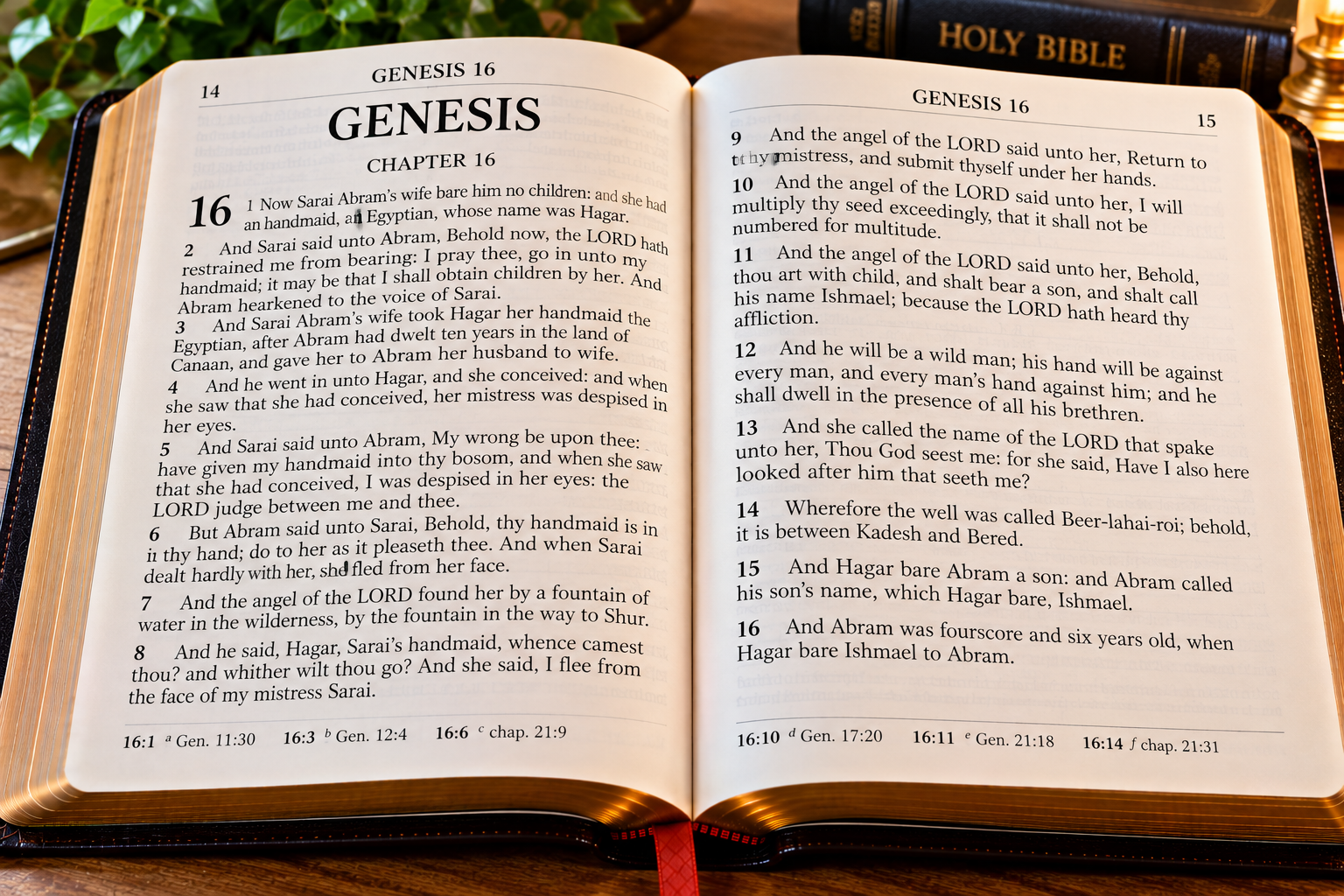
Book: Genesis Chapter: 16 Content Category: Faith & Bible Study Content Type: Biblical Chapter Overview and Interpretation Primary Scripture: Genesis 16:1–16 Key Theme: Sarai and Abram attempt to resolve the problem of childlessness through Hagar, leading to conflict and suffering. God meets Hagar in the wilderness, hears her affliction, and promises a future for her son, Ishmael.
1. Introduction to Genesis 16
Genesis 16 describes a difficult chapter in the life of Abram and Sarai. God has promised Abram descendants, but Sarai remains childless. After waiting, Sarai proposes that Abram have a child through her Egyptian servant, Hagar. Abram agrees, and Hagar becomes pregnant.
The pregnancy creates conflict within the household. Sarai feels dishonored, Hagar experiences mistreatment, and Abram allows Sarai to deal with Hagar as she sees fit. Hagar eventually flees into the wilderness.
There, the angel of the LORD finds Hagar near a spring of water and speaks to her. He tells her to return to Sarai and promises that her descendants will become numerous. He also instructs her to name her son Ishmael, because the LORD has heard her affliction.
Hagar responds by acknowledging the God who sees her. The chapter ends with Abram naming his son Ishmael and the record of Abram’s age when Ishmael is born.
Genesis 16 explores impatience, human attempts to control the fulfillment of God’s promises, household conflict, the suffering of a vulnerable woman, and God’s attention to those who are afflicted. It also introduces Ishmael, whose story will continue in Genesis.
Key Verse — Genesis 16:13 (KJV)
“Thou God seest me: for she said, Have I also here looked after him that seeth me?”
Hagar’s response highlights one of the chapter’s most significant themes: God sees her in a situation of distress. Although Hagar is a servant within Abram’s household, the biblical narrative gives her a personal encounter with God and preserves her response to that encounter.
2. Chapter Overview: Genesis 16:1–16

8
A. Sarai Remains Childless — Genesis 16:1
Genesis begins by explaining that Sarai, Abram’s wife, has not borne him children. She has an Egyptian servant named Hagar.
This detail connects the chapter directly to Genesis 15, where God promised Abram an heir from his own body and descendants as numerous as the stars. Yet the promised child has not arrived, and Sarai remains unable to conceive.
The delay becomes the setting for the household’s decision to seek another way for Abram to have a child.
The text identifies Hagar as an Egyptian servant, placing her in a socially vulnerable position within Abram and Sarai’s household. She has little authority over the decisions that will affect her body and future.
Key lesson: Waiting for an important promise can create emotional pressure, but the choices made under that pressure can affect other people deeply.
B. Sarai Proposes That Abram Have a Child Through Hagar — Genesis 16:2
Sarai tells Abram that the LORD has restrained her from bearing children. She then proposes that Abram go in to Hagar, hoping to build a family through her.
Abram listens to Sarai and accepts the proposal.
The practice of a wife giving a servant to her husband to produce an heir is known from the broader ancient Near Eastern setting. However, the fact that a practice existed does not automatically mean that the biblical narrative endorses it.
Genesis 16 records the decision and its consequences. It does not state that God commanded Sarai to make this arrangement or that God instructed Abram to have a child through Hagar.
The contrast with Genesis 15 is important. God had promised Abram an heir, but Abram and Sarai now pursue a solution of their own.
Key lesson: A culturally familiar or seemingly practical solution is not necessarily the same as following God’s direction.
C. Abram Takes Hagar as His Wife — Genesis 16:3
After Abram has lived in Canaan for ten years, Sarai gives Hagar to him as a wife. The text identifies Hagar as Sarai’s Egyptian servant.
The passage shows that the decision was not an impulsive event occurring immediately after Genesis 15. A substantial period has passed since Abram first received the promise.
The narrative therefore emphasizes the experience of waiting. Abram and Sarai have lived with the promise for years, yet its fulfillment has not taken place in the way they might have expected.
The text does not give a detailed account of Hagar’s feelings or whether she had a meaningful choice in the arrangement. Readers should avoid assuming that she freely welcomed the situation simply because the household proceeded with it.
D. Hagar Becomes Pregnant and Conflict Begins — Genesis 16:4
Hagar conceives after Abram goes in to her. When she realizes she is pregnant, she looks upon Sarai with contempt, or Sarai perceives that Hagar regards her differently.
The pregnancy changes the relationships within the household. Sarai, who had been unable to conceive, now finds herself in conflict with the servant who is carrying Abram’s child.
The text describes Hagar’s changed attitude but does not provide a full account of her motives. Her behavior contributes to the conflict, yet the broader situation is shaped by the unequal household arrangement that placed her in this position.
Key lesson: Decisions intended to solve one problem can create new tensions when they do not account for the dignity, feelings, and rights of everyone affected.
E. Sarai Complains to Abram — Genesis 16:5
Sarai turns to Abram and says that the wrong done to her is his responsibility. She reminds him that she gave Hagar to him and now feels despised in Hagar’s eyes.
Sarai calls upon the LORD to judge between her and Abram.
Her words reveal the breakdown of trust within the household. What began as a shared attempt to address childlessness has become a source of resentment and accusation.
The chapter does not present Sarai as simply free from responsibility or Abram as the only person accountable. Sarai proposed the arrangement, Abram accepted it, and the resulting conflict involves both of them. Hagar, meanwhile, is the servant whose life has been directly affected by the decisions of those with greater authority.
F. Abram Leaves the Situation to Sarai — Genesis 16:6
Abram tells Sarai that Hagar is in her hand and that Sarai may do to her what seems good to her. Sarai then deals harshly with Hagar, and Hagar flees.
Abram’s response is important because he does not actively resolve the conflict. Although he participated in the arrangement that led to Hagar’s pregnancy, he places the immediate responsibility for Hagar’s treatment in Sarai’s hands.
The passage describes Sarai’s treatment of Hagar as harsh. It does not detail every action involved, so readers should not invent specific forms of abuse beyond what the text says.
Hagar’s flight reveals the seriousness of the situation. She leaves the household and enters the wilderness, where she faces danger and uncertainty.
Key lesson: Avoiding responsibility for a conflict can allow harm to continue. Leadership includes a responsibility to address the consequences of one’s decisions.
G. The Angel of the LORD Finds Hagar in the Wilderness — Genesis 16:7
The angel of the LORD finds Hagar by a spring of water in the wilderness, on the way to Shur.
This is a significant moment in the chapter. Hagar has left Abram and Sarai’s household and is alone in a vulnerable environment. Yet the narrative says that the angel of the LORD finds her.
The spring provides the setting for the encounter and gives the scene a practical dimension: Hagar is in a wilderness area where access to water matters for survival.
The narrative does not depict Hagar as invisible simply because she is a servant or an Egyptian. God addresses her directly, and her experience becomes part of the biblical account.
Key lesson: Human beings who are overlooked or mistreated by others are not overlooked in the biblical story of God’s care.
H. Hagar Is Asked Where She Has Come From and Where She Is Going — Genesis 16:8
The angel of the LORD calls Hagar by name and asks where she has come from and where she is going.
Hagar replies that she is fleeing from Sarai, her mistress.
The question brings Hagar’s circumstances into the open. She identifies the source of her flight and makes clear that she is leaving a difficult household situation.
The passage does not portray her as merely an unnamed servant. She is addressed personally, and her answer is recorded.
The question about where she is going also highlights her uncertainty. She knows what she is escaping, but the text does not indicate that she has a secure destination or a detailed plan for her future.
I. Hagar Is Told to Return — Genesis 16:9
The angel of the LORD tells Hagar to return to her mistress and submit herself under her hands.
This is one of the chapter’s most difficult verses for modern readers because it occurs after Hagar has fled from harsh treatment.
The text records a specific instruction given to Hagar within this biblical narrative. It should not be generalized into a rule that every person experiencing abuse or mistreatment must return to a harmful situation.
The passage does not provide a universal pastoral or legal policy for responding to abuse. Its immediate focus is Hagar’s encounter with the angel of the LORD and the promise that follows.
Readers should interpret the verse in its literary and historical context, recognizing both what the text says and the limits of applying this specific instruction to unrelated modern situations.
J. God Promises Hagar Numerous Descendants — Genesis 16:10
The angel of the LORD tells Hagar that her descendants will be multiplied greatly and will be too numerous to count.
This promise echoes the language used concerning Abram’s descendants in Genesis 15:5. Although Hagar is not the primary recipient of the covenant promise made to Abram, the chapter gives her a promise concerning her own descendants.
The promise establishes that Hagar and her child have a future within the biblical story. Their significance is not erased because Hagar is a servant or because her pregnancy arose from a troubled household arrangement.
Key lesson: The biblical narrative gives attention to people whose lives are often shaped by decisions made by those with greater power.
K. Hagar Is Told to Name Her Son Ishmael — Genesis 16:11–12
The angel of the LORD tells Hagar that she will bear a son and must call him Ishmael, because the LORD has heard her affliction.
The name Ishmael is associated with the meaning “God hears.” This meaning is central to the passage: Hagar’s suffering has not gone unnoticed.
The angel also describes the future character of Ishmael’s life and his relationship with others. Genesis 16:12 uses vivid language to describe his independent and contentious future.
This verse has sometimes been interpreted too broadly as a judgment on all the later descendants of Ishmael. Such a conclusion goes beyond what the chapter explicitly establishes. The verse describes Ishmael in the context of this prophetic announcement; it should not be used to assign a fixed moral character to every later people associated with him.
L. Hagar Calls the LORD the God Who Sees Her — Genesis 16:13–14
Hagar responds by acknowledging the God who has seen her. Her words are traditionally understood as recognizing that God sees her in her distress.
The place is associated with a well named Beer-lahai-roi, a name connected with the encounter and Hagar’s experience of being seen by God.
This is one of the most distinctive moments in Genesis 16. Hagar, who has been mistreated and forced into a vulnerable situation, responds to the divine encounter with a statement about God’s awareness of her.
The passage emphasizes both hearing and seeing: God hears her affliction, and Hagar recognizes that she has been seen.
Key lesson: God’s attention to suffering is a major theme of this passage, particularly the suffering of someone with little social power.
M. Ishmael Is Born — Genesis 16:15–16
Hagar gives birth to Abram’s son, and Abram names him Ishmael, as the angel of the LORD had instructed.
Abram is eighty-six years old when Ishmael is born.
The chapter ends with the birth of the child and the recording of Abram’s age. The promised son Isaac has not yet been born; his birth will be described later in Genesis 21.
The ending keeps the larger narrative in view. Ishmael is an important part of Abram’s family story, but Genesis will continue to distinguish between Ishmael’s place in the household and the covenant line through Isaac.
The text neither erases Ishmael nor makes him the child through whom the specific covenant promise of Genesis 15 will be carried forward. Both details are important for understanding the chapters that follow.
3. Major Themes in Genesis 16
| Theme | Scripture | Meaning |
|---|---|---|
| Waiting for God’s promise | Genesis 16:1–3 | Abram and Sarai respond to their prolonged childlessness by arranging an alternative. |
| Human initiative and divine promise | Genesis 16:2–4 | The household’s decision creates consequences that the participants did not appear to anticipate. |
| Household conflict | Genesis 16:4–6 | Pregnancy intensifies resentment and conflict among Abram, Sarai, and Hagar. |
| Abuse of power and vulnerability | Genesis 16:6 | Hagar experiences harsh treatment and flees from the household. |
| God’s attention to suffering | Genesis 16:7–13 | God encounters Hagar and responds to her affliction. |
| The promise of descendants | Genesis 16:10–12 | Hagar receives a promise concerning her son and his descendants. |
| God hears | Genesis 16:11 | Ishmael’s name recalls that God has heard Hagar’s affliction. |
| God sees | Genesis 16:13 | Hagar recognizes God’s awareness of her circumstances. |
| Family and covenant history | Genesis 16:15–16 | Ishmael’s birth becomes an important part of Abram’s family story. |
4. Biblical Interpretation Note
Genesis 16 requires careful interpretation because it addresses infertility, an ancient household practice, unequal power, mistreatment, and a divine encounter. The chapter should neither be read as though every action of Abram and Sarai is approved by God nor reduced to a story about personal impatience alone.
A. Did God Tell Abram and Sarai to Use Hagar to Produce an Heir?
Scripture: Genesis 16:1–3
No such command appears in the chapter. Sarai proposes the arrangement, and Abram agrees. The narrative records their decision but does not state that God instructed them to pursue it.
This distinction is important because Genesis 15 has already recorded God’s promise that Abram will have an heir. Genesis 16 shows Abram and Sarai responding to the delay through their own household arrangement.
The chapter does not explicitly state every motive behind their decision. It does, however, show that the arrangement leads to conflict and suffering.
Interpretive principle: A decision made in an attempt to achieve a desired outcome should not automatically be treated as God’s instruction merely because it occurs within a biblical story.
B. Was the Arrangement With Hagar Common in the Ancient World?
Scripture: Genesis 16:1–4
The practice of using a female servant to produce an heir for a household is known from ancient Near Eastern social settings. Such arrangements could be connected with inheritance, family continuity, and the social pressures surrounding childlessness.
Genesis 16 reflects a world in which servants had significantly less power than household heads. Hagar’s position is therefore central to understanding the ethical complexity of the story.
However, historical context explains the setting; it does not by itself establish that the practice was morally approved by God. The chapter does not present an explicit divine command authorizing Abram and Sarai’s decision.
C. Why Did Conflict Develop Between Sarai and Hagar?
Scripture: Genesis 16:4–6
After Hagar conceives, the relationship between the two women deteriorates. Sarai feels dishonored, while Hagar’s attitude toward Sarai changes.
The text gives only a limited account of Hagar’s perspective. It records Sarai’s complaint and Hagar’s subsequent flight, but it does not provide a detailed conversation between the women that explains every aspect of their conflict.
A careful reading recognizes that the arrangement created a complicated and unequal relationship. Sarai had authority within the household, while Hagar was her servant and was directly affected by the decision made by Abram and Sarai.
Interpretive principle: Avoid reducing the conflict to one person’s fault when the narrative presents a household situation shaped by several people’s decisions and unequal power.
D. Was Abram Responsible for Hagar’s Suffering?
Scripture: Genesis 16:2–6
Abram agrees to Sarai’s proposal and takes Hagar as his wife. When the conflict develops, he tells Sarai to deal with Hagar as she sees fit. Sarai then treats Hagar harshly, and Hagar flees.
The narrative therefore shows that Abram participates in the decision that leads to the conflict and does not actively resolve the mistreatment when it occurs. Sarai is also responsible for her treatment of Hagar.
The text does not describe every detail of the household’s actions, so interpretations should remain tied to what is actually recorded.
The broader lesson concerns responsibility: people who participate in decisions that affect others should not ignore the consequences when those decisions create harm.
E. Why Does God Encounter Hagar in the Wilderness?
Scripture: Genesis 16:7–13
Hagar has fled from Sarai and is found by the angel of the LORD near a spring of water. God addresses her by name, asks about her circumstances, and gives her a promise concerning her son.
The encounter is significant because Hagar is a servant and a foreign woman in Abram’s household. Nevertheless, her experience is given direct attention in Scripture.
The chapter does not suggest that God approves of every action taken by Abram or Sarai. Instead, the encounter highlights God’s awareness of Hagar’s affliction and His concern for her future.
Theological principle: God’s attention to a person does not depend solely on that person’s social status, power, or position within a family.
F. Does Genesis 16:9 Mean That People Experiencing Abuse Must Return?
Scripture: Genesis 16:6–9
The angel of the LORD instructs Hagar to return to Sarai and submit under her hand. This is a specific instruction within Hagar’s encounter in the biblical narrative.
It should not be turned into a universal rule requiring people who experience domestic abuse, coercion, or mistreatment to return to unsafe environments. The chapter does not provide a general policy for every modern situation involving abuse.
A responsible interpretation distinguishes the specific instruction given to Hagar from the broader biblical responsibilities to protect vulnerable people, act justly, and refrain from mistreating others.
For modern readers facing abuse or danger, personal safety and appropriate support matter. This passage should not be used to pressure someone to remain in a harmful situation.
G. What Does the Name Ishmael Mean?
Scripture: Genesis 16:11
The name Ishmael is commonly understood to mean “God hears.” Genesis 16:11 explicitly connects the name with the statement that the LORD has heard Hagar’s affliction.
The name therefore functions as a reminder of the central message of Hagar’s encounter: her suffering has been heard by God.
The meaning is particularly significant because Hagar is in a vulnerable position and has fled from the household. The naming of her son preserves the connection between her affliction and God’s response.
H. What Does “Thou God Seest Me” Mean?
Scripture: Genesis 16:13
Hagar recognizes that God sees her. This is not merely a general statement that God knows everything; within the story, it is Hagar’s personal response to being encountered and addressed in the wilderness.
The passage connects God’s seeing with His attention to a person who is suffering. Hagar’s experience becomes a significant biblical illustration of divine awareness and care.
The verse should not be used to promise that every difficult situation will be resolved immediately or in the same way. Rather, it affirms that Hagar is seen by God in the circumstances described in the text.
I. Is Ishmael the Child Through Whom God’s Covenant Promise Will Be Fulfilled?
Scripture: Genesis 16:10–16; Genesis 17:18–21
Ishmael is Abram’s son, and God promises that he will have numerous descendants. His birth is an important part of Abram’s family history.
However, Genesis 17:19–21 later identifies Isaac as the son through whom God will establish His covenant. The distinction matters: Ishmael receives a promise concerning his future, while the covenant line specified in the narrative continues through Isaac.
These passages should be read together. Genesis 16 does not erase Ishmael’s significance, and Genesis 17 does not identify him as the son through whom the particular covenant promise will continue.
J. What Does Genesis 16 Teach About God’s Promises?
Genesis 16 shows the tension between God’s promise and the actions of people who are waiting for its fulfillment. Abram and Sarai pursue an alternative arrangement, and the result is conflict within the household.
The chapter does not explicitly state that every consequence was a direct punishment for their decision. It does show that the arrangement brought significant relational difficulties.
The following chapters continue the story. Genesis 17 reaffirms the covenant and identifies Isaac as the promised son, and Genesis 21 records Isaac’s birth.
Interpretive principle: Read Genesis 16 as one stage in the unfolding narrative. Its significance becomes clearer when connected to the covenant promises and family history recorded in the surrounding chapters.
5. Character Study: Abram, Sarai, and Hagar
1. Abram — The Man Who Agrees to an Alternative
Genesis 16:2–6
Abram agrees to Sarai’s proposal and later leaves her to handle the conflict with Hagar. His actions show how decisions made during a period of waiting can create responsibilities that cannot simply be ignored.
2. Sarai — The Woman Struggling With Childlessness
Genesis 16:1–6
Sarai proposes the arrangement with Hagar and later experiences resentment and conflict. Her story illustrates the emotional pressures surrounding prolonged childlessness, while also showing that a person’s suffering does not justify harsh treatment of another.

3. Hagar — The Woman God Sees
Genesis 16:4–14
Hagar is a servant whose life is shaped by decisions made by others. After fleeing into the wilderness, she encounters the angel of the LORD and receives a promise concerning her son. Her response emphasizes that God sees her affliction.

4. Ishmael — The Son Whose Name Recalls God’s Hearing
Genesis 16:11–16
Ishmael’s name is connected to God’s hearing of Hagar’s affliction. His birth marks an important development in Abram’s family story, and the promise concerning his descendants continues in later chapters.
6. Theological Significance of Genesis 16
1. Human Attempts to Control God’s Timing Can Have Consequences
Abram and Sarai attempt to address childlessness through their own arrangement. The resulting conflict demonstrates the importance of considering the consequences of decisions made under pressure.
2. God Hears the Afflicted
Ishmael’s name is connected with God’s hearing of Hagar’s affliction. This theme is central to the chapter and resonates with other biblical accounts in which God hears the cries of people who suffer.
3. God Sees People Who Are Overlooked by Society
Hagar is a servant and a foreign woman, yet the biblical narrative gives her a direct encounter with God. Her story challenges readers to recognize the dignity and suffering of people who have little social power.
4. Human Responsibility Matters
Abram and Sarai’s actions have consequences for Hagar and the household. The chapter does not treat God’s presence as a reason to ignore human responsibility for decisions and their effects.
5. God’s Care Does Not Erase the Distinction Between the Covenant Lines
Ishmael receives a promise concerning his descendants, while later chapters identify Isaac as the son through whom God’s covenant with Abraham will continue. The narrative holds both truths together.
6. God’s Purposes Continue Through a Complicated Family History
Genesis 16 does not present Abram’s household as free from conflict or mistakes. The chapter contributes to a larger biblical narrative in which God’s promises unfold amid complicated human relationships.
7. Practical Applications for Christian Living
- Be patient while waiting. Delays can create pressure to seek immediate alternatives, but important decisions should be made with care.
- Do not assume that a practical solution is automatically God’s direction. Consider biblical principles, consequences, and the effect on other people.
- Take responsibility for decisions. If your choices contribute to a conflict, do not withdraw from the responsibility to address the harm.
- Treat vulnerable people with dignity. Hagar’s position as a servant does not make her suffering insignificant.
- Avoid using power harshly. Authority should be exercised with fairness and concern for those who depend on you.
- Listen to people who are suffering. Hagar’s story emphasizes the importance of hearing the concerns of people whose voices might otherwise be ignored.
- Remember that God sees and hears. The chapter offers reassurance that suffering is not invisible within the biblical understanding of God.
- Interpret Scripture responsibly. Do not use Hagar’s specific instruction to justify forcing someone to return to an unsafe situation.
- Consider the long-term effects of decisions. Choices made within a family or community can affect relationships and future generations.
- Recognize that a person’s background does not determine their worth. Hagar’s Egyptian identity and social position do not exclude her from receiving God’s attention in the narrative.
8. Key Questions for Bible Study
These questions can be used for personal reflection, family devotion, a church class, or a small-group discussion.
A. Observation Questions — What Does the Text Say?
- Who is Hagar, and what is her relationship to Sarai?
- What problem does Sarai face at the beginning of Genesis 16?
- What does Sarai propose to Abram?
- What happens after Hagar conceives?
- Why does Sarai complain to Abram?
- How does Abram respond to Sarai’s complaint?
- Where does Hagar flee?
- Who finds Hagar near the spring of water?
- What name is Hagar instructed to give her son, and why?
- What does Hagar say about the God who encounters her?
- How old is Abram when Ishmael is born?
B. Interpretation Questions — What Does the Text Mean?
- How does Genesis 16 connect with God’s promise to Abram in Genesis 15?
- Does the chapter state that God instructed Abram and Sarai to use Hagar to produce an heir?
- How does the ancient household setting help explain the arrangement involving Hagar?
- What does the conflict reveal about the consequences of the household’s decision?
- How do Abram’s and Sarai’s actions contribute to Hagar’s suffering?
- Why is God’s encounter with Hagar significant in the context of her social position?
- What is the meaning of Ishmael’s name within the narrative?
- What does Hagar’s statement about the God who sees her reveal about her experience?
- How should Genesis 16:9 be interpreted without turning Hagar’s specific instruction into a universal rule for people experiencing abuse?
- How do Genesis 17:18–21 and Genesis 21 help clarify Ishmael’s place in the biblical narrative?
C. Application Questions — How Should We Respond?
- What can you learn from Abram and Sarai’s response to a prolonged period of waiting?
- How can you avoid making major decisions simply because you feel pressured by circumstances?
- What responsibilities do people have when their decisions cause harm to others?
- How can you treat people with dignity when you hold more authority or influence than they do?
- What can Hagar’s story teach you about listening to people who feel overlooked?
- How can you support someone who is experiencing mistreatment or family conflict?
- What does the phrase “God sees me” mean to you when you face a difficult situation?
- How can you distinguish between a specific instruction in a biblical narrative and a general principle for Christian living?
- What practical steps can help prevent conflict when several people are affected by one decision?
- How can you remain hopeful while waiting for an important outcome without assuming that you know exactly how God will act?
D. Deeper Reflection Questions
- How does Genesis 16 portray the relationship between human choices and God’s continuing purposes?
- Why is it important to consider Hagar’s perspective rather than focusing only on Abram and Sarai?
- How does the chapter challenge the idea that a person’s social position determines whether their suffering matters?
- What does the distinction between Ishmael and Isaac teach about reading covenant promises across Genesis?
- How can the church respond to this passage in ways that emphasize compassion, safety, responsibility, and faithful interpretation?
- How does Genesis 16 contribute to the larger biblical theme of God hearing the cries of the afflicted?
9. Related Bible Verses for Further Study
| Bible reference | Connection to Genesis 16 |
|---|---|
| Genesis 12:1–3 | God calls Abram and promises to bless him and the nations through him. |
| Genesis 15:1–6 | God promises Abram an heir and numerous descendants. |
| Genesis 17:18–21 | God speaks about Ishmael and identifies Isaac as the son through whom the covenant will be established. |
| Genesis 21:1–21 | Isaac is born, and Hagar and Ishmael later experience another wilderness episode. |
| Exodus 2:23–25 | God hears the cries of the Israelites in their suffering. |
| Exodus 3:7–8 | God declares that He has seen the affliction of His people and heard their cries. |
| Psalm 34:15–18 | The psalm describes God’s attention to the cries of the righteous and the brokenhearted. |
| Psalm 139:1–12 | A reflection on God’s complete knowledge and presence. |
| Proverbs 31:8–9 | A call to speak for those who cannot adequately defend themselves and to judge fairly. |
| Luke 1:46–55 | Mary’s song reflects God’s attention to the humble and His acts of mercy. |
| Galatians 3:6–9 | Paul discusses Abraham’s faith and the blessing of the nations. |
| James 1:27 | A call to care for vulnerable people and maintain moral integrity. |
10. Chapter Summary
Genesis 16 describes how Sarai, still childless after years of waiting, gives her Egyptian servant Hagar to Abram in an attempt to produce an heir. Hagar conceives, and conflict develops between the women. Sarai treats Hagar harshly, and Hagar flees into the wilderness. There the angel of the LORD finds her, addresses her situation, and promises that her descendants will become numerous. Hagar is instructed to name her son Ishmael because God has heard her affliction. She responds by acknowledging the God who sees her. Ishmael is born when Abram is eighty-six years old.
The chapter explores the consequences of human decisions, the responsibility to treat vulnerable people with dignity, and God’s attention to those who suffer. It also advances the story of Abram’s family while preparing readers for the covenant developments in Genesis 17 and the birth of Isaac in Genesis 21.
One-sentence summary: Genesis 16 teaches that human attempts to resolve God’s promises on their own terms can create conflict, while Hagar’s encounter with God reveals His attention to the afflicted and His promise concerning Ishmael’s future.