

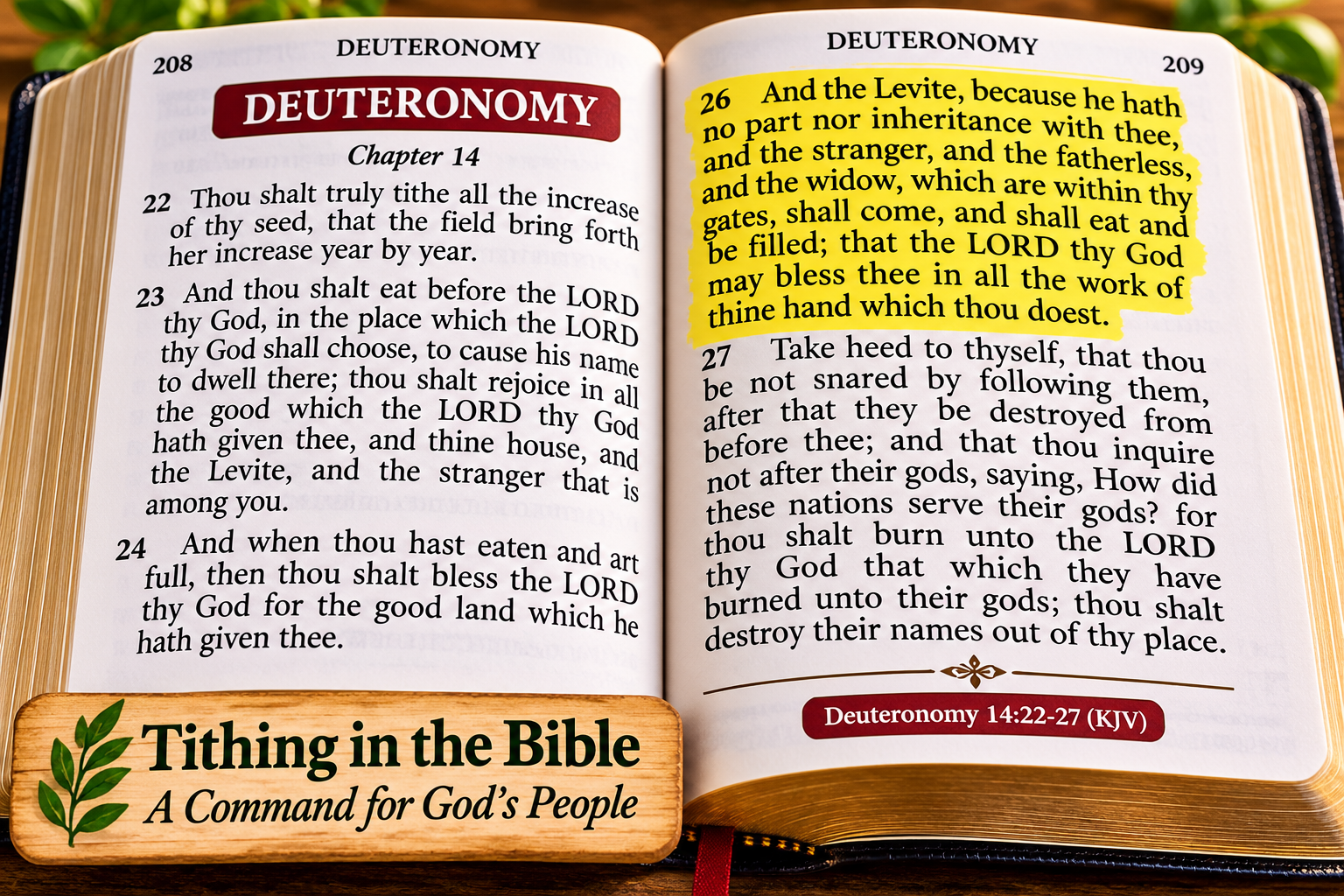
Why Is Tithing Important in the Bible?
Tithing is an important subject in the Bible because it concerns how people respond to God’s provision, manage their resources, support religious ministry, and care for others. The word tithe means a tenth, or 10 percent. In the Old Testament, tithing was part of God’s covenant instructions to Israel and involved agricultural produce and livestock.
The Bible also records examples of giving a tenth before the law of Moses. In Genesis 14:18–20, Abraham gives a tenth to Melchizedek, the king of Salem and priest of God Most High. In Genesis 28:20–22, Jacob promises to give God a tenth of what he receives.
Under Israel’s covenant law, tithes helped support the Levites and provided for certain community responsibilities. In the New Testament, Jesus addressed tithing while emphasizing justice, mercy, and faithfulness. The apostles also taught believers to give willingly, generously, and according to their means.
Christians differ on whether the 10 percent tithe remains a binding requirement today. However, biblical teaching consistently emphasizes generosity, responsible stewardship, support for ministry, and concern for people in need.
Understanding why tithing is important in the Bible requires examining its original purpose and how its principles relate to Christian giving today.
Key Scriptures: Leviticus 27:30; Malachi 3:10; Matthew 23:23; 2 Corinthians 9:7.
1. Tithing Acknowledges God as the Owner of Everything
One reason tithing is important in the Bible is that it reflects the belief that everything ultimately belongs to God.
Psalm 24:1 declares that the earth and everything in it belong to the Lord. This teaching establishes a foundation for biblical stewardship: people are responsible for managing resources that exist within God’s creation.
In the Old Testament, the Israelites were instructed to set aside tithes from their agricultural produce and livestock. These instructions reminded them that their livelihood was connected to the land and God’s provision.
Deuteronomy 8:17–18 warns the people against believing that their own strength alone produces wealth. They were instructed to remember the Lord, who gave them the ability to produce wealth.
For Christians today, this principle encourages a responsible attitude toward money. Income, possessions, abilities, and opportunities should not be viewed solely in terms of personal gain. They can also be used to support others and contribute to meaningful work.
Tithing is one way many Christians express this belief, although the biblical principle of stewardship extends beyond a specific percentage.
Practical application: Consider how you manage your income and possessions. Ask whether your spending, saving, giving, and financial commitments reflect gratitude and responsible stewardship.
Key Scriptures: Psalm 24:1; Deuteronomy 8:17–18.
2. Tithing Expresses Gratitude for God’s Provision
Tithing is often understood as a way of acknowledging God’s provision and expressing gratitude.
Genesis 14:18–20 records Abraham giving Melchizedek a tenth after his victory over the kings who had taken Lot and other possessions. Melchizedek blessed Abraham in the name of God Most High, and Abraham gave him a tenth of everything.
The passage does not explicitly state every motive behind Abraham’s gift, but it places the giving within an encounter involving blessing and acknowledgment of God.
Similarly, Deuteronomy 8:10–18 reminds Israel to remember God when they experience abundance. The people were warned not to become proud or forget the source of their provision.
This principle challenges people to recognize that financial success involves more than personal effort alone. Work and planning matter, but people also depend on health, opportunities, relationships, and circumstances they cannot fully control.
For many Christians, giving is a practical expression of thankfulness. It is an opportunity to use some of their resources to support their church, help people in need, or contribute to charitable work.
Practical application: Reflect on the resources and opportunities you have received. Develop a giving plan that expresses gratitude while taking your financial responsibilities into account.
Key Scriptures: Genesis 14:18–20; Deuteronomy 8:10–18.
3. Tithing Supported Religious Ministry in Ancient Israel
Tithing was important in Israel because it helped support the people responsible for particular religious duties.
Numbers 18:21–24 explains that the Israelites’ tithes were assigned to the Levites in return for their service in the tabernacle.
The Levites had responsibilities connected with Israel’s worship and religious life. Unlike the other tribes, they did not receive a territorial inheritance in the same way. The tithe provided for their needs while they carried out their assigned duties.
This arrangement shows that religious service required practical resources. The community’s contributions helped sustain the people responsible for carrying out the nation’s religious responsibilities.
The New Testament also recognizes the importance of supporting gospel ministry. In 1 Corinthians 9:13–14, Paul explains that those who proclaim the gospel may receive their living from the gospel.
The Old Testament system and New Testament church practices are not identical. Nevertheless, both passages recognize the legitimacy of providing material support for religious service.
Today, many Christians contribute financially to their churches to help support pastoral ministry, teaching, outreach, missions, and other activities.
Practical application: Consider how financial contributions can support meaningful ministry. Look for responsible stewardship, transparency, and accountability in the organizations you support.
Key Scriptures: Numbers 18:21–24; 1 Corinthians 9:13–14.
4. Tithing Was Connected to Caring for People in Need
Another important aspect of biblical tithing is its relationship to community welfare.
Deuteronomy 14:28–29 instructs the Israelites to set aside a tithe every third year for the Levite, foreigner, fatherless, and widow living within their towns.
These groups could face economic vulnerability and might lack reliable sources of support. The instructions helped provide access to community resources.
Deuteronomy 26:12–13 also describes the distribution of the tithe in connection with these responsibilities.
These passages demonstrate that Israel’s religious obligations were connected to practical care for others. Worship was not intended to be separated from concern for the vulnerable.
The specific rules belonged to Israel’s covenant law, but the broader concern for people in need appears throughout Scripture.
In the New Testament, Acts 4:32–35 describes believers sharing resources so that people experiencing need could receive assistance. James 1:27 also emphasizes caring for orphans and widows in their distress.
These passages encourage Christians to view generosity as more than supporting religious institutions. It also includes helping people who need food, shelter, financial assistance, and other practical support.
Practical application: Consider setting aside resources for charitable giving, community assistance, or people experiencing hardship. Giving can be one way to put compassion into action.
Key Scriptures: Deuteronomy 14:28–29; Acts 4:32–35; James 1:27.
5. Tithing Taught Israel to Honor God With Its Resources
Leviticus 27:30 describes a tenth of the land’s produce as holy to the Lord. This language shows that the tithe was set apart within Israel’s covenant system.
The practice was not merely an ordinary financial transaction. It was connected to Israel’s relationship with God and the nation’s responsibilities under the law.
Proverbs 3:9 also instructs readers to honor the Lord with their wealth and the firstfruits of their produce. Although this verse is not itself a detailed command about the modern income tithe, it expresses the principle of honoring God through the use of material resources.
For Christians, honoring God with resources can involve financial giving, but it also includes honesty, fairness, responsible spending, generosity, and care for others.
A person cannot substitute a financial contribution for every other aspect of faithfulness. Jesus emphasized this point when He criticized religious leaders who practiced tithing while neglecting justice, mercy, and faithfulness.
Practical application: Let financial giving be part of a broader commitment to honoring God through your choices, relationships, work, and treatment of others.
Key Scriptures: Leviticus 27:30; Proverbs 3:9; Matthew 23:23.
6. Tithing Encourages Discipline and Intentional Giving
A further reason Christians practice tithing is that a defined percentage can make giving easier to plan.
The Old Testament tithe established a specific obligation within Israel’s covenant system. In the New Testament, 1 Corinthians 16:1–2 provides an example of planned and regular contributions.
Paul instructed the Corinthians to set aside contributions on the first day of each week for a collection intended to help other believers. The passage demonstrates the value of organizing giving rather than waiting until the last moment.
It does not establish a universal 10 percent requirement. Instead, it shows that giving can be approached with preparation and consistency.
For Christians who follow the 10 percent practice, tithing can provide a straightforward way to organize regular contributions. Others may establish a different giving plan based on their understanding of Scripture and their circumstances.
In either case, intentional planning can help people balance generosity with household expenses and other financial responsibilities.
Practical application: Include giving in your household budget. Choose a regular schedule and an amount that reflect your convictions, financial capacity, and responsibilities.
Key Scriptures: 1 Corinthians 16:1–2; 2 Corinthians 8:12.
7. Tithing and Giving Reveal the Attitude of the Heart
The Bible repeatedly emphasizes that the attitude behind giving matters.
Second Corinthians 9:7 teaches that each person should give what they have decided in their heart, not reluctantly or under compulsion, because God loves a cheerful giver.
Paul’s instruction focuses on willingness and sincerity. Giving should not be forced through shame, manipulation, or promises of guaranteed financial returns.
This does not mean that every act of giving must be accompanied by an intense feeling of happiness. Rather, it means that giving should be a thoughtful decision made willingly instead of an act imposed through coercion.
Jesus also warned against giving merely to gain public recognition. In Matthew 6:1–4, He taught that acts of righteousness should not be performed simply to receive praise from other people.
These passages encourage believers to examine their motives. Financial giving should not be a means of purchasing status, controlling others, or displaying superiority.
Practical application: Before giving, consider why you are giving and whether the decision reflects your convictions. Give sincerely, without using money to seek recognition or influence.
Key Scriptures: 2 Corinthians 9:7; Matthew 6:1–4.
8. Tithing Must Not Replace Justice, Mercy, and Faithfulness
One of the clearest biblical warnings about tithing appears in Matthew 23:23.
Jesus criticized the scribes and Pharisees for carefully tithing mint, dill, and cumin while neglecting the weightier matters of the law: justice, mercy, and faithfulness.
The religious leaders were attentive to detailed requirements but failed to give sufficient attention to important moral responsibilities.
Jesus said they should have practiced the weightier matters without neglecting the others.
The passage teaches that religious observance should not become a substitute for righteous conduct. A person may give money regularly while neglecting honesty, fairness, compassion, or responsibility toward others.
This is especially important when considering why tithing matters. Its importance cannot be reduced to the amount contributed. The wider biblical message concerns faithfulness to God in every part of life.
Practical application: Examine your conduct as well as your financial giving. Consider whether your relationships and decisions demonstrate justice, mercy, honesty, and faithfulness.
Key Scriptures: Matthew 23:23; Luke 11:42.
9. Tithing and Giving Can Strengthen a Community of Generosity
Biblical generosity helps meet practical needs and encourages people to support one another.
Acts 2:44–45 describes early believers sharing possessions and resources according to people’s needs. Acts 4:32–35 similarly describes believers contributing resources so that people experiencing need could receive assistance.
These accounts illustrate a community in which material resources were used to help others rather than being treated only as personal possessions.
The passages do not establish a universal rule that every Christian must surrender all possessions or follow an identical financial arrangement. They show how early believers responded to particular needs through generosity and sharing.
Second Corinthians 8:12–14 also emphasizes giving according to one’s ability and describes the goal of meeting needs within the community.
For Christians today, giving may support a church’s ministry, provide relief during emergencies, fund charitable work, or help families facing hardship.
Practical application: Consider how your resources can contribute to the well-being of others. Support trustworthy organizations and look for practical ways to help people experiencing need.
Key Scriptures: Acts 2:44–45; Acts 4:32–35; 2 Corinthians 8:12–14.
10. Tithing Raises Important Questions About Faith and Stewardship
For many Christians, tithing is a way to express trust in God. However, biblical trust should not be confused with a promise that giving a particular amount will guarantee wealth.
Malachi 3:8–10 addresses Israel’s withholding of tithes and offerings within the nation’s covenant relationship with God. The passage includes a promise of provision in that historical setting.
Some Christians apply its principles of faithfulness and trust to their own giving. Others emphasize that the specific promise was addressed to Israel and should not be treated as a universal financial guarantee.
The New Testament encourages believers to trust God’s provision and practice generosity. Yet it also describes faithful people who experienced hardship, poverty, and persecution.
Second Corinthians 9:6–8 encourages generous giving and speaks of God’s provision for good works. It should not be interpreted as a guarantee that every contribution will produce a particular financial return.
Faithful stewardship involves trust, but it also requires wisdom. Christians should not be encouraged to neglect essential needs or take on harmful debt simply because they have been told that giving a particular amount guarantees prosperity.
Practical application: Give with faith and sincerity while managing your resources responsibly. Avoid treating tithing as a transaction that obligates God to deliver a specific financial result.
Key Scriptures: Malachi 3:8–10; 2 Corinthians 9:6–8.
11. Is Tithing Required for Christians Today?
Christians hold different views about whether the 10 percent tithe remains a binding requirement.
The View That Christians Should Continue Tithing
Some churches teach that the tithe remains a continuing obligation or a minimum standard for Christian giving. They often point to Abraham’s example, Jesus’ words in Matthew 23:23, and the importance of honoring God with one’s resources.
For these believers, tithing provides a clear structure for consistent giving and supports the work of the local church.
The View That Tithing Belonged to Israel’s Covenant Law
Other Christians emphasize that the Old Testament tithe was connected to Israel’s covenant law, agricultural production, the Levites, and the nation’s religious system.
They point out that the New Testament does not explicitly command every Christian to give exactly 10 percent of income. Instead, it emphasizes willingness, generosity, regularity, and giving according to one’s means.
These Christians may still choose to give 10 percent or more, but they do not consider that percentage a universal legal requirement.
A Balanced Biblical Conclusion
The Bible clearly teaches generosity, support for ministry, responsible stewardship, and concern for people in need. Christians differ on whether these principles require a specific percentage today.
It is helpful to distinguish explicit biblical instructions from interpretations held by different Christian traditions.
Believers should study Scripture in context, understand their church’s teaching, and make responsible financial decisions according to their convictions and circumstances.
Key Scriptures: Malachi 3:8–10; Matthew 23:23; 2 Corinthians 9:7.
12. Key Bible Verses About the Importance of Tithing
The following passages provide a foundation for further study.
- Genesis 14:18–20: Abraham gives a tenth to Melchizedek.
- Leviticus 27:30: A tenth of the land’s produce is described as holy to the Lord.
- Numbers 18:21–24: Tithes provide for the Levites.
- Deuteronomy 14:28–29: The tithe is connected with provision for people in need.
- Proverbs 3:9: Readers are instructed to honor the Lord with their wealth.
- Malachi 3:8–10: Israel is challenged concerning tithes and offerings.
- Matthew 23:23: Jesus emphasizes justice, mercy, and faithfulness alongside tithing.
- 1 Corinthians 9:13–14: Those who proclaim the gospel may receive their living from the gospel.
- 1 Corinthians 16:1–2: Paul teaches planned, regular contributions.
- 2 Corinthians 8:12: Giving is considered according to what a person has.
- 2 Corinthians 9:6–8: Giving should be willing, generous, and cheerful.
- Hebrews 13:15–16: Doing good and sharing with others are pleasing to God.
These passages should be read in context. Together, they illustrate the biblical importance of giving while showing that the specific requirements and applications differ across historical and covenant settings.
13. Frequently Asked Questions About the Importance of Tithing
Why Is Tithing Important to God?
In the Old Testament, tithing was part of Israel’s covenant law and helped support religious service and community responsibilities. More broadly, biblical teaching emphasizes honoring God, managing resources responsibly, supporting ministry, and caring for people in need.
What Is the Main Purpose of Tithing in the Bible?
The tithe supported the Levites and certain community needs in ancient Israel. Many Christians today understand tithing as a way to honor God and support their church. The broader biblical purpose of giving includes generosity, stewardship, and care for others.
What Are the Benefits of Tithing?
Christians who practice tithing may find that it provides a consistent structure for giving, helps support ministry, and encourages intentional financial stewardship. These practical benefits should not be confused with a guarantee of wealth or a specific divine reward.
Does God Bless People Who Tithe?
The Bible teaches about God’s provision and encourages generosity. However, Malachi 3:10 should be understood in its covenant context rather than treated as a universal promise that everyone who tithes will become wealthy.
Is Tithing More Important Than Helping the Poor?
The Bible does not present financial giving to religious institutions as a substitute for caring for people in need. Deuteronomy 14:28–29 connects Israel’s tithing practices with community welfare, while Matthew 23:23 emphasizes justice, mercy, and faithfulness.
Is Ten Percent a Requirement for Every Christian?
Christians disagree on this question. Some churches teach 10 percent as a continuing obligation or minimum, while others understand the Old Testament tithe as part of Israel’s covenant law and emphasize proportionate New Testament giving. The New Testament does not explicitly prescribe a universal 10 percent minimum for every believer.
What Is the Most Important Lesson About Tithing?
An important lesson is that giving should reflect faithfulness, gratitude, generosity, and responsible stewardship. Financial contributions matter, but they should not replace justice, mercy, honesty, and concern for others.
Conclusion: Why Is Tithing Important in the Bible?
Tithing is important in the Bible because it has been connected with honoring God, supporting religious service, and meeting community needs. Under Israel’s covenant law, tithes provided for the Levites and contributed to the welfare of vulnerable people.
The New Testament continues to emphasize generosity, support for ministry, and giving according to one’s means. Jesus also warns that religious observance must never replace justice, mercy, and faithfulness.
Christians differ on whether the 10 percent tithe remains a universal requirement today. Understanding these differences requires studying Scripture in context and distinguishing explicit biblical instructions from contemporary interpretations.
The broader lesson is that biblical giving involves more than calculating a percentage. It concerns how believers use their resources to honor God, support meaningful work, manage money responsibly, and demonstrate love toward others.
Closing Scripture: 2 Corinthians 9:7.
Paul’s teaching provides an important principle for Christian giving: contributions should be made willingly and thoughtfully, not reluctantly or under compulsion.