

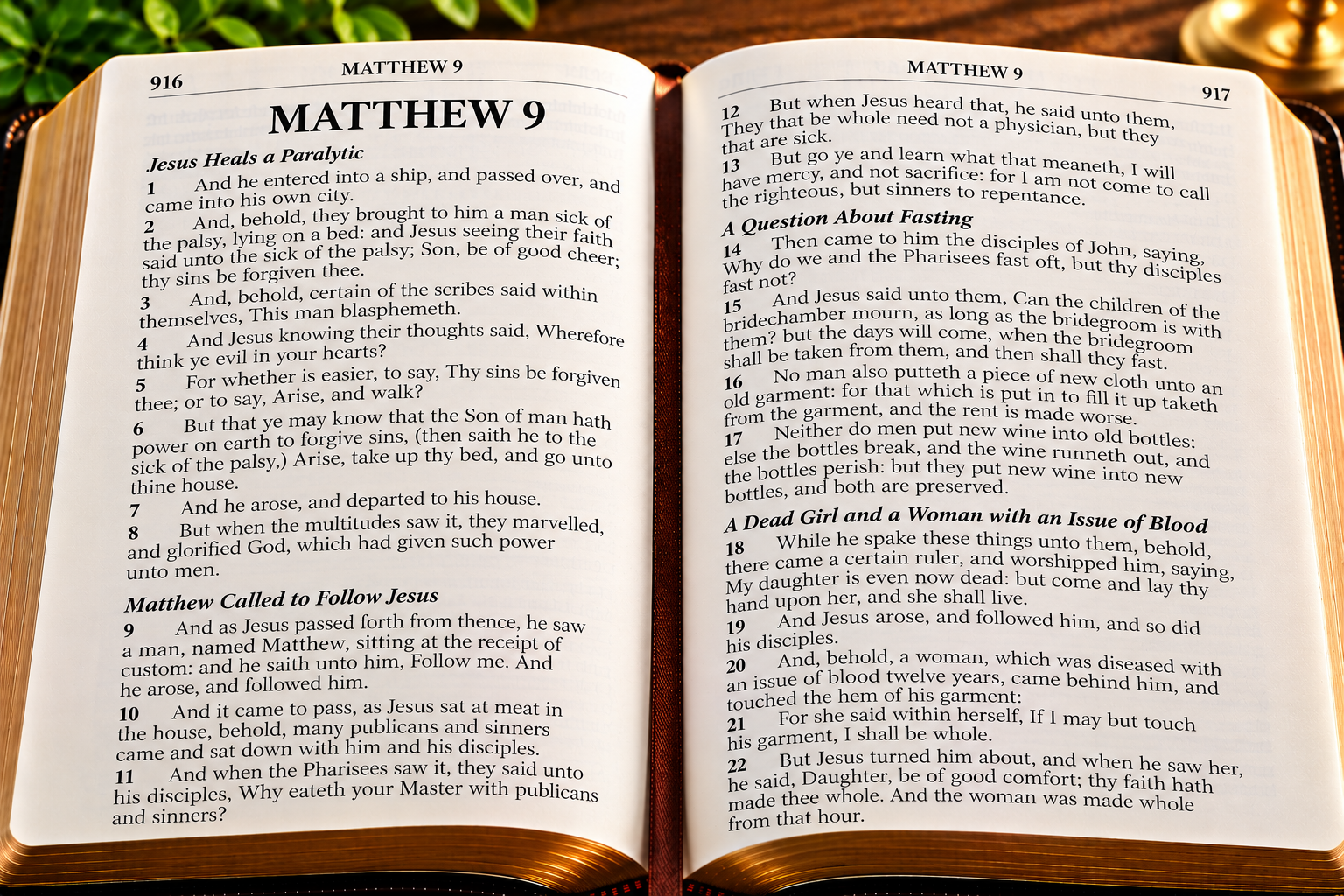
Matthew Chapter 9 reveals the authority, compassion, and divine mission of Jesus Christ. Through a series of miracles, teachings, and personal encounters, Jesus demonstrates His power over sin, sickness, death, and demonic oppression. He also challenges religious traditions and calls people to respond to God with faith, humility, and repentance.
In this chapter, Jesus forgives and heals a paralyzed man, calls Matthew the tax collector to become His disciple, teaches about fasting, raises a ruler’s daughter, heals a woman who had suffered from bleeding for twelve years, restores sight to two blind men, and delivers a man who could not speak because of demonic oppression.
The chapter concludes with Jesus traveling through cities and villages, teaching, preaching the gospel of the kingdom, and healing diseases. Seeing the crowds, He is moved with compassion because they are weary and scattered, like sheep without a shepherd. He tells His disciples that the harvest is plentiful but the laborers are few.
Matthew 9 teaches that Jesus came not merely to perform miracles but to bring people into a restored relationship with God and call them into a life of discipleship.
1. Jesus Heals a Paralyzed Man and Forgives His Sins (Matthew 9:1–8)
Jesus returns to His own city, where people bring Him a paralyzed man lying on a bed. Seeing their faith, Jesus first addresses the man’s spiritual condition.
Matthew 9:2 records Jesus saying:
“Son, be of good cheer; thy sins be forgiven thee.” — Matthew 9:2, KJV
Some scribes accuse Jesus of blasphemy because they understand that forgiveness of sins belongs to God. Jesus responds by asking which is easier: to say that the man’s sins are forgiven or to tell him to rise and walk.
To demonstrate that the Son of man has authority on earth to forgive sins, Jesus commands the paralyzed man to rise, take up his bed, and go home. The man obeys, and the crowd glorifies God.
Key lessons:
- Jesus has authority to forgive sins and restore people.
- Spiritual needs are important alongside physical needs.
- Faith may be demonstrated through bringing others to Jesus.
- Jesus’ miracles reveal His authority and lead people to glorify God.
2. Jesus Calls Matthew the Tax Collector (Matthew 9:9–13)
As Jesus passes by the tax office, He sees a man named Matthew and says, “Follow me.” Matthew rises and follows Him.
Later, Jesus eats with tax collectors and sinners. The Pharisees question His disciples about why their Teacher associates with such people. Jesus answers that those who are well do not need a physician, but those who are sick do.
He then declares:
“For I am not come to call the righteous, but sinners to repentance.” — Matthew 9:13, KJV
Jesus refers to Hosea 6:6, emphasizing that God desires mercy rather than empty religious observance.
Key lessons:
- Jesus calls people to leave their former ways and follow Him.
- No one should be considered beyond the reach of God’s mercy.
- True righteousness includes compassion for people who need spiritual restoration.
- Religious practices must reflect God’s character and purpose.
Matthew’s calling reminds believers that following Jesus involves a genuine response, not merely admiration from a distance.
3. Jesus Teaches About Fasting (Matthew 9:14–17)
The disciples of John the Baptist ask Jesus why His disciples do not fast as they and the Pharisees do.
Jesus compares His presence among His disciples to a bridegroom being with his friends. While the bridegroom is present, it is not the appropriate time for mourning. He explains that a time will come when the bridegroom will be taken away, and then His disciples will fast.
Jesus also uses two illustrations: new cloth on an old garment and new wine in old wineskins. These examples teach that His coming introduces the new reality of God’s kingdom, which cannot simply be contained within old patterns without understanding the change He brings.
Key lessons:
- Spiritual disciplines should be practiced with understanding and sincerity.
- Jesus’ presence brings joy and fulfillment to God’s purposes.
- Following Jesus requires a heart prepared to receive His teaching.
- Religious traditions should not become substitutes for a living relationship with God.
This passage does not teach that every older practice is automatically wrong. Instead, it emphasizes that Jesus’ ministry must be understood in light of His identity and the new era He inaugurates.
4. Jesus Raises a Ruler’s Daughter and Heals a Suffering Woman (Matthew 9:18–26)
A ruler approaches Jesus and explains that his daughter has died. He believes that if Jesus comes and lays His hand upon her, she will live.
As Jesus travels with him, a woman who has suffered from an issue of blood for twelve years approaches from behind and touches the hem of His garment. She believes that touching His garment will make her well.
Jesus turns to her and says:
“Daughter, be of good comfort; thy faith hath made thee whole.” — Matthew 9:22, KJV
The woman is healed from that moment.
When Jesus reaches the ruler’s house, He finds mourners gathered there. He tells them that the girl is not dead but sleeps, and they laugh at Him. Jesus enters, takes the girl by the hand, and she rises.
News of this miracle spreads throughout the region.
Key lessons:
- Jesus responds compassionately to suffering and desperation.
- Faith brings people to Jesus, even when circumstances appear hopeless.
- Jesus has authority over sickness and death.
- God’s power is not limited by the length or severity of a person’s suffering.
Matthew places these two accounts together, showing Jesus responding to both a public emergency and the private suffering of a woman. The woman’s twelve years of suffering and the girl’s youth highlight the breadth of Jesus’ compassion.
5. Jesus Heals Two Blind Men (Matthew 9:27–31)
As Jesus continues His journey, two blind men follow Him, crying out:
“Thou son of David, have mercy on us.” — Matthew 9:27, KJV
Their words identify Jesus as the Son of David, a title associated with the promised royal Messiah.
Jesus asks whether they believe He is able to do this. They answer, “Yea, Lord.” He touches their eyes and declares that it will be done according to their faith. Their eyes are opened.
Jesus instructs them not to publicize the event, but they spread the news throughout the region.
Key lessons:
- Jesus is the promised Messiah and the source of mercy.
- Faith recognizes Jesus’ ability and turns to Him for help.
- Jesus responds to those who seek Him earnestly.
- The miracle reveals His compassion and messianic authority.
The account emphasizes faith in Jesus, but it should not be used to conclude that every person who remains ill or disabled lacks faith.
6. Jesus Heals a Mute Man (Matthew 9:32–34)
After the two men leave, people bring Jesus a man who cannot speak because of demonic oppression. Jesus casts out the demon, and the man begins to speak.
The crowds are amazed and declare that nothing like this has ever been seen in Israel. The Pharisees, however, accuse Jesus of casting out demons by the ruler of the demons.
This contrast reveals two different responses to Jesus: amazement and recognition among the crowds, and opposition among religious leaders.
Key lessons:
- Jesus demonstrates authority over demonic oppression.
- People respond differently to the evidence of Jesus’ works.
- Spiritual opposition can lead people to reject what they do not wish to accept.
- Believers should evaluate spiritual claims carefully and remain grounded in Scripture.
7. Jesus Has Compassion on the Crowds (Matthew 9:35–38)
The chapter concludes by summarizing Jesus’ ministry. He travels through cities and villages, teaching in synagogues, preaching the gospel of the kingdom, and healing sickness and disease.
When Jesus sees the crowds, He is moved with compassion because they are weary and scattered, “as sheep having no shepherd.”
He tells His disciples:
“The harvest truly is plenteous, but the labourers are few.” — Matthew 9:37, KJV
Jesus then instructs them to pray to the Lord of the harvest to send laborers into His harvest.
Key lessons:
- Jesus sees people with compassion rather than contempt.
- Teaching, preaching, and caring for people are connected parts of ministry.
- Many people need spiritual guidance and the message of God’s kingdom.
- Prayer is essential to the work of reaching and serving others.
- Believers are called to participate in God’s work, not merely observe it.
This passage prepares the reader for Matthew Chapter 10, where Jesus sends His twelve disciples out to minister.
Major Themes in Matthew Chapter 9
- Jesus’ authority to forgive sins: Forgiveness is central to His mission.
- Faith in Jesus Christ: People approach Jesus with trust in His power and mercy.
- Compassion for the suffering: Jesus responds to physical, spiritual, and emotional needs.
- The call to discipleship: Matthew’s response demonstrates the importance of following Jesus.
- Mercy over empty religion: God desires sincere hearts that reflect His compassion.
- The kingdom of God: Jesus’ teaching and miracles reveal the presence and authority of God’s kingdom.
- Jesus’ victory over death and oppression: His miracles demonstrate power beyond ordinary human limitations.
- The need for spiritual workers: The harvest image emphasizes the importance of prayer and mission.
Biblical Interpretation Note: Understanding Matthew Chapter 9
1. Forgiveness and Healing Are Distinct but Connected
In Matthew 9:1–8, Jesus forgives the paralyzed man’s sins before healing him. The physical healing serves as visible evidence of Jesus’ authority to forgive sins.
The passage does not mean that every illness is caused by a particular personal sin. Scripture recognizes suffering in different circumstances, and this account should not be used to blame sick or disabled people for their condition.
Interpretive principle: The miracle confirms Jesus’ authority, while the declaration of forgiveness reveals the deeper spiritual significance of His mission.
2. Jesus Calls Sinners to Repentance
When Jesus calls Matthew and eats with tax collectors and sinners, He demonstrates God’s willingness to reach people who are spiritually lost. His statement about calling sinners to repentance does not mean that sin is unimportant. Rather, it explains why sinners need His saving work.
Jesus’ association with sinners is an expression of mercy and a call to transformation, not an endorsement of wrongdoing.
Interpretive principle: God’s mercy invites people to turn from sin and follow Jesus in a changed life.
3. The Bridegroom and the New Wine
Jesus’ reference to the bridegroom points to the significance of His presence among His disciples. His illustrations of the new cloth and new wine emphasize that His ministry cannot be understood merely as another version of existing religious routines.
The passage should be read in its immediate context: Jesus is explaining why His disciples’ practices differ from those of other religious groups. It is not a blanket condemnation of Jewish Scripture or every inherited religious practice.
Interpretive principle: Religious practices should be understood in light of Jesus’ identity, teaching, and kingdom mission.
4. Faith and the Miracles of Jesus
The accounts of the suffering woman, the ruler’s daughter, and the blind men demonstrate trust in Jesus. Their faith moves them to seek His help, but the chapter does not establish a formula guaranteeing that every request will result in immediate physical healing.
Biblical faith involves trusting God, seeking Him sincerely, and remaining faithful even when the outcome differs from what a person desires.
Interpretive principle: Faith directs people toward Jesus; it should not be used to accuse those who continue to suffer.
5. Jesus’ Authority Over Death and Demonic Oppression
The raising of the ruler’s daughter and the deliverance of the mute man show that Jesus’ authority extends beyond ordinary human ability. Matthew presents these events as signs of His messianic identity and the power of God’s kingdom.
The text describes the mute man’s condition as associated with demonic oppression. It should not be used to assume that every speech difficulty, disability, or medical condition has a demonic cause.
Interpretive principle: Read each miracle according to the specific circumstances Matthew describes rather than applying it indiscriminately to every modern condition.
6. The Harvest and the Mission of God’s People
Matthew 9:35–38 connects Jesus’ compassion with the need for workers. The harvest represents the people who need the message and ministry of God’s kingdom. Jesus tells His disciples to pray for laborers, showing that mission begins with dependence on God.
Prayer and action belong together. Those who pray for workers should also be willing to serve as God provides opportunities and equips them.
Interpretive principle: Christian ministry should be motivated by compassion, grounded in prayer, and directed toward teaching, proclaiming the gospel, and serving people.
Central Message of Matthew Chapter 9
Matthew Chapter 9 presents Jesus as the Messiah who forgives sins, calls sinners to repentance, heals the sick, raises the dead, and delivers those under demonic oppression. His actions reveal both His authority and His compassion.
The chapter also challenges believers to examine their hearts, respond to Jesus in faith, extend mercy to others, and participate in the work of God’s kingdom.
Key Questions for Bible Study: Matthew Chapter 9
A. Observation Questions
- What did Jesus say to the paralyzed man before healing him?
- How did the scribes react when Jesus forgave the man’s sins?
- What did Jesus command the paralyzed man to do?
- Whom did Jesus call while passing by the tax office?
- Who questioned Jesus about eating with tax collectors and sinners?
- What illustration did Jesus use to explain His association with sinners?
- What did Jesus teach about fasting and the bridegroom?
- What two illustrations did Jesus use to explain the new and the old?
- How long had the woman suffered from her issue of blood?
- What did the ruler believe Jesus could do for his daughter?
- How did the two blind men address Jesus?
- What did Jesus observe about the crowds at the end of the chapter?
B. Interpretation Questions
- Why did Jesus forgive the paralyzed man’s sins before healing him?
- What does the healing of the paralyzed man reveal about Jesus’ authority?
- Why did Jesus compare Himself to a physician?
- What does Matthew’s response to Jesus’ call teach about discipleship?
- What does Jesus’ reference to Hosea 6:6 teach about mercy and religious observance?
- What is the significance of the bridegroom illustration?
- What do the new cloth and new wine illustrations teach about Jesus’ ministry?
- How do the ruler’s request and the woman’s actions demonstrate faith?
- What does the raising of the ruler’s daughter reveal about Jesus?
- Why is it important not to assume that every illness results from personal sin or lack of faith?
- What does the title “Son of David” reveal about the two blind men’s understanding of Jesus?
- Why did the crowds and Pharisees respond differently to Jesus’ miracles?
C. Application Questions
- What can you learn from the friends who brought the paralyzed man to Jesus?
- Is there an area of your life in which you need to seek Jesus’ forgiveness and guidance?
- What might following Jesus require you to leave behind, as Matthew did?
- How can you demonstrate mercy toward people who are judged or rejected by society?
- Are your spiritual practices sincere expressions of faith, or have any become empty routines?
- How can you maintain faith when healing or deliverance does not happen as quickly as you hope?
- What can you learn from the woman’s determination to approach Jesus?
- How should Christians respond when people suffer from illness or disability?
- How can you show compassion to people who feel spiritually lost or neglected?
- What practical steps can you take to serve people in your church or community?
D. Reflection and Personal Growth Questions
- Which account in Matthew 9 speaks most strongly to your current circumstances, and why?
- What does this chapter teach you about the character of Jesus?
- How can you distinguish genuine faith from treating God as a means of obtaining desired outcomes?
- What traditions or assumptions might prevent you from recognizing God’s work?
- Who in your life needs encouragement, prayer, or practical support?
- What is one concrete way you can participate in God’s harvest this week?
Memory Verse
“The harvest truly is plenteous, but the labourers are few.” — Matthew 9:37, KJV
Reflection: Jesus sees the spiritual needs of people and calls His followers to respond with compassion. Pray for God to raise up faithful workers, and consider how you can serve others through prayer, teaching, encouragement, and practical care.
Conclusion: Living Out the Message of Matthew Chapter 9
Matthew Chapter 9 reveals that Jesus Christ has authority to forgive sins, heal the sick, raise the dead, and deliver people from demonic oppression. His ministry demonstrates God’s compassion toward people who are suffering, overlooked, or in need of spiritual restoration.
The chapter also teaches that following Jesus requires more than religious observance. It calls for faith, repentance, mercy, and a willingness to serve. Jesus does not merely see crowds; He sees people who need guidance, hope, and the message of God’s kingdom.
As you study Matthew 9, consider how you can respond to Jesus with greater faith, show mercy to others, and become a willing laborer in God’s harvest.