

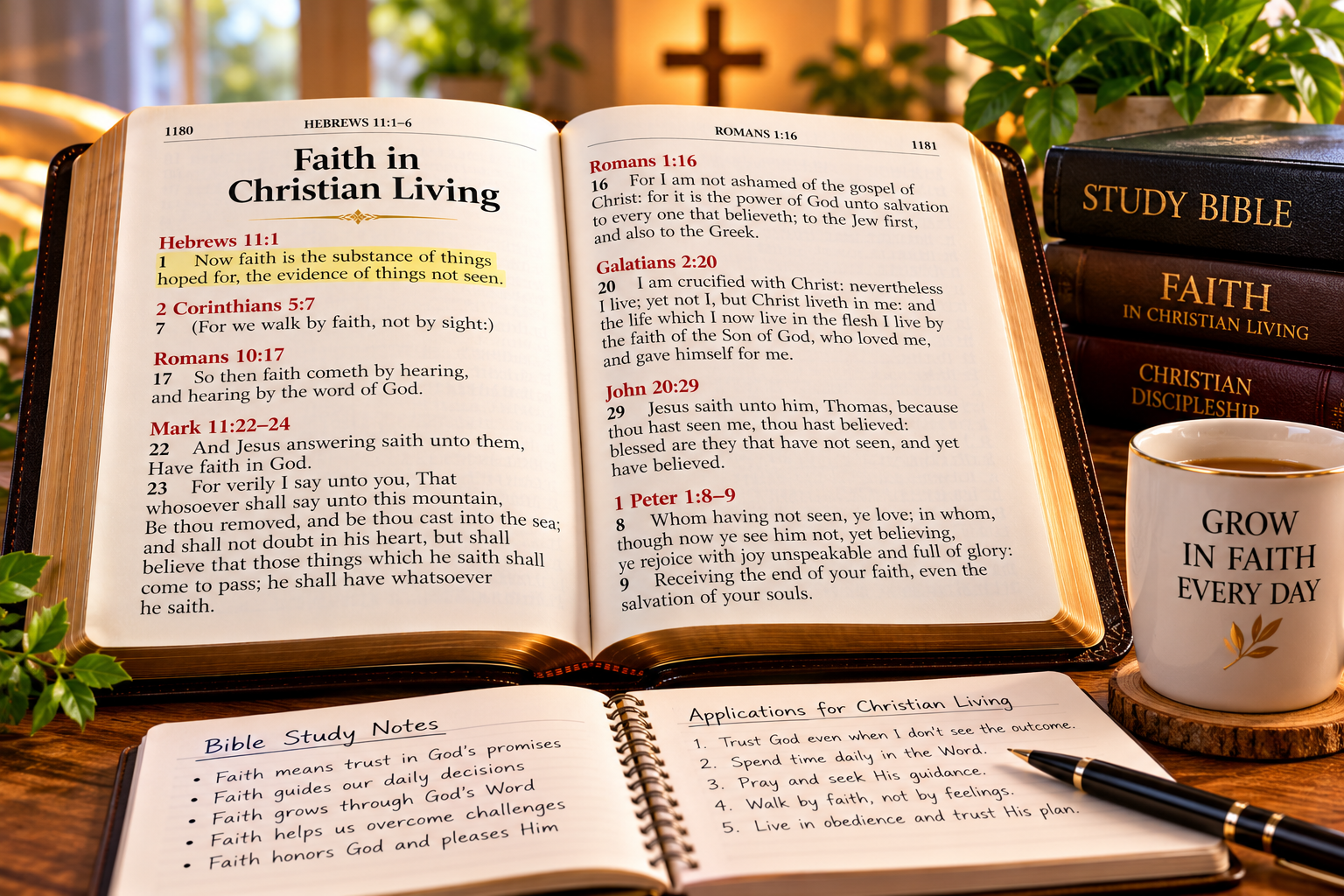
Faith is one of the most important foundations of Christian living. It shapes how believers understand God, respond to life’s challenges, make decisions, develop relationships, and follow the teachings of Jesus Christ. Through faith, Christians trust God’s character, believe His Word, depend on His grace, and seek to live according to His purposes.
The Bible teaches that faith is essential to a relationship with God. Hebrews 11:6 explains that without faith it is impossible to please Him, because those who come to God must believe that He exists and rewards those who earnestly seek Him.
Christian faith is more than agreeing with religious teachings or believing that God exists. It involves trusting God, relying on His promises, and responding to His Word through obedience. Genuine faith influences how believers live, especially when circumstances are uncertain or difficult.
However, faith does not mean that Christians will never experience suffering, fear, disappointment, sickness, or unanswered questions. Throughout the Bible, faithful people experienced significant trials. Their stories demonstrate that faith is not the absence of difficulty but a commitment to trust God through every season of life.
Abraham trusted God’s promise, Moses followed God’s direction, David sought God during danger, and the disciples learned to depend on Jesus. Their examples show how faith can shape a believer’s character, choices, and relationship with God.
In this article, we will explore the biblical meaning of faith, why faith is important in Christian living, the benefits of trusting God, examples of faith in the Bible, and practical ways to strengthen your faith daily.
1. What Is Faith in Christian Living?
Faith is trust and confidence in God, His character, and His revealed Word. In Christian living, faith involves believing God’s truth, relying on His grace, and seeking to follow His will.
Hebrews 11:1 provides one of the Bible’s most well-known descriptions of faith:
Hebrews 11:1 (KJV)
“Now faith is the substance of things hoped for, the evidence of things not seen.”
This verse describes faith as confidence in what is hoped for and assurance concerning what is not seen.
Christian faith does not require believers to ignore evidence, reject wisdom, or pretend that difficulties do not exist. Rather, it encourages them to trust God’s character even when they cannot fully understand their circumstances or see how a situation will develop.
The Main Elements of Biblical Faith
1. Believing in God: Faith begins with acknowledging God and trusting that He exists.
2. Trusting God’s character: Believers depend on God’s faithfulness, wisdom, holiness, love, and goodness.
3. Believing God’s Word: Christians look to Scripture to understand God’s promises, commands, and purposes.
4. Depending on God’s grace: Faith recognizes that salvation is God’s gift rather than something earned through human effort.
5. Responding through obedience: Genuine faith influences a person’s decisions, attitudes, and actions.
6. Remaining faithful during difficulties: Faith encourages perseverance when circumstances are painful or uncertain.
Faith is therefore not merely a feeling. It is a relationship of trust that shapes how a Christian lives.
2. What Does the Bible Say About the Importance of Faith?
The Bible consistently emphasizes the importance of faith in a believer’s relationship with God.
Faith Is Essential to Pleasing God
Hebrews 11:6 teaches that without faith it is impossible to please God.
This passage emphasizes that approaching God requires trust in Him. Believers seek Him because they believe He exists and that seeking Him matters.
Faith is not simply an occasional response to a crisis. It is an essential part of a life devoted to God.
We Are Saved by Grace Through Faith
Ephesians 2:8–9 teaches that salvation is by grace through faith, not the result of works that allow a person to boast.
This passage establishes that salvation is God’s gift. Christians do not earn forgiveness and reconciliation with God through good deeds, religious activities, or personal achievements.
Instead, they depend on God’s grace through faith in Jesus Christ.
Good works remain important in Christian living, but they are the fruit of God’s saving work rather than the price paid to obtain salvation.
The Righteous Shall Live by Faith
Romans 1:17 declares that the righteous shall live by faith.
This teaching demonstrates that faith is not limited to the beginning of the Christian journey. It continues to shape a believer’s life, encouraging dependence on God and commitment to His truth.
Living by faith means trusting God in ordinary responsibilities, difficult decisions, relationships, and seasons of uncertainty.
Faith Comes Through Hearing God’s Word
Romans 10:17 explains that faith comes through hearing, and hearing through the Word of God.
This verse highlights the importance of engaging with Scripture.
Reading and studying the Bible helps Christians understand God’s character, recognize His promises, and distinguish biblical truth from assumptions or misleading teachings.
Faith grows as believers learn God’s Word and respond to it with trust and obedience.
3. Why Is Faith Important in Christian Living?
Faith influences every major aspect of the Christian life. It affects how believers approach God, handle challenges, make decisions, and relate to other people.
The following are twelve important reasons faith matters in Christian living.
1. Faith Strengthens Your Relationship With God
Faith is foundational to a personal relationship with God.
Christians trust God because of who He is and what He has revealed through Scripture and Jesus Christ. This trust encourages them to approach Him in prayer, worship Him, seek His wisdom, and depend on His grace.
Without trust, a relationship becomes difficult to develop. Faith allows believers to approach God with confidence while recognizing His holiness and authority.
Bible Verse: Hebrews 11:6
This verse teaches that those who come to God must believe that He exists and that He rewards those who earnestly seek Him.
Faith encourages Christians to seek God sincerely rather than treating religion as a collection of outward activities.
2. Faith Is Essential to Salvation
One of the most important reasons faith matters is its relationship to salvation.
Christianity teaches that human beings are reconciled to God through His grace, received through faith in Jesus Christ.
Bible Verse: Ephesians 2:8–9
Paul explains that salvation is by grace through faith and not by works.
This means that believers do not earn salvation through charitable activities, church attendance, financial giving, or religious ceremonies.
Instead, they depend on what God has accomplished through Jesus Christ.
Genuine faith also produces a changed life. Ephesians 2:10 immediately explains that believers are created in Christ Jesus for good works.
Good works do not purchase salvation; they are an appropriate response to God’s grace.
3. Faith Helps You Trust God During Difficult Times
Every person experiences difficulties at some point. Christians may face financial hardship, family problems, illness, bereavement, disappointment, or uncertainty about the future.
Faith helps believers remember God’s character when circumstances are difficult.
Bible Verse: Proverbs 3:5–6
“Trust in the LORD with all thine heart; and lean not unto thine own understanding.”
This passage encourages believers to depend on God rather than treating their own understanding as sufficient.
Trusting God does not mean denying reality or refusing practical help. It means facing challenges while seeking God’s wisdom, receiving appropriate support, and remaining committed to biblical truth.
Faith can help Christians persevere even when they do not understand why a difficult situation has occurred.
4. Faith Gives Hope for the Future
Hope is important in Christian living because believers often face uncertainty.
Faith encourages Christians to trust God’s promises and look beyond immediate circumstances. It reminds them that their lives are not defined solely by present struggles.
Bible Verse: Romans 15:13
Paul prays that the God of hope will fill believers with joy and peace in believing so that they may abound in hope through the power of the Holy Spirit.
This verse connects faith with hope, joy, and peace.
Christian hope is not simply positive thinking. It rests on confidence in God and the promises revealed in Scripture.
Even when circumstances do not change quickly, faith can help believers continue living with purpose and hope.
5. Faith Helps You Overcome Fear
Fear can affect decisions, relationships, and spiritual growth. People may fear failure, rejection, financial insecurity, illness, or the unknown.
Faith reminds Christians that they can seek God’s presence and strength while acknowledging their fears.
Bible Verse: Isaiah 41:10
“Fear thou not; for I am with thee: be not dismayed; for I am thy God.”
This passage was originally addressed to God’s people in a particular historical context. It reveals God’s assurance of His presence and help to His people.
Christians can draw encouragement from God’s faithfulness while recognizing that fear is a human experience and does not automatically mean that someone lacks faith.
Faith can help believers respond to fear with prayer, wise action, and confidence in God.
6. Faith Encourages Obedience to God’s Word
Genuine faith influences how a person lives.
Believing God’s Word should affect choices, attitudes, priorities, and relationships. Faith encourages Christians to obey God’s commands even when obedience requires sacrifice or patience.
Bible Verse: James 2:17
James teaches that faith without works is dead.
His point is that a claim to faith that produces no meaningful response is incomplete. Genuine faith should be reflected in a person’s life.
Obedience does not mean that Christians become perfect or never struggle. It means that they seek to follow Christ, repent when they sin, and continue growing in spiritual maturity.
7. Faith Strengthens Your Prayer Life
Faith and prayer are closely connected in Scripture.
Prayer allows believers to bring their concerns to God, seek wisdom, express gratitude, and depend on His help.
Bible Verse: Mark 11:24
Jesus teaches His followers to pray with faith.
This passage encourages trust in God, but it should not be interpreted as a guarantee that every request will be fulfilled exactly as desired.
Biblical faith includes confidence in God’s wisdom and a willingness to submit to His will.
Through faith-filled prayer, Christians learn to depend on God rather than treating prayer as a means of controlling Him.
8. Faith Helps You Make Wise Decisions
Christians face decisions involving education, work, family, relationships, finances, and ministry.
Faith encourages them to seek God’s wisdom and evaluate their choices according to Scripture.
Bible Verse: James 1:5
James teaches that those who lack wisdom should ask God, who gives generously.
Faith does not mean making decisions without careful thought. It encourages believers to pray, study Scripture, consider relevant facts, seek wise counsel, and act responsibly.
Trusting God includes acknowledging that human understanding is limited while using the wisdom and resources available.
9. Faith Encourages Patience and Perseverance
Some circumstances take time to change. Believers may wait for opportunities, healing, reconciliation, or clarity about their future.
Faith helps Christians remain committed to God during periods of waiting.
Bible Verse: Hebrews 10:36
The writer explains that believers need patience so that, after doing God’s will, they may receive what has been promised.
The passage encourages perseverance rather than giving up when obedience becomes difficult.
Faith does not guarantee that every personal desire will eventually be fulfilled in the way expected. It encourages Christians to remain faithful and trust God even when the outcome is uncertain.
10. Faith Helps You Resist Temptation
Temptation can challenge Christians in areas such as dishonesty, anger, pride, jealousy, and harmful habits.
Faith encourages believers to depend on God, remember Scripture, and choose actions that reflect their commitment to Christ.
Bible Verse: 1 Corinthians 10:13
Paul teaches that God is faithful and provides a way to endure temptation.
This passage encourages believers not to assume that they are powerless against temptation.
Faith should be accompanied by practical steps, such as avoiding situations that encourage sin, seeking accountability, and developing habits consistent with biblical teaching.
11. Faith Encourages Love, Forgiveness, and Compassion
Faith should influence how Christians treat other people.
Believers are called to show love, practice forgiveness, help those in need, and treat others with dignity.
Bible Verse: Galatians 5:6
Paul speaks of faith working through love.
This verse demonstrates that Christian faith should not remain an abstract belief. It should be expressed through loving conduct.
Faith encourages Christians to forgive others while maintaining appropriate boundaries where necessary, serve those experiencing hardship, and seek reconciliation when possible.
12. Faith Helps You Grow Spiritually
Christian maturity involves learning to trust God, understanding Scripture, practicing obedience, and reflecting the character of Jesus Christ.
Faith encourages believers to continue growing even when they recognize weaknesses in their lives.
Bible Verse: Colossians 2:6–7
Paul encourages Christians to walk in Christ, rooted and built up in Him and established in the faith.
This passage emphasizes that faith should be an ongoing part of Christian life.
Through prayer, Bible study, worship, fellowship, service, and obedience, believers can develop greater spiritual maturity.
4. Examples of Faith in the Bible
The Bible contains many examples of people whose faith influenced their decisions and responses to difficult circumstances.
Abraham: Faith in God’s Promise
Scripture: Genesis 12:1–4; Genesis 15:1–6; Romans 4:18–22
Abraham responded to God’s call to leave his homeland and journey toward a land God would show him.
God also promised Abraham descendants, even though Abraham and Sarah faced circumstances that made the promise appear impossible.
Abraham’s story illustrates the importance of trusting God’s promise even when its fulfillment is not immediately visible.
His journey was not without uncertainty or mistakes, but his faith became a central example in biblical teaching about trusting God.
Lesson: Faith means trusting God’s promises while continuing to follow His direction.
Noah: Faith That Led to Action
Scripture: Genesis 6:9–22; Hebrews 11:7
Noah obeyed God’s instructions to build an ark in preparation for the coming flood.
Hebrews 11:7 identifies Noah’s response as an act of faith.
His example demonstrates that faith can involve acting on God’s instructions even when others do not understand.
Lesson: Genuine faith influences decisions and produces obedient action.
Moses: Faith in God’s Deliverance
Scripture: Exodus 3:1–12; Hebrews 11:24–29
Moses initially expressed concerns about his ability to lead the Israelites out of Egypt.
God called him to confront Pharaoh and lead His people toward freedom.
Moses’ story demonstrates that faith does not require a person to feel naturally confident in every situation. Instead, believers can depend on God’s help while carrying out difficult responsibilities.
Lesson: Faith encourages obedience even when a task feels overwhelming.
Joshua: Faith to Enter the Promised Land
Scripture: Joshua 1:1–9; Joshua 6:1–20
Joshua was called to lead Israel after Moses’ death.
God encouraged him to be strong and courageous and to remain attentive to the Book of the Law.
Joshua’s leadership illustrates the connection between faith, courage, obedience, and God’s instructions.
Lesson: Faith encourages believers to move forward responsibly while relying on God’s guidance.
David: Faith in the Face of Opposition
Scripture: 1 Samuel 17:32–50
David confronted Goliath when the Israelite army was afraid.
David expressed confidence in the Lord’s ability to deliver him, drawing on his previous experiences of God’s help.
His example illustrates that faith can provide courage when facing intimidating circumstances.
Lesson: Faith directs confidence toward God rather than relying exclusively on outward strength or personal ability.
Daniel: Faithfulness Under Pressure
Scripture: Daniel 6:1–23
Daniel continued his regular practice of prayer even when doing so violated a royal decree.
He remained faithful to God despite the risk of punishment.
Daniel’s story demonstrates that faith can involve maintaining spiritual convictions when they conflict with external pressure.
Lesson: Faithfulness requires commitment to God even when doing what is right is costly.
The Woman Who Touched Jesus’ Garment
Scripture: Mark 5:25–34
A woman who had suffered from bleeding for twelve years approached Jesus in the hope of being healed.
Jesus acknowledged her faith and told her that her faith had made her well.
The account emphasizes her trust in Jesus and His response to her.
Lesson: Faith encourages people to seek Christ with hope, even after prolonged suffering.
This passage should not be used to suggest that every illness persists because a person lacks faith.
The Centurion: Faith in Jesus’ Authority
Scripture: Matthew 8:5–13
A Roman centurion asked Jesus to heal his servant. He believed Jesus could heal the servant without physically visiting the home.
Jesus commended the centurion’s faith.
Lesson: Faith recognizes Jesus’ authority and approaches Him with trust and humility.
5. What Is the Difference Between Faith and Belief?
Faith and belief are closely related, and the Bible often uses these concepts together. However, Christian faith involves more than simply agreeing that a statement is true.
| Belief | Biblical Faith |
|---|---|
| May involve accepting that a statement is true. | Involves trust and reliance on God. |
| Can remain intellectual or theoretical. | Influences choices, attitudes, and actions. |
| May not lead to a personal response. | Encourages obedience and commitment. |
| Can exist without changing behavior. | Should produce spiritual growth and loving action. |
James 2:19 observes that even demons believe that God is one and tremble. James uses this example to show that mere acknowledgment of a fact is not the same as faithful commitment to God.
Biblical faith involves trusting God and responding to Him.
For example, believing that God commands forgiveness is different from actively seeking to forgive someone who has caused harm. Faith encourages Christians to put biblical teaching into practice, while recognizing that growth and healing can take time.
6. How Can You Strengthen Your Faith in God?
Faith can grow as Christians learn Scripture, seek God in prayer, participate in Christian fellowship, and apply biblical truth to everyday life.
The following practices can help strengthen your faith.
Step 1: Read the Bible Regularly
The Bible reveals God’s character, promises, commands, and plan of salvation through Jesus Christ.
Reading Scripture helps believers understand what they are called to trust.
Supporting Scripture: Romans 10:17.
Begin with a manageable reading plan. You might read one chapter of the Gospel of John each day or study a short passage from the Psalms.
Reflect on what the passage teaches about God and how it should influence your life.
Step 2: Develop a Consistent Prayer Life
Prayer provides an opportunity to express dependence on God, ask for wisdom, confess sin, and pray for others.
A consistent prayer routine can help believers remain attentive to their relationship with God.
Supporting Scripture: Philippians 4:6–7.
Set aside a regular time for prayer and include thanksgiving, confession, personal requests, and intercession.
Step 3: Remember God’s Faithfulness
Reflecting on how God has sustained you through previous seasons can encourage trust during present difficulties.
You can record meaningful Scripture passages, prayers, and reflections in a journal.
Remember that interpreting past experiences requires humility. Not every event will have an obvious explanation, but reflecting on God’s character and the support you have received can encourage gratitude.
Supporting Scripture: Psalm 77:11–12.
Step 4: Obey God’s Word
Faith becomes visible through daily choices.
Practice honesty, patience, generosity, forgiveness, humility, and love. When you make mistakes, acknowledge them and seek to change.
Supporting Scripture: James 2:17.
Obedience does not earn God’s grace. It is a response to the grace believers have received.
Step 5: Spend Time With Other Believers
Christian fellowship provides encouragement, teaching, prayer, and mutual support.
Other believers may help you understand Scripture, persevere through difficult circumstances, and recognize areas where you need growth.
Supporting Scripture: Hebrews 10:24–25.
Participate in a local church, Bible study, or prayer group where Scripture is taught responsibly and members encourage one another.
Step 6: Learn From Biblical Examples of Faith
Study the lives of Abraham, Moses, Ruth, David, Daniel, Mary, and the apostles.
Consider how they trusted God, responded to challenges, and learned through mistakes.
Remember that biblical figures were human beings with weaknesses. Their stories should be understood within their full contexts rather than treated as simple formulas for obtaining desired results.
Supporting Scripture: Hebrews 11.
Step 7: Practice Gratitude
Thankfulness helps Christians remember God’s goodness and recognize blessings that may otherwise be overlooked.
Gratitude does not require denying hardship. It allows believers to acknowledge difficulties while also recognizing sources of encouragement and provision.
Supporting Scripture: 1 Thessalonians 5:16–18.
Step 8: Continue Trusting God During Difficult Seasons
Faith may be especially challenging when prayers seem unanswered or circumstances remain uncertain.
Continue reading Scripture, praying, seeking wise counsel, and taking appropriate practical steps.
Remember that biblical faith does not mean that a person must always feel confident or free from fear.
Supporting Scripture: Psalm 46:1–3.
Step 9: Ask God for Help When Your Faith Feels Weak
Christians may experience doubt, confusion, and spiritual discouragement.
In Mark 9:24, a father seeking help for his son cried out, “Lord, I believe; help thou mine unbelief.”
His words show that a person can bring struggles with faith honestly before Jesus.
When you experience doubt, seek answers through Scripture, thoughtful study, prayer, and trustworthy Christian guidance.
Step 10: Put Your Faith Into Practice Through Love
Faith should influence how believers serve others and respond to human needs.
Help people who are struggling, show kindness, support your church community, and practice compassion in everyday relationships.
Supporting Scripture: Galatians 5:6.
Faith becomes evident through a life that increasingly reflects the love and character of Christ.
7. What Does It Mean to Live by Faith?
Living by faith means allowing trust in God and His Word to shape everyday decisions and behavior.
It does not mean abandoning planning, refusing medical treatment, ignoring evidence, or expecting God to solve every problem without personal effort.
Instead, living by faith involves depending on God while accepting personal responsibilities.
Living by Faith in Your Personal Life
Trust God with your future, relationships, spiritual growth, and personal challenges.
Seek His wisdom and evaluate your choices in light of Scripture.
Living by Faith in Your Family
Practice patience, honesty, forgiveness, and compassion in family relationships.
Pray for family members and seek to resolve conflicts in healthy and responsible ways.
Living by Faith at Work
Conduct yourself with integrity. Fulfill your responsibilities, treat colleagues fairly, and avoid dishonest practices.
Faith should influence how you work and how you treat others.
Living by Faith During Financial Challenges
Pray for wisdom, create a responsible budget, seek employment opportunities when needed, and ask for appropriate assistance.
Faith does not guarantee wealth. It encourages stewardship, generosity, contentment, and trust in God during financial uncertainty.
Living by Faith During Illness
Pray for healing and comfort while seeking appropriate medical care.
The Bible includes accounts of healing, but it does not teach that every faithful believer will experience immediate physical healing.
Faith can support hope and perseverance even when illness continues.
Living by Faith When Making Difficult Decisions
Seek God’s wisdom through Scripture and prayer. Consider the facts, consequences, and responsibilities involved.
Consult trustworthy people when appropriate, and remain willing to reconsider a decision if new information becomes available.
Living by faith involves seeking to honor God rather than assuming that every personal preference is His specific direction.
8. Does Having Faith Mean You Will Never Experience Problems?
No. The Bible does not promise that Christians will be free from every difficulty.
Jesus warned His followers that they would experience trouble in the world (John 16:33). The apostles also endured persecution, imprisonment, rejection, and physical suffering.
Faith does not remove every hardship. Instead, it encourages believers to trust God while facing difficulties honestly.
Consider the following biblical examples:
- Job experienced severe suffering and wrestled with difficult questions.
- David faced danger, grief, and periods of distress.
- Paul endured imprisonment, persecution, and physical hardship.
- Jesus experienced rejection, suffering, and death.
These accounts demonstrate that hardship is not automatic evidence of weak faith.
Christians should avoid judging the faith of others based on whether they are sick, poor, grieving, or experiencing difficulties.
Instead, believers can offer prayer, practical help, compassion, and encouragement.
Faith provides a foundation for perseverance, but it does not require a person to deny pain or refuse support.
9. Bible Verses About the Importance of Faith
The following Scriptures can encourage believers to trust God and grow in Christian maturity.
- Hebrews 11:1 — Describes faith as the substance of things hoped for and the evidence of things not seen.
- Hebrews 11:6 — Explains the importance of faith in approaching God.
- Romans 1:17 — Teaches that the righteous shall live by faith.
- Romans 10:17 — Explains the relationship between hearing God’s Word and faith.
- Ephesians 2:8–9 — Teaches that salvation is by grace through faith.
- 2 Corinthians 5:7 — Encourages believers to walk by faith rather than sight.
- Proverbs 3:5–6 — Encourages trust in the Lord and acknowledgment of Him in every way.
- Mark 9:24 — Records a father’s prayer asking Jesus for help with his unbelief.
- Mark 11:22–24 — Jesus teaches His followers about faith and prayer.
- James 1:3–4 — Explains how the testing of faith produces perseverance.
- James 2:17 — Teaches that faith without works is dead.
- 1 Corinthians 16:13 — Encourages believers to stand firm in the faith.
- Galatians 2:20 — Describes the Christian life as one lived by faith in the Son of God.
- Galatians 5:6 — Speaks of faith working through love.
- Philippians 4:13 — Expresses strength through Christ in the context of Paul’s circumstances.
- Romans 15:13 — Connects faith with hope, joy, and peace.
- Psalm 37:5 — Encourages believers to commit their way to the Lord and trust Him.
- Isaiah 41:10 — Offers assurance of God’s help and presence to His people.
- 1 Peter 1:6–7 — Discusses tested faith and its preciousness.
- 1 John 5:4 — Connects faith with overcoming the world.
Read these verses in context and reflect on how they apply to your relationship with God and your daily Christian walk.
10. Common Challenges to Faith and How to Overcome Them
Even sincere Christians can experience seasons of doubt, discouragement, and spiritual struggle.
Doubt and Uncertainty
You may have questions about Scripture, God’s purposes, or difficult experiences.
How to respond: Bring your questions honestly before God. Study the relevant passages, seek thoughtful answers, and speak with trustworthy Christian leaders who welcome sincere questions.
Unanswered Prayer
It can be painful when a request does not receive the answer you hoped for.
How to respond: Continue praying while recognizing that the Bible does not promise every request will be granted according to personal expectations. Seek wisdom, practical support, and encouragement.
Fear of the Future
Uncertainty about work, relationships, finances, or health may weaken confidence.
How to respond: Focus on what you can responsibly do today. Pray for wisdom, review relevant Scripture, and seek appropriate support rather than attempting to predict every future outcome.
Disappointment With Other People
The actions of Christians or church leaders may cause hurt or confusion.
How to respond: Recognize that human beings are imperfect. Seek appropriate accountability, maintain healthy boundaries, and distinguish the failures of individuals from the teachings of Scripture.
Spiritual Dryness
You may find that prayer or Bible reading feels less meaningful for a period.
How to respond: Maintain simple spiritual practices, seek Christian fellowship, and avoid measuring your faith solely by emotional intensity.
Feeling That Your Faith Is Too Small
You may compare yourself with other Christians and feel spiritually inadequate.
How to respond: Remember the father’s prayer in Mark 9:24. You can acknowledge weakness and ask Jesus for help while continuing to seek Him.
11. A Simple Daily Plan for Growing in Faith
A daily routine can help you develop a stronger foundation in Scripture and prayer.
| Daily Practice | Suggested Time |
|---|---|
| Read a Bible passage | 5 minutes |
| Reflect on what it teaches about God | 3 minutes |
| Pray about your needs and responsibilities | 5 minutes |
| Record one truth to remember | 2 minutes |
| Identify one practical way to live out your faith | 2 minutes |
| Total | 17 minutes |
This schedule is only a suggestion. You can adapt it to your circumstances.
The goal is to create a sustainable practice of learning God’s Word, seeking Him in prayer, and applying biblical truth to daily life.
12. A Prayer for Stronger Faith in God
Heavenly Father,
Thank You for Your goodness, mercy, and faithfulness. Thank You for the gift of salvation through Jesus Christ and for the truth of Your Word.
Lord, help me grow in faith. Teach me to trust You when life is peaceful and when circumstances are difficult. Strengthen my confidence in Your character and help me depend on Your wisdom rather than relying only on my own understanding.
Forgive me when fear, doubt, pride, or discouragement prevents me from responding faithfully to Your Word. Give me a humble heart that is willing to learn, repent, and grow.
Father, help me remain faithful when I face unanswered questions or difficult decisions. Give me patience while I wait, courage when I feel afraid, and wisdom to take the right steps.
Help me demonstrate my faith through love, honesty, forgiveness, kindness, and obedience. Teach me to care for others and to serve people who need encouragement and practical assistance.
When my faith feels weak, remind me that I can bring my struggles honestly before You. Help me seek answers through Scripture, prayer, and wise counsel.
Guide my thoughts, words, and actions so that my life reflects the character of Jesus Christ.
I place my hopes, plans, and concerns in Your hands. Help me walk by faith, remain grounded in Your Word, and trust You through every season of life.
In the name of Jesus Christ, I pray.
Amen.
13. Frequently Asked Questions About Faith in Christian Living
1. Why is faith important in Christian living?
Faith is important because it is foundational to a relationship with God, essential to receiving His grace through Jesus Christ, and influential in how Christians respond to life’s challenges. Faith encourages believers to trust God, follow Scripture, pray, and grow spiritually.
2. What does the Bible say about faith?
The Bible teaches that faith involves trusting God and responding to His Word. Hebrews 11:1 describes faith in terms of things hoped for and things not seen, while Hebrews 11:6 emphasizes its importance in approaching God.
3. How does faith affect everyday life?
Faith influences decisions, relationships, attitudes, and priorities. It encourages Christians to practice honesty, forgiveness, patience, generosity, and obedience while seeking God’s wisdom in daily responsibilities.
4. How can I strengthen my faith in God?
You can strengthen your faith by reading Scripture, praying regularly, participating in Christian fellowship, reflecting on God’s faithfulness, practicing obedience, and seeking wise answers to difficult questions.
5. What is the relationship between faith and salvation?
Ephesians 2:8–9 teaches that salvation is by grace through faith, not earned by works. Christians depend on God’s grace through Jesus Christ, and good works are a response to that grace rather than a way to purchase salvation.
6. Can a Christian have faith and still experience fear?
Yes. Fear is a human experience and does not automatically mean a person lacks faith. Faith encourages believers to bring their fears to God, seek wisdom, receive support, and take responsible action.
7. Does faith mean believing that everything will happen the way I want?
No. Biblical faith means trusting God and seeking His will, not assuming that every personal desire will be fulfilled. Christians can express their requests honestly while remaining open to God’s wisdom.
8. What is the difference between faith and works?
Faith involves trusting God, while works are actions that express or demonstrate that trust. James 2:17 emphasizes that genuine faith should produce meaningful action. In Christian teaching, good works do not earn salvation but should flow from a life shaped by God’s grace.
9. What should I do when my faith feels weak?
Pray honestly, study Scripture, seek encouragement from trustworthy believers, and take one faithful step at a time. Mark 9:24 provides an example of someone asking Jesus for help with his unbelief.
10. What is the best Bible verse about faith?
Hebrews 11:1 is one of the most recognized verses about faith because it describes faith in relation to hope and what is not seen. Hebrews 11:6 is also important because it emphasizes faith in approaching God.
11. Can faith help me during difficult times?
Faith can encourage hope, perseverance, and trust in God during hardship. It does not guarantee that every problem will disappear, but it can support believers as they seek God’s wisdom and respond to challenges.
12. What does it mean to walk by faith?
Second Corinthians 5:7 teaches that believers walk by faith rather than by sight. In Christian living, this means trusting God and following His Word even when the full outcome is not visible, while continuing to exercise wisdom and responsibility.
Conclusion: Make Faith the Foundation of Your Christian Life
Faith is essential to Christian living because it shapes how believers relate to God, understand salvation, respond to challenges, and live according to His Word.
The Bible teaches that salvation is received through God’s grace by faith, that faith is necessary in approaching God, and that genuine faith should influence daily actions.
The examples of Abraham, Moses, Daniel, David, and other biblical figures demonstrate that faith can involve courage, patience, obedience, and perseverance. Their stories also remind us that faithful people experience uncertainty and hardship.
Growing in faith does not mean that you will never have questions, feel afraid, or experience disappointment. It means continuing to seek God, learn from Scripture, pray sincerely, and trust His character through every season of life.
Begin by reading God’s Word regularly, developing a consistent prayer routine, practicing gratitude, and putting biblical teaching into action. Seek Christian fellowship and remember that spiritual growth often develops through daily choices rather than dramatic experiences.
Remember: Faith is not merely something Christians profess; it is a trust in God that should shape how they live.
May your faith in God grow stronger each day, helping you live with hope, wisdom, courage, love, and obedience to Jesus Christ.
Suggested Call to Action
Take a few minutes today to read Hebrews 11:1–6 and reflect on what it teaches about faith. Ask God to help you trust Him more deeply and identify one practical way to put your faith into action. Share this article with someone who needs encouragement to grow in their Christian walk.