

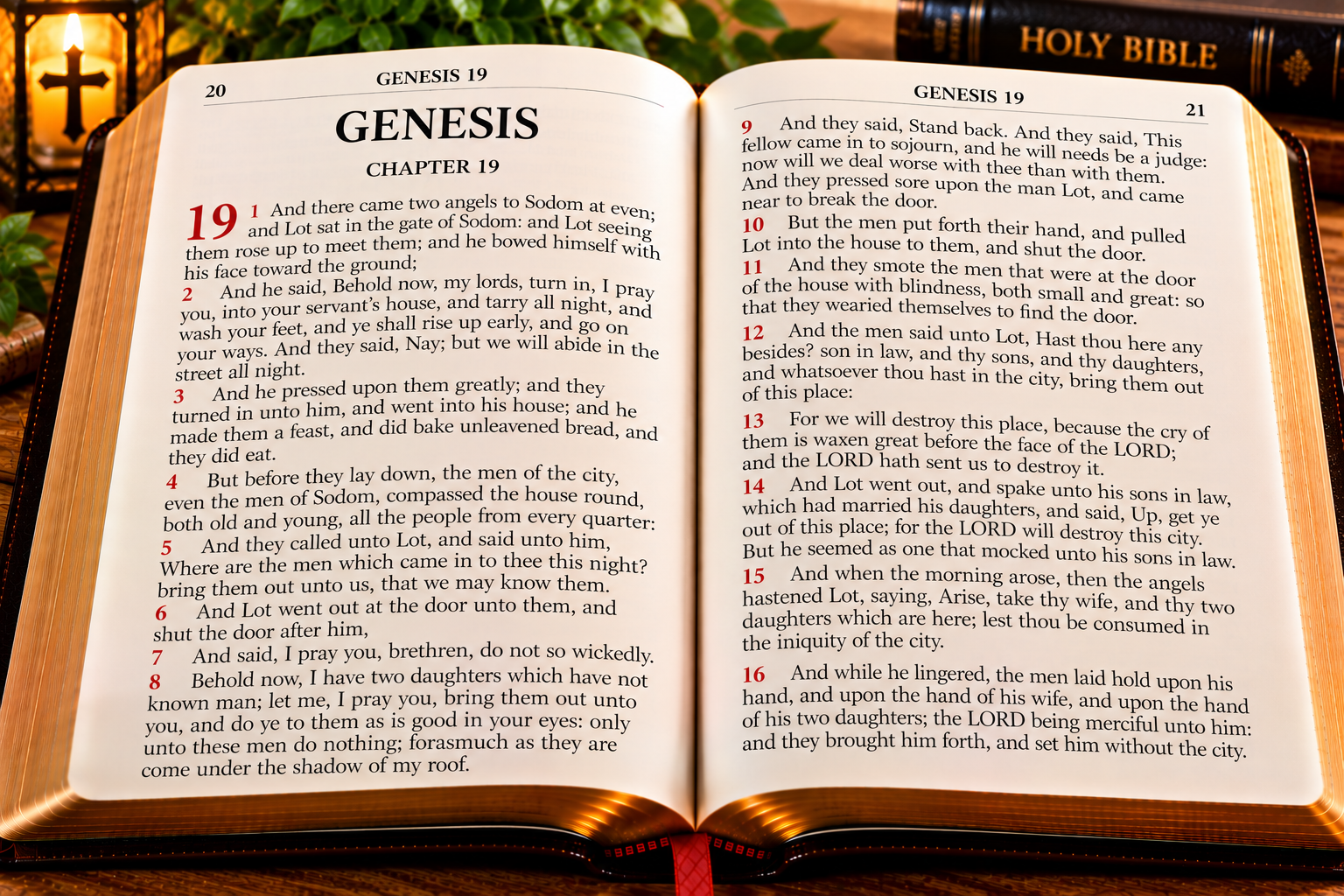
Book: Genesis Chapter: 19 Content Category: Bible Chapter Study Content Type: Chapter Overview, Biblical Interpretation, and Bible Study Questions Primary Scripture: Genesis 19:1–38 Key Theme: God’s judgment against wickedness, His rescue of Lot and his family, and the consequences of disregarding divine warnings.
Introduction to Genesis 19
Genesis 19 continues the account of Abraham’s intercession for Sodom in Genesis 18. Two angels arrive in Sodom, where Lot welcomes them into his home. The events that follow reveal the city’s profound moral corruption, the danger faced by Lot and his household, and God’s decision to bring judgment upon Sodom and Gomorrah.
The chapter also describes Lot’s rescue, his wife’s disobedience to the command not to look back, and the destruction of the cities of the plain. The final section recounts Lot’s life with his daughters in a cave and the births of Moab and Ben-ammi, who become ancestors of the Moabites and Ammonites.
Genesis 19 is a sobering chapter about the seriousness of sin and the consequences of persistent wrongdoing. It also demonstrates divine mercy: the angels take Lot, his wife, and his daughters by the hand and lead them out of the city when Lot hesitates.
The chapter contains disturbing events, including attempted sexual violence, the destruction of a city, and the sexual exploitation within Lot’s family. These details should be approached carefully, without treating harmful conduct as acceptable or using the narrative to justify mistreatment of vulnerable people.
Key Verse — Genesis 19:16 (KJV)
“And while he lingered, the men laid hold upon his hand, and upon the hand of his wife, and upon the hand of his two daughters; the LORD being merciful unto him: and they brought him forth, and set him without the city.”
This verse highlights an important theme in the chapter: Lot’s rescue is described as an act of the LORD’s mercy, even when Lot hesitates to leave.
Chapter Overview: Genesis 19
A. The Two Angels Arrive in Sodom — Genesis 19:1–3
The chapter begins with two angels arriving in Sodom in the evening. Lot is sitting at the gate of the city, a location that could serve as a place for public business, community interaction, and legal matters. When he sees the visitors, he rises to meet them, bows with his face toward the ground, and invites them to spend the night at his house.
Initially, the visitors say that they will spend the night in the street. Lot insists that they come to his home, where he prepares a meal and unleavened bread for them.
Lot’s hospitality resembles Abraham’s welcome of the visitors in Genesis 18. However, the setting in Sodom soon reveals a sharp contrast between the hospitality of Lot’s household and the hostility of the surrounding community.
Lessons from Genesis 19:1–3
- Hospitality can involve protecting and caring for visitors.
- A community’s moral condition is revealed partly through how it treats vulnerable people.
- Lot’s welcome provides a contrast to the violence that follows.
- The passage encourages kindness while recognizing the importance of wisdom and safety.
B. The Men of Sodom Attempt to Assault Lot’s Visitors — Genesis 19:4–11
Before the visitors retire for the night, the men of Sodom surround Lot’s house. The narrative describes the men as coming from every part of the city, both young and old. They demand that Lot bring out his visitors so that they may have sexual relations with them.
The request is coercive and threatening. It is not a description of a consensual encounter. The visitors are surrounded by a hostile crowd, and the men seek to use sexual violence to dominate and humiliate them.
Lot goes outside and shuts the door behind him. He pleads with the crowd not to commit such wickedness. However, he then makes a deeply troubling offer involving his two daughters, proposing that the men do to them as they please rather than harm his guests.
The text records Lot’s offer, but recording an action is not the same as approving it. His proposal exposes the moral crisis of the situation and demonstrates how even a person who shows hospitality can respond in deeply wrong ways under pressure. The Bible does not present the proposed abuse of his daughters as a model for protecting guests.
The crowd rejects Lot’s appeal, threatens him, and moves to break down the door. The angels intervene by pulling Lot into the house and striking the men with blindness so that they cannot find the entrance.
The scene exposes the crowd’s violent intentions and the danger faced by Lot’s household.
Lessons from Genesis 19:4–11
- Sexual violence and coercion are serious forms of wrongdoing.
- The actions of a crowd do not become righteous simply because many people participate.
- Protecting one person must never be used to justify sacrificing another person’s safety or dignity.
- God’s intervention prevents the crowd from carrying out its immediate threat.
- The passage challenges readers to consider how violence and the abuse of power affect a community.
C. The Angels Warn Lot to Leave the City — Genesis 19:12–14
After the crowd has been restrained, the angels ask Lot whether he has any other family members in the city, including sons-in-law, sons, daughters, or anyone else who belongs to his household. They tell him to bring them out because the city is about to be destroyed.
The angels explain that the outcry against Sodom has become so great that the LORD has sent them to destroy it. Lot goes to speak with the men who are to marry his daughters and urges them to leave because the LORD will destroy the city.
However, the men regard his warning as a joke.
Their response highlights a central problem in the chapter: a warning can be dismissed when people do not take its message seriously. The text does not provide a detailed account of why the men refuse to believe Lot, but it clearly states that they do not act on his warning.
Lessons from Genesis 19:12–14
- Warnings about serious danger should not be dismissed carelessly.
- People may reject a warning even when the consequences are severe.
- Concern for others includes communicating important information honestly.
- The passage invites readers to examine whether pride, disbelief, or attachment to familiar surroundings prevents them from responding to necessary change.
D. Lot Hesitates, but the Angels Lead Him Out — Genesis 19:15–22
As dawn approaches, the angels urge Lot to take his wife and two daughters and leave before the city is destroyed. Lot hesitates.
The angels then take hold of the hands of Lot, his wife, and his daughters and lead them out of the city because the LORD is merciful to Lot. Once outside, they instruct the family to escape for their lives, avoid looking back, and flee to the mountains so that they will not be swept away.
Lot responds with fear. He says that he cannot reach the mountains quickly enough and asks permission to escape to a nearby small city instead. The angels grant his request and agree not to overthrow the town he identifies, Zoar.
This section shows both urgency and mercy. Lot does not respond with immediate decisiveness, but the angels persist in bringing him to safety. The account does not explain every reason for his hesitation, so readers should avoid claiming certainty about his motives.
The name Zoar is associated with the idea of smallness, reflecting Lot’s description of the place as a little city.
Lessons from Genesis 19:15–22
- Hesitation can complicate a response to urgent danger.
- God’s mercy is a prominent feature of Lot’s rescue.
- The angels provide specific instructions for escaping the coming judgment.
- Lot is permitted to flee to Zoar rather than the mountains, showing accommodation within the narrative.
- The passage encourages readers to respond wisely when confronted with genuine danger and necessary change.
E. Sodom and Gomorrah Are Destroyed — Genesis 19:23–29
Lot reaches Zoar as the sun rises. The LORD then rains brimstone and fire upon Sodom and Gomorrah, overthrowing the cities, the surrounding plain, the inhabitants of the cities, and the vegetation of the land.
The judgment is described as comprehensive and devastating. The account presents the destruction as an act of divine judgment against the cities following the earlier declaration that their sin was exceedingly grievous (Genesis 18:20–21).
Lot’s wife looks back, contrary to the instruction given to the family, and becomes a pillar of salt. The narrative does not explain precisely what motivated her to look back. It is therefore better to acknowledge her disobedience without inventing a definite explanation for her thoughts.
Abraham later looks toward the area where Sodom and Gomorrah stood and sees smoke rising from the land. The chapter then recalls God’s remembrance of Abraham and His sending Lot out of the destruction.
The reference to Abraham connects Genesis 19 directly to the intercession in Genesis 18. Although the city is not spared, the narrative emphasizes that Lot is brought out of the catastrophe.
Lessons from Genesis 19:23–29
- The chapter portrays divine judgment as a serious response to persistent wickedness.
- Disregarding a clear warning can have grave consequences.
- The account of Lot’s wife warns against disobedience, although her precise motivation is not revealed.
- God’s rescue of Lot is connected narratively with His remembrance of Abraham.
- The chapter holds together the themes of judgment, mercy, and the consequences of human choices.
F. Lot and His Daughters Live in a Cave — Genesis 19:30–32
After leaving Zoar, Lot becomes afraid to remain there. He and his two daughters move to the mountains and live in a cave.
The daughters believe that there are no men available to preserve their family line. The elder daughter proposes that they make their father drink wine and lie with him so that they can have children through him. The passage introduces their plan without presenting it as morally acceptable.
The daughters’ belief that no men remain may reflect their limited perspective after the destruction of the cities. The text does not establish that they had exhaustive knowledge of everyone who survived outside their immediate surroundings.
Lessons from Genesis 19:30–32
- Fear and crisis can shape people’s decisions.
- The Bible records morally troubling actions without necessarily endorsing them.
- Desperation does not make every proposed solution right.
- Readers should distinguish between understanding the circumstances of an action and approving the action itself.
G. The Birth of Moab and Ben-ammi — Genesis 19:33–38
The two daughters carry out their plan on successive nights. Their father is unaware of what happens during the encounters described in the passage. Both daughters become pregnant.
The elder daughter gives birth to a son named Moab, associated in the narrative with the Moabites. The younger daughter gives birth to Ben-ammi, associated with the Ammonites.
These concluding verses explain the origins of two peoples who later appear in Israel’s history. The account also provides a troubling conclusion to Lot’s story, contrasting his earlier hospitality with the breakdown of moral judgment and family boundaries in the cave.
The passage should be read as a narrative of what occurred, not as a model of sexual conduct or family relationships. Its inclusion helps explain the later biblical relationship between Israel, Moab, and Ammon.
Lessons from Genesis 19:33–38
- Biblical genealogies often explain the origins of peoples and their relationships to Israel.
- The Bible does not conceal the moral failures and painful consequences found in the lives of its characters.
- Family crises can have consequences that extend beyond one generation.
- The story encourages readers to seek wise, ethical responses to fear and uncertainty rather than acting from desperation.
Major Themes in Genesis 19
| Theme | Scripture | Meaning |
|---|---|---|
| Hospitality and protection | Genesis 19:1–3 | Lot welcomes visitors into his home. |
| Sexual violence and corruption | Genesis 19:4–11 | The crowd’s coercive intentions reveal the city’s grave moral disorder. |
| Divine warning | Genesis 19:12–14 | Lot is warned that destruction is coming, but his prospective sons-in-law dismiss the warning. |
| Divine mercy | Genesis 19:15–22 | The angels physically lead Lot and his family out of danger. |
| Divine judgment | Genesis 19:23–25 | Sodom and Gomorrah are destroyed in the narrative’s account of God’s judgment. |
| Consequences of disobedience | Genesis 19:17, 26 | Lot’s wife disobeys the instruction not to look back. |
| Intercession and deliverance | Genesis 19:27–29 | Lot’s rescue is narrated in connection with God’s remembrance of Abraham. |
| Family breakdown and ancestry | Genesis 19:30–38 | The account of Lot’s daughters explains the origins of Moab and Ammon. |
Biblical Interpretation Note: Understanding Genesis 19
1. Why Were Sodom and Gomorrah Destroyed?
Scripture: Genesis 18:20–21; Genesis 19:4–11, 23–25; Ezekiel 16:49–50
Genesis 19 presents the destruction of Sodom and Gomorrah as divine judgment following grave wrongdoing. The preceding chapter describes the cities’ sin as exceedingly grievous, while Genesis 19 illustrates the violence and hostility of the men who surround Lot’s house.
Other biblical passages add important context. Ezekiel 16:49–50 identifies Sodom’s pride, excessive prosperity, neglect of the poor and needy, and other abominations. Jude 1:7 refers to sexual immorality and pursuing strange flesh in its description of Sodom and Gomorrah.
Taken together, these passages portray Sodom as an example of serious moral corruption. Genesis 19 specifically describes a threatening attempt at collective sexual violence, not a consensual relationship.
Interpretive principle: Explain Sodom’s judgment through the wider biblical witness. Do not reduce the city’s wrongdoing to one isolated issue while ignoring violence, arrogance, injustice, and the mistreatment of others.
2. What Was the Sin of the Men Who Surrounded Lot’s House?
Scripture: Genesis 19:4–11; Judges 19:22–26
The men demand access to Lot’s visitors for sexual purposes and threaten violence when Lot refuses. Their behavior involves coercion, intimidation, and an attempted assault.
The narrative is especially disturbing because the crowd acts collectively and refuses to respect the safety of the visitors. Lot’s own response is also morally troubling because he offers his daughters to the crowd. Although he seeks to protect his guests, the text does not endorse the proposed abuse of his daughters.
The parallel account in Judges 19 also describes a violent mob and the abuse of a vulnerable visitor. These narratives expose the destructive consequences of a community in which people use power to violate others.
Interpretive principle: Distinguish between hospitality, which welcomes and protects people, and the abuse of power, which threatens or exploits them. Genesis 19 does not justify sexual violence or the sacrifice of one person’s dignity to protect another.
3. Why Did Lot Hesitate to Leave Sodom?
Scripture: Genesis 19:15–16
The angels urgently instruct Lot to leave the city, but he lingers. The text does not explicitly explain the precise reason for his hesitation.
Possible explanations sometimes offered include attachment to his home, concern about his future, fear of the unknown, or difficulty accepting the warning. These are interpretations, not facts directly stated in the passage.
What the text does make clear is that Lot’s hesitation does not prevent the angels from taking him and his family out of the city. The narrator explicitly attributes this rescue to the LORD’s mercy.
Interpretive principle: Acknowledge what the text says about Lot’s hesitation without presenting a speculative motive as certain.
4. Why Was Lot’s Wife Turned into a Pillar of Salt?
Scripture: Genesis 19:17, 26; Luke 17:28–33
The angels instruct Lot’s family not to look back while escaping. Lot’s wife looks back and becomes a pillar of salt.
The narrative presents her action in connection with the warning she disobeys, but it does not explicitly explain her inner motivation. The passage does not state whether she looked back because of grief, curiosity, attachment to her former life, or another reason.
Jesus later refers to Lot’s wife in Luke 17:32: “Remember Lot’s wife.” In the context of His teaching about readiness and the danger of clinging to earthly life when decisive action is required, her example becomes a warning against turning back.
Interpretive principle: The text supports a lesson about taking God’s warning seriously. Avoid asserting a particular psychological explanation that Scripture does not provide.
5. Does Lot’s Rescue Mean That He Was Perfectly Righteous?
Scripture: Genesis 19:15–29; 2 Peter 2:6–9
Genesis 19 portrays Lot as a man who welcomes the visitors and is subsequently rescued from Sodom. It also records his troubling offer concerning his daughters and his hesitation to leave the city.
Second Peter 2:7–8 describes Lot as righteous and distressed by the lawless conduct around him. This New Testament assessment should be considered alongside the complicated behavior recorded in Genesis.
The Bible’s description of Lot as righteous does not mean that every action he takes is morally exemplary. Biblical narratives frequently portray people who belong to God’s purposes while still displaying serious weaknesses and making harmful decisions.
Interpretive principle: Do not equate being described as righteous with being sinless. Read the biblical testimony as a whole, recognizing both the character assessment given in 2 Peter and the moral complexity of Genesis 19.
6. What Does the Destruction of Sodom Teach About Divine Judgment?
Scripture: Genesis 19:23–29; Deuteronomy 32:4; Psalm 89:14
The destruction of Sodom and Gomorrah is presented as an act of divine judgment. Genesis 18 establishes that Abraham appeals to God’s justice, and Genesis 19 narrates the destruction of the cities alongside the rescue of Lot.
The account does not portray judgment as a trivial matter. The destruction is devastating, and the story emphasizes the seriousness of persistent wickedness.
At the same time, the chapter includes mercy. Lot is led out of the city, and the narrative specifically attributes his deliverance to the LORD’s mercy. Judgment and mercy therefore appear together in the account.
The chapter should not be used to claim that every natural disaster, city-wide tragedy, or modern catastrophe is evidence of a specific divine judgment. Genesis 19 concerns a particular event within the biblical narrative.
Interpretive principle: Apply the moral and theological lessons of the passage without assuming that readers can identify the divine purpose behind every present-day tragedy.
7. What Is the Significance of Abraham’s Intercession?
Scripture: Genesis 18:22–33; Genesis 19:27–29
Genesis 18 records Abraham’s repeated appeals for Sodom. He asks whether God will spare the city for the sake of righteous people living there. In Genesis 19, the city is destroyed, but Lot is brought out of the catastrophe.
Genesis 19:29 connects Lot’s rescue with God’s remembrance of Abraham. This creates a narrative link between Abraham’s intercession and Lot’s deliverance.
However, the text does not explicitly state that Abraham’s prayer is the sole reason for every aspect of Lot’s rescue. The clearest point is that the account links God’s remembrance of Abraham with the deliverance of Lot.
Interpretive principle: The narrative encourages readers to take intercession seriously while avoiding claims that exceed what the text establishes about the exact relationship between a particular prayer and a particular outcome.
8. Why Does Genesis Record the Actions of Lot’s Daughters?
Scripture: Genesis 19:30–38; Deuteronomy 23:3–6; Ruth 1:1–5
The final section describes Lot’s daughters getting their father drunk and becoming pregnant by him. Their sons, Moab and Ben-ammi, become associated with the origins of the Moabites and Ammonites.
The narrative explains the origins of peoples who play important roles in Israel’s later history. The account also illustrates the moral and familial disorder that follows the destruction of Sodom.
The Bible’s inclusion of an event does not make the conduct described acceptable. The text records the actions and their outcomes without presenting the incestuous relationships as a moral example to follow.
Interpretive principle: Read difficult biblical narratives carefully. Distinguish between reporting an event, explaining its historical significance, and prescribing conduct for God’s people.
9. How Does Genesis 19 Connect with the New Testament?
Several New Testament passages refer to Sodom and Lot:
- Luke 17:28–32: Jesus uses the days of Lot to warn about the need for readiness and the danger of being unprepared for divine judgment.
- 2 Peter 2:6–9: Sodom and Gomorrah are presented as examples of judgment, while Lot’s rescue illustrates God’s ability to deliver the godly from trials.
- Jude 1:7: Sodom and Gomorrah are cited as examples of sexual immorality and judgment.
- Matthew 10:14–15: Jesus uses Sodom and Gomorrah as a comparison when teaching about accountability for rejecting the message of His disciples.
These passages show that Genesis 19 became an important biblical example of judgment, accountability, and deliverance.
Interpretive principle: Use New Testament references to clarify how later biblical writers interpret Sodom and Lot, while keeping each passage’s immediate context in view.
Key Questions for Bible Study: Genesis 19
These questions are suitable for personal study, family devotion, small-group discussions, or church Bible study.
A. Observation Questions
Focus on what the chapter directly records.
- Who arrived in Sodom in the evening? (Genesis 19:1)
- Where was Lot when he saw the visitors?
- How did Lot welcome the two angels? (Genesis 19:1–3)
- What did the men of Sodom demand from Lot? (Genesis 19:4–5)
- How did Lot respond to the crowd’s demands? (Genesis 19:6–8)
- What did the angels do when the crowd threatened Lot? (Genesis 19:9–11)
- What warning did the angels give Lot about Sodom? (Genesis 19:12–13)
- How did Lot’s prospective sons-in-law respond to his warning? (Genesis 19:14)
- Why did the angels take Lot and his family by the hand? (Genesis 19:15–16)
- What instructions did the angels give the family as they left the city? (Genesis 19:17)
- Which city did Lot ask permission to escape to? (Genesis 19:18–22)
- What happened to Sodom and Gomorrah? (Genesis 19:23–25)
- What happened to Lot’s wife? (Genesis 19:26)
- What did Abraham see when he looked toward Sodom and Gomorrah? (Genesis 19:27–28)
- What were the names of Lot’s two grandsons? (Genesis 19:36–38)
B. Interpretation Questions
Explore what the passage means and how its details fit together.
- What contrast does the chapter establish between Lot’s hospitality and the conduct of the men of Sodom?
- What does the crowd’s behavior reveal about the abuse of power and the rejection of human dignity?
- Why is it important to distinguish the attempted sexual violence in Genesis 19 from a consensual relationship?
- What does the LORD’s mercy toward Lot reveal about the character of his rescue?
- Why might Lot have hesitated to leave, and what can be said with certainty from the text?
- What does the destruction of Sodom teach about divine judgment?
- How does the account of Lot’s wife relate to Jesus’ warning in Luke 17:32?
- How does Genesis 19 connect Abraham’s intercession in the previous chapter with Lot’s deliverance?
- Why does the Bible record the troubling actions of Lot and his daughters without presenting them as moral examples?
- What do the concluding verses reveal about the later relationship between Israel, Moab, and Ammon?
C. Application Questions
Consider how the chapter’s lessons apply to life today.
- How can you practice hospitality while also protecting the safety and dignity of everyone involved?
- What should a person do when a group or community pressures them to participate in wrongdoing?
- How can you respond when someone dismisses a serious warning or refuses to consider the consequences of their actions?
- What can Lot’s hesitation teach about responding to necessary change?
- How can believers show compassion toward people who make serious mistakes without excusing harmful conduct?
- What does the chapter teach about protecting vulnerable people from exploitation and violence?
- How can you avoid judging every modern tragedy as a direct act of divine punishment?
- What can Abraham’s concern for others teach you about intercessory prayer?
- How can families respond to fear and crisis without making harmful decisions?
- What practical step can you take to promote justice, safety, and responsible conduct in your community?
D. Deeper Reflection Questions
These questions encourage theological reflection and more detailed discussion.
- How do divine judgment and mercy operate together in Genesis 19?
- What does the chapter reveal about the relationship between personal choices and wider community consequences?
- How should Christians interpret difficult biblical narratives that describe immoral actions by people who also receive divine help?
- What is the relationship between Genesis 18’s account of Abraham’s intercession and Genesis 19’s account of judgment?
- How can readers distinguish between God’s specific judgment in a biblical narrative and the causes of present-day disasters?
- What does the New Testament’s treatment of Lot add to our understanding of his character?
- Why is it important to consider the full biblical witness when explaining the sins of Sodom?
- What does the chapter teach about the limits of human understanding when interpreting the motives of biblical characters?
E. Personal Reflection and Prayer
Use these prompts to connect your study with personal reflection.
- Obedience: Is there a clear, wise course of action I have been delaying?
- Hospitality: How can I welcome and care for others without compromising anyone’s safety?
- Justice: How can I respond when I witness coercion, exploitation, or mistreatment?
- Mercy: How can I show compassion while still recognizing the seriousness of wrongdoing?
- Intercession: Who needs my continued prayer, encouragement, or practical assistance?
- Discernment: How can I distinguish what Scripture explicitly teaches from assumptions I may bring to the text?
Related Bible Verses for Further Study
| Bible Passage | Connection to Genesis 19 |
|---|---|
| Genesis 18:20–33 | God’s concern about Sodom and Abraham’s intercession. |
| Leviticus 19:33–34 | Welcoming and treating strangers fairly. |
| Deuteronomy 32:4 | God’s justice and faithfulness. |
| Ezekiel 16:49–50 | Pride, neglect of the needy, and the sins associated with Sodom. |
| Luke 17:28–33 | Jesus’ teaching about the days of Lot and the danger of turning back. |
| 2 Peter 2:6–9 | Sodom’s judgment and Lot’s deliverance. |
| Jude 1:7 | Sodom and Gomorrah as examples of sexual wrongdoing and judgment. |
| James 5:16 | The importance of prayer. |
Chapter Summary: Genesis 19
Genesis 19 recounts the arrival of two angels in Sodom, the violent demands of the city’s men, the warning of impending destruction, and the rescue of Lot and his family. Sodom and Gomorrah are destroyed, Lot’s wife disobeys the instruction not to look back, and Lot later lives in a cave with his daughters. The chapter concludes with the births of Moab and Ben-ammi, explaining the origins of the Moabites and Ammonites.
The chapter presents a sobering account of wickedness, judgment, and the consequences of human decisions. At the same time, it emphasizes divine mercy through Lot’s rescue and connects that rescue to God’s remembrance of Abraham.
One-sentence summary: Genesis 19 teaches about the seriousness of persistent wickedness, the reality of divine judgment, the mercy shown in Lot’s rescue, and the importance of responding to warnings with wisdom and obedience.