

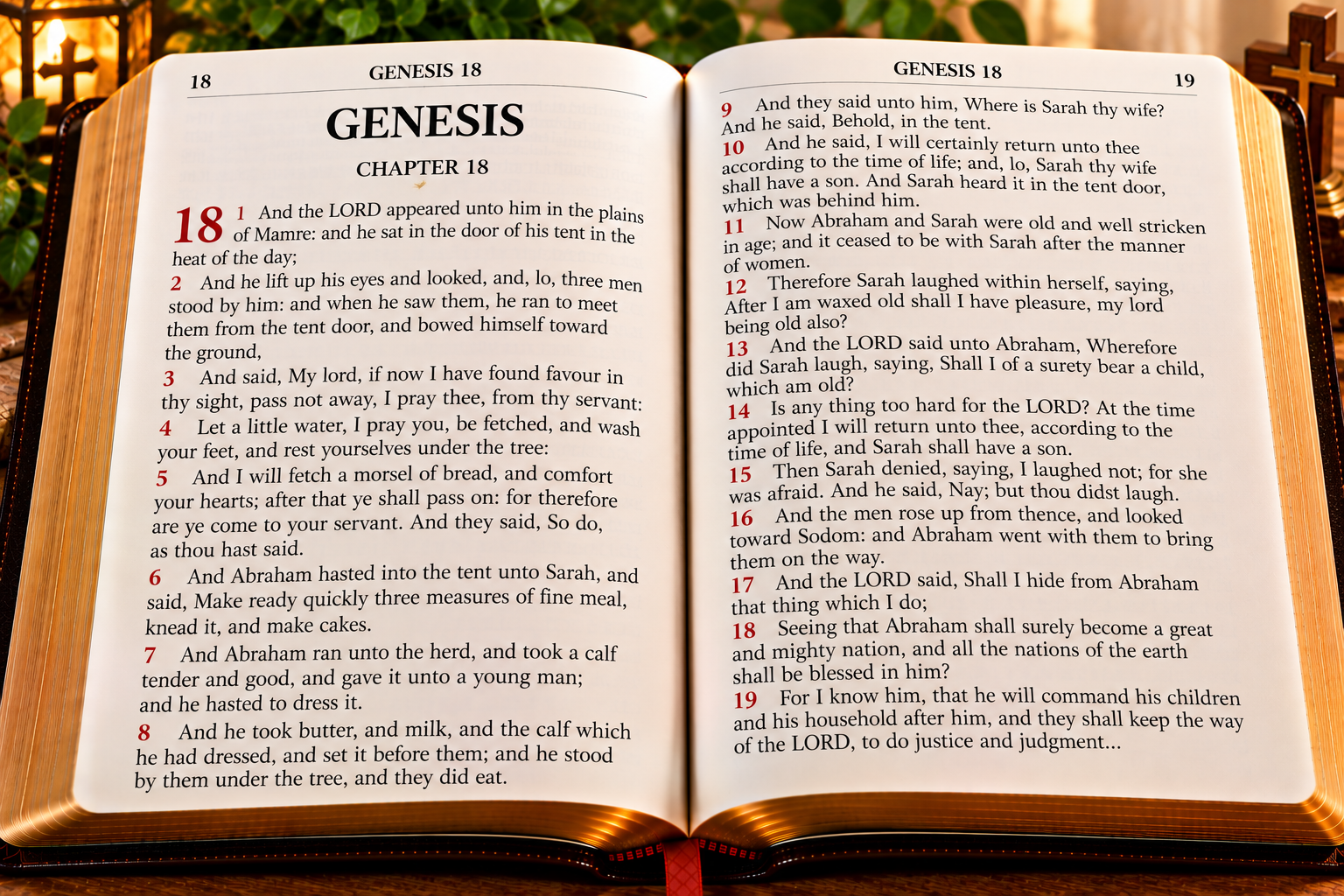
Book: Genesis Chapter: 18 Content Category: Bible Chapter Overview and Interpretation Content Type: Scripture Study, Biblical Interpretation, and Bible Study Questions Primary Scripture: Genesis 18:1–33 Key Theme: God confirms His promise to Abraham and Sarah, demonstrates His power to fulfill what seems impossible.
Introduction
Genesis 18 is an important chapter in the story of Abraham because it brings together three major biblical themes: God’s faithfulness to His promises, the importance of hospitality, and the relationship between divine justice and intercessory prayer.
The chapter begins when the LORD appears to Abraham near the great trees of Mamre. Abraham welcomes three visitors and provides food and rest for them. During the visit, God announces that Sarah will have a son, even though she is advanced in age. Sarah laughs privately at the promise, but God responds by declaring that nothing is too difficult for Him.
The second part of the chapter shifts from the promise of Isaac to the impending judgment of Sodom and Gomorrah. God reveals His plans concerning Sodom, and Abraham responds by asking whether the righteous will be destroyed alongside the wicked. His questions demonstrate concern for justice and the preservation of the innocent.
Genesis 18 therefore teaches that God is both the faithful keeper of His promises and the righteous Judge of the earth. It also shows that believers can approach God with reverence, honest questions, and persistent prayer.
Key Verse — Genesis 18:14 (KJV)
“Is any thing too hard for the LORD? At the time appointed I will return unto thee, according to the time of life, and Sarah shall have a son.”
This verse captures one of the chapter’s central messages: human limitations do not prevent God from fulfilling His purposes.
Chapter Overview: Genesis 18
A. The LORD Appears to Abraham at Mamre — Genesis 18:1–2
Genesis 18 opens with the LORD appearing to Abraham as he sits in the entrance of his tent during the heat of the day. Abraham looks up and sees three men standing nearby. He runs to meet them, bows toward the ground, and welcomes them.
The passage describes the encounter as an appearance of the LORD, but it also introduces three visitors. The precise nature of the visitors has been interpreted differently across Jewish and Christian traditions. Later in the narrative, two of the visitors proceed toward Sodom, and Genesis 19:1 identifies them as angels.
The important point in Genesis 18 is that God communicates with Abraham in a personal and direct way. Abraham’s response demonstrates attentiveness, humility, and readiness to serve.
Lessons from Genesis 18:1–2
- God is able to reveal Himself according to His purposes.
- Abraham responds to the visitors with respect and eagerness.
- The encounter prepares the reader for God’s announcement concerning Sarah and the future of Sodom.
- The passage encourages readers to remain attentive to opportunities to serve others.
B. Abraham Demonstrates Hospitality — Genesis 18:3–8
Abraham asks the visitors to remain with him so that he can provide water for their feet, rest under the tree, and food for their journey. He quickly asks Sarah to prepare cakes from fine flour, selects a tender calf, and has a servant prepare it. He then presents the food to the visitors and stands nearby while they eat.
Abraham’s actions reveal a generous and attentive approach to hospitality. He does not merely offer polite words; he provides practical care.
The narrative emphasizes the effort Abraham and his household make to welcome the visitors. Sarah prepares the bread, a servant prepares the calf, and Abraham brings additional food. Hospitality is presented as an active expression of kindness.
The New Testament later encourages believers to practice hospitality, including the possibility of welcoming people without knowing the full significance of the encounter (Hebrews 13:2). However, Genesis 18 should not be read as a promise that every act of hospitality will result in a supernatural visitation.
Lessons from Genesis 18:3–8
- Hospitality involves practical service, not words alone.
- Generosity can be expressed through food, rest, attention, and care.
- Abraham’s household participates in serving the visitors.
- Christian hospitality should be offered with sincerity and wisdom.
C. God Announces the Birth of Isaac — Genesis 18:9–10
The visitors ask Abraham where Sarah is. Abraham replies that she is in the tent. One of the visitors then announces that he will return at the appointed time and Sarah will have a son.
This announcement continues the promise already given to Abraham in Genesis 17:15–21, where God specifically identifies Sarah as the mother of the promised son and names him Isaac.
The promise is significant because Sarah has been unable to bear children, and both she and Abraham are old. The birth of Isaac is therefore not presented as an ordinary expectation based on their circumstances. It is part of God’s covenant promise.
The reference to an appointed time also emphasizes that the fulfillment will occur according to God’s timing rather than human expectations.
Lessons from Genesis 18:9–10
- God remains faithful to the promises He has made.
- The fulfillment of a promise may require patience.
- God’s purposes are not determined solely by human circumstances.
- Faith includes trusting God’s word while waiting for its fulfillment.
D. Sarah Laughs at the Promise — Genesis 18:11–12
Genesis explains that Abraham and Sarah are advanced in age and that Sarah is past the usual age of childbearing. When she hears the announcement, she laughs within herself and questions whether she can experience such joy when both she and her husband are old.
Sarah’s laughter reflects the apparent impossibility of the promise from a human perspective. The text allows readers to see her private reaction rather than presenting her as someone who immediately understands how the promise will be fulfilled.
Her response also prepares the reader for the name Isaac, which is associated with laughter. The birth of Isaac will transform the circumstances that now seem unbelievable.
Sarah’s reaction can be understood as a mixture of disbelief, amazement, and awareness of her physical limitations. The passage does not require readers to assume that every question or moment of doubt is identical in nature.
Lessons from Genesis 18:11–12
- Human limitations can make God’s promises difficult to understand.
- People may struggle to believe what appears impossible.
- God’s faithfulness does not depend on a person’s perfect understanding.
- The chapter invites readers to bring their questions to God rather than treating their present circumstances as the final word.
E. God Challenges Sarah’s Doubt — Genesis 18:13–15
The LORD asks Abraham why Sarah laughed and questioned whether she could bear a child at her age. God then asks the central question of the chapter: “Is any thing too hard for the LORD?”
God confirms that Sarah will have a son at the appointed time. When Sarah becomes afraid and denies laughing, the LORD responds that she did laugh.
This exchange reveals God’s knowledge of Sarah’s private reaction. It also reinforces the certainty of the promise. Sarah’s response does not cancel God’s intention to fulfill what He has declared.
The question about what is too difficult for the LORD is not a claim that every personal desire will automatically come true. In context, it affirms God’s ability to accomplish the specific purpose He has promised: Sarah will bear Isaac.
Lessons from Genesis 18:13–15
- God knows both outward actions and inward thoughts.
- God’s power is not limited by the circumstances that limit human beings.
- God’s promises must be understood in their biblical context.
- Fear and doubt do not necessarily prevent God from carrying out His purposes.
F. God Reveals His Concern About Sodom — Genesis 18:16–21
After the visitors rise to leave, they look toward Sodom, and Abraham accompanies them. The LORD then considers whether to reveal to Abraham what He is about to do.
God explains that Abraham will become a great and mighty nation and that the nations of the earth will be blessed through him. God also identifies Abraham’s responsibility to teach his household to keep the way of the LORD by practicing righteousness and justice.
The passage connects God’s covenant with Abraham to moral responsibility. Abraham is not chosen merely to receive blessings; his household is also expected to uphold God’s ways.
God then speaks about the outcry against Sodom and Gomorrah, explaining that their sin is exceedingly grievous. He declares His intention to examine the situation. The language of going down and seeing presents the investigation in a humanly understandable way and emphasizes the seriousness of the matter.
The narrative prepares readers for the judgment described in Genesis 19. It also introduces the question Abraham will raise: how can divine judgment be reconciled with the treatment of righteous people who might live among the wicked?
Lessons from Genesis 18:16–21
- God’s covenant blessings carry responsibilities.
- Righteousness and justice are central to the biblical understanding of faithful living.
- Serious accusations call for careful attention rather than careless assumptions.
- God is portrayed as fully aware of the moral condition of human communities.
G. Abraham Intercedes for Sodom — Genesis 18:22–25
The visitors turn toward Sodom, while Abraham remains standing before the LORD. Abraham approaches God and asks whether He will destroy the righteous with the wicked.
He begins by asking whether fifty righteous people within the city would be enough for God to spare the entire place. He then declares:
“That be far from thee to do after this manner, to slay the righteous with the wicked: and that the righteous should be as the wicked, that be far from thee: Shall not the Judge of all the earth do right?” — Genesis 18:25 (KJV)
This question is central to the chapter’s teaching about divine justice. Abraham appeals to God’s character as the Judge of all the earth and asks that the righteous not be treated as though they were guilty of the same wrongdoing as the wicked.
Abraham does not deny that Sodom’s sin deserves attention. Instead, he asks whether judgment can be carried out in a way that recognizes the distinction between the righteous and the wicked.
His prayer is bold, but it is not presented as arrogant. Abraham approaches God respectfully while reasoning from what he understands about God’s justice.
Lessons from Genesis 18:22–25
- Prayer can include honest questions about justice.
- Believers may appeal to God’s righteous character when interceding for others.
- God’s justice should not be confused with arbitrary punishment.
- Intercession demonstrates concern for people beyond one’s immediate household.
H. Abraham Continues to Intercede — Genesis 18:26–33
God responds that if He finds fifty righteous people in Sodom, He will spare the entire place for their sake.
Abraham continues his appeal, reducing the number from fifty to forty-five, then forty, thirty, twenty, and finally ten. At each stage, he acknowledges his own position with humility, describing himself as dust and ashes and asking permission to continue speaking.
God agrees to spare the city if ten righteous people are found there.
The conversation ends when the LORD departs and Abraham returns to his place. The narrative does not state that ten righteous people were found. Genesis 19 describes the destruction of Sodom and the rescue of Lot and his family, showing that the city was not spared.
Abraham’s intercession demonstrates persistence and concern for justice. It also shows that God listens to Abraham’s appeals. Nevertheless, the chapter does not imply that persistent prayer can force God to act against His character or guarantee the outcome a person desires.
Lessons from Genesis 18:26–33
- Intercessory prayer can be persistent and specific.
- Humility and boldness can exist together in prayer.
- God listens to Abraham’s requests and responds to each one.
- Prayer should be grounded in God’s character rather than an attempt to control God.
- The conclusion prepares the reader to understand the judgment of Sodom in Genesis 19.
Biblical Interpretation Note: Understanding Genesis 18
1. The Appearance of the LORD and the Three Visitors
Scripture: Genesis 18:1–2, 18:16, 18:22; Genesis 19:1
The opening verse states that the LORD appeared to Abraham, while the next verse describes three men standing nearby. Later, two of the visitors go to Sodom and are identified as angels.
Christian interpreters have offered different explanations of the three visitors. Some understand the appearance as a theophany, meaning a manifestation of God. Others see the scene as the LORD appearing in the presence of two angelic messengers. Some Christian traditions have interpreted the three visitors in relation to the Trinity.
However, Genesis 18 does not explicitly state that the three visitors are three divine persons. Therefore, the passage should not be used as conclusive proof of the doctrine of the Trinity. The clearest textual point is that the LORD appears to Abraham and communicates with him through this encounter.
Interpretive principle: Distinguish what the passage explicitly says from later theological interpretations of its meaning.
2. Hospitality as an Expression of Righteous Living
Scripture: Genesis 18:3–8; Leviticus 19:33–34; Hebrews 13:1–2
Abraham’s hospitality involves food, water, rest, and personal attention. The narrative presents these actions as a concrete expression of welcome.
The passage can be applied to Christian teaching about generosity and care for others. Hebrews 13:2 also encourages hospitality by reminding believers that some people have entertained angels without knowing it.
Nevertheless, Genesis 18 does not teach that hospitality is a transaction through which people earn God’s favor or guarantee a miraculous reward. Abraham’s conduct is an example of generous service, not a formula for obtaining supernatural experiences.
Interpretive principle: Apply the passage by emphasizing generosity, care, and service rather than promising specific rewards for hospitality.
3. Sarah’s Laughter and the Promise of Isaac
Scripture: Genesis 18:9–15; Genesis 17:15–21; Genesis 21:1–7
Sarah laughs because the promised birth appears impossible in light of her age and circumstances. God responds by affirming that Sarah will have a son at the appointed time.
The question, “Is any thing too hard for the LORD?” emphasizes God’s ability to fulfill His covenant promise. It does not mean that every plan, wish, or personal expectation will be fulfilled simply because someone believes strongly enough.
The promise is specific: Sarah will give birth to Isaac, through whom the covenant line will continue. Genesis 21 records the fulfillment.
Interpretive principle: Read promises in their immediate context. God’s power is unlimited, but individual passages must not be turned into guarantees that every desired outcome will occur.
4. Abraham’s Covenant Responsibility: Righteousness and Justice
Scripture: Genesis 18:18–19; Genesis 12:1–3; Micah 6:8
God connects Abraham’s future with the instruction of his household. Abraham is to command his children and household after him to keep the way of the LORD by doing righteousness and justice.
This is a significant detail because the Abrahamic covenant includes both blessing and responsibility. Abraham’s calling is connected to God’s wider purpose of blessing the nations, and his household is expected to live according to God’s moral ways.
Righteousness and justice are not presented as optional additions to Abraham’s faith. They are central to the way his household is expected to respond to God’s calling.
Interpretive principle: Covenant blessing should not be separated from the ethical responsibilities that accompany it.
5. God’s Investigation of Sodom
Scripture: Genesis 18:20–21; Genesis 19:1–29; Ezekiel 16:49–50
God describes the outcry against Sodom and Gomorrah as great and their sin as grievous. The statement that He will go down and see what has happened uses language that makes the divine action understandable to human readers.
The passage should not be interpreted to mean that God lacks knowledge and must investigate events in the same limited way a human judge would. Instead, the narrative emphasizes the seriousness of the situation before judgment is carried out.
Genesis 19 provides further details about the conduct of the men of Sodom. Ezekiel 16:49–50 also identifies pride, abundance, ease, neglect of the poor and needy, and other abominations in its description of Sodom’s sin. Together, these passages show that the biblical witness treats Sodom’s wrongdoing as a serious moral matter.
Interpretive principle: Understand the language of divine investigation in light of the narrative’s portrayal of God’s knowledge and justice, and use the wider biblical context when discussing Sodom’s sins.
6. Abraham’s Question: “Shall Not the Judge of All the Earth Do Right?”
Scripture: Genesis 18:23–25; Deuteronomy 32:4; Psalm 89:14
Abraham’s question expresses confidence that God’s judgment must be consistent with His righteousness. He asks whether the righteous will be destroyed alongside the wicked and appeals to God’s character as the Judge of all the earth.
This is not simply an attempt to prevent punishment. Abraham is asking whether judgment will distinguish between the guilty and the innocent and whether the city might be spared for the sake of the righteous who live there.
The passage provides an important biblical foundation for thinking about justice: God is not portrayed as arbitrary or morally indifferent. His judgments are consistent with His righteous character.
Interpretive principle: Abraham’s prayer is grounded in God’s character, not in the assumption that human beings have complete knowledge of every circumstance.
7. The Meaning of the Ten Righteous People
Scripture: Genesis 18:26–33; Genesis 19:1–29
Abraham begins by asking whether fifty righteous people would be sufficient for God to spare Sodom. He continues to reduce the number until he asks about ten. God agrees to spare the city if ten righteous people are found there.
The passage does not tell readers that Abraham knew exactly how many righteous people lived in Sodom. Nor does it explicitly explain why he stopped at ten. Interpretations of that number should therefore be presented as possibilities rather than certainties.
Genesis 19 shows that the city is ultimately destroyed, while Lot and members of his family are rescued. The narrative distinguishes between the judgment of the city and the rescue of those whom God brings out.
Interpretive principle: Do not claim that the text explicitly says ten righteous people were present or that Abraham’s stopping point has one definitively established symbolic meaning.
8. The Relationship Between Intercession and Divine Justice
Scripture: Genesis 18:22–33; Exodus 32:11–14; James 5:16
Abraham’s intercession is an example of prayer that seeks mercy for others. He approaches God respectfully, states his concern, and continues to appeal for the city.
The narrative presents God as responding to Abraham’s requests, but it does not portray prayer as a means of manipulating God. Instead, the conversation allows readers to see Abraham’s concern for justice and mercy in relation to God’s character.
The wider biblical witness also includes intercessory prayer by Moses and other faithful people. James 5:16 emphasizes the importance of prayer, though it should not be used to suggest that every prayer will receive the exact result requested.
Interpretive principle: Intercession is a faithful response to God’s character and purposes, not a guarantee that every requested outcome will occur.
Key Questions for Bible Study: Genesis 18
These questions can be used for personal devotion, family Bible study, small groups, or church discussion.
A. Observation Questions
These questions focus on what the chapter directly says.
- Where was Abraham sitting when the LORD appeared to him? (Genesis 18:1)
- How many visitors did Abraham see? (Genesis 18:2)
- How did Abraham welcome the visitors? (Genesis 18:2–8)
- What food and refreshments did Abraham arrange for them? (Genesis 18:4–8)
- What promise did the visitor make concerning Sarah? (Genesis 18:9–10)
- Why did Sarah find the announcement difficult to believe? (Genesis 18:11–12)
- What question did the LORD ask after Sarah laughed? (Genesis 18:13–14)
- What did God say about Abraham’s responsibility toward his household? (Genesis 18:19)
- What concern did God reveal about Sodom and Gomorrah? (Genesis 18:20–21)
- How did Abraham respond when he learned about the coming judgment? (Genesis 18:22–25)
- What numbers did Abraham propose as the minimum number of righteous people for the city to be spared? (Genesis 18:24–32)
- What happened at the end of the conversation between Abraham and the LORD? (Genesis 18:33)
B. Interpretation Questions
These questions explore the meaning of the passage.
- What does the appearance of the LORD to Abraham reveal about God’s relationship with him?
- What do Abraham’s actions teach about hospitality and service?
- Why is Sarah’s laughter important to the story of Isaac?
- What does the question “Is any thing too hard for the LORD?” mean in its immediate context?
- Why does God connect Abraham’s calling with righteousness and justice? (Genesis 18:19)
- What does the description of Sodom’s sin reveal about the seriousness of wrongdoing?
- Why does Abraham appeal to God’s justice rather than simply asking Him to cancel the judgment?
- What does Abraham’s repeated questioning reveal about the nature of intercessory prayer?
- What is the relationship between God’s mercy and His justice in this chapter?
- Why should readers avoid turning the promise to Sarah into a guarantee that every personal desire will be fulfilled?
C. Application Questions
These questions help connect the passage to everyday life.
- How can you practice hospitality toward people in your home, church, workplace, or community?
- What can Abraham’s service teach you about caring for others in practical ways?
- Is there a promise in Scripture that you find difficult to trust because of your circumstances?
- How can you respond faithfully when you have questions or doubts?
- What does it mean to pursue righteousness and justice in your family and community?
- How can you pray for people who are facing difficult circumstances or living in communities affected by wrongdoing?
- How can you show concern for others while still recognizing the seriousness of harmful behavior?
- What can Abraham’s example teach you about praying with both humility and boldness?
- How can you distinguish between trusting God’s power and assuming that He must fulfill your personal plans?
- What practical step can you take this week to demonstrate hospitality, justice, or intercessory concern?
D. Deeper Reflection Questions
These questions encourage deeper theological and spiritual reflection.
- What does Genesis 18 teach about God’s faithfulness when a promise appears impossible?
- How does the birth promise to Sarah fit into the larger story of God’s covenant with Abraham?
- What does Abraham’s question about the Judge of all the earth reveal about biblical understandings of justice?
- How can God’s judgment and mercy be understood together in the account of Sodom?
- What does the chapter teach about the relationship between receiving God’s promises and living responsibly?
- How does Abraham’s intercession compare with Moses’ intercession for Israel in Exodus 32?
- Why is it important to interpret biblical promises according to their original context?
- How might the chapter shape a Christian understanding of prayer for people who are not part of one’s immediate family or community?
E. Personal Reflection and Prayer
After studying Genesis 18, consider these prompts:
- Faith: What situation seems impossible to me, and how can I respond with trust without presuming to know God’s exact plan?
- Hospitality: Who might need practical care, encouragement, or welcome from me?
- Justice: Where can I act more fairly, responsibly, and compassionately?
- Intercession: Who can I pray for consistently, asking God for mercy, protection, and what is right?
- Humility: How can I approach God honestly while remaining respectful of His wisdom and authority?
Closing Reflection
Genesis 18 invites readers to trust God’s faithfulness, practice generous hospitality, pursue righteousness and justice, and pray for others with humility and persistence. Sarah’s promised son reminds readers of God’s power to fulfill His specific covenant purposes, while Abraham’s intercession shows the importance of appealing to God’s righteous character.
Central lesson: God is faithful to His promises, righteous in His judgments, and attentive to the prayers of those who seek Him.