

Introduction: Understanding the Biblical Principles of Tithing
Tithing is an important subject in Christian teaching because it concerns giving, worship, stewardship, and our relationship with God. Throughout the Bible, God’s people are instructed to recognize His provision, manage their resources responsibly, support worship and ministry, and care for those in need.
The word tithe means a tenth, or 10 percent. In the Old Testament, tithing was part of Israel’s covenant law and involved agricultural produce and livestock. The Bible also records individuals, such as Abraham and Jacob, giving or promising a tenth before the law of Moses was established.
In the New Testament, Jesus addressed tithing during His ministry, while the apostles taught believers about generosity, supporting gospel ministry, and giving willingly according to their means. Christians interpret the relationship between Old Testament tithing and New Testament giving in different ways.
Some churches teach that Christians should continue giving at least 10 percent of their income. Others view the tithe as a helpful guideline while emphasizing the New Testament principles of generous, voluntary, and proportionate giving.
Understanding the principles of tithing requires examining Scripture in its historical and literary context. This article explores what the Bible says about tithing, the purpose of giving, and how Christians can apply biblical principles to their financial decisions today.
Key Scriptures: Genesis 14:18–20; Leviticus 27:30; 2 Corinthians 9:7.
1. What Is Tithing According to the Bible?
The Meaning of the Word Tithe
The word tithe refers to a tenth of something. In the Old Testament, tithing commonly involved agricultural produce and livestock rather than a modern salary paid in money.
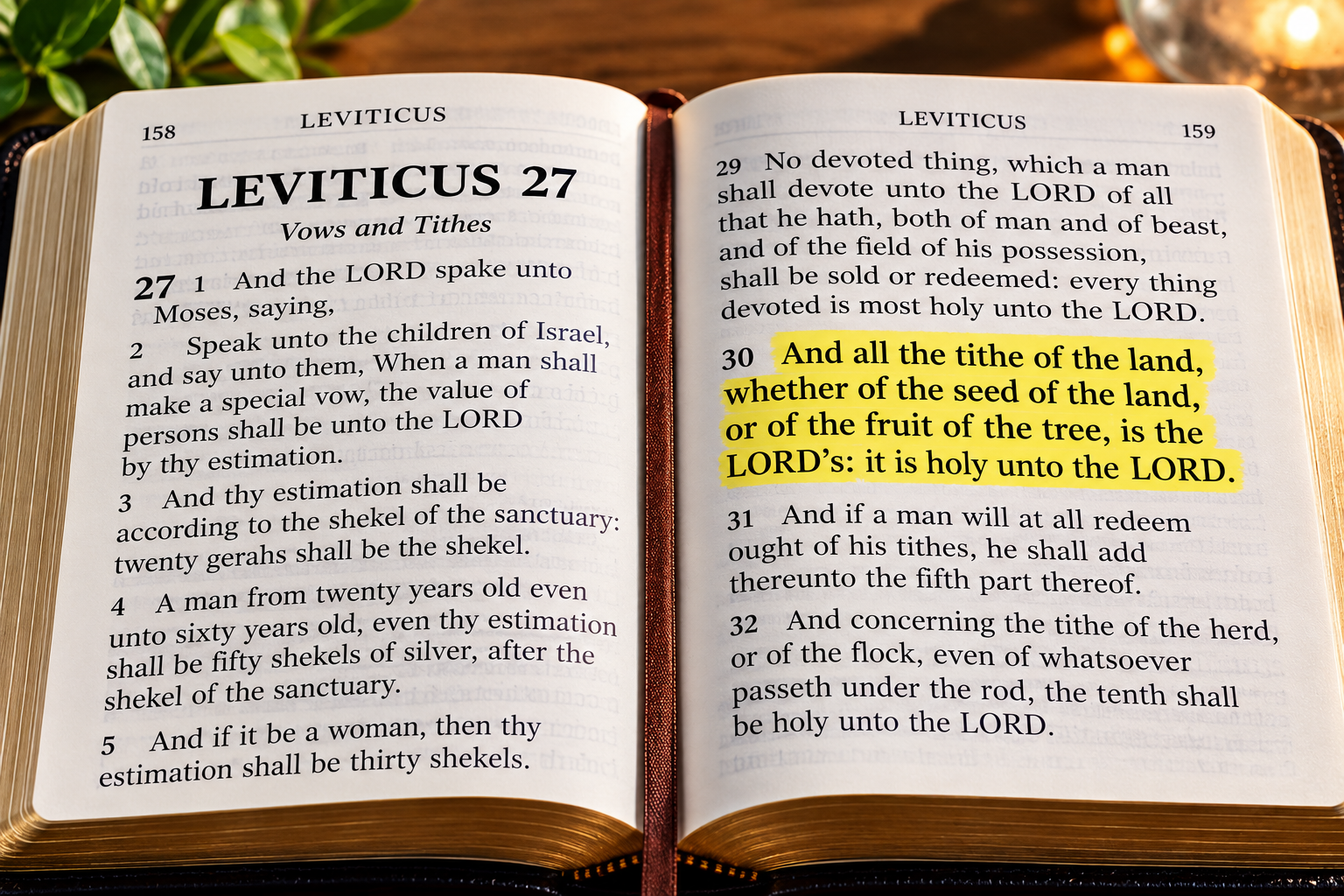
Leviticus 27:30 describes a tenth of the produce of the land as holy to the Lord. Leviticus 27:32 also addresses the tenth of the herd or flock.
These instructions were given within Israel’s covenant relationship with God. They established obligations for the people concerning the resources they received from the land and their livestock.
Today, many Christian churches apply the principle of a tenth to personal income. Under this approach, a person who receives $2,000 in income might give $200 as a tithe.
However, it is important to distinguish this modern practice from the specific agricultural provisions described in the Old Testament. The Bible does not explicitly define how modern wage earners must calculate a tithe from salaries, taxes, or payroll deductions.
The Difference Between Tithes and Offerings
A tithe is specifically a tenth, while an offering is a broader term for something given to God or contributed for a religious purpose.
In the Old Testament, offerings included different kinds of contributions and sacrifices. Some were prescribed by the law, while others could be voluntary.
In many contemporary churches, a tithe refers to a regular contribution of 10 percent of income, while an offering refers to additional financial support. This distinction is common in modern church practice, although biblical terminology is broader.
Deuteronomy 14:22–29 describes tithing practices in Israel that included religious observance and provision for Levites and people in need. These instructions show that tithing had both religious and community responsibilities.
Key Scriptures: Leviticus 27:30–33; Deuteronomy 14:22–29.
2. The First Examples of Tithing in the Bible
Abraham Gives a Tenth to Melchizedek
One of the earliest recorded examples of tithing appears in Genesis 14:18–20.
After Abraham’s victory in rescuing Lot and recovering the possessions taken by invading kings, Melchizedek, king of Salem and priest of God Most High, met him. Melchizedek blessed Abraham, and Abraham gave him a tenth of everything.
This event occurred before the law of Moses was established. For this reason, some Christians argue that Abraham’s example demonstrates a principle of giving that existed before Israel’s covenant law.
Others emphasize that Genesis records a particular event rather than giving a universal command for every believer to contribute 10 percent of income.
Hebrews 7:1–10 revisits Abraham’s encounter with Melchizedek to explain the significance of Melchizedek’s priesthood in relation to the priesthood of Jesus. The passage is especially concerned with priesthood and the superiority of Christ, rather than providing a direct command that every Christian must tithe.
Abraham’s example nevertheless illustrates the importance of recognizing God’s work and responding with honor and gratitude.
Jacob’s Vow to Give God a Tenth
Another early example appears in Genesis 28:20–22. After Jacob’s dream at Bethel, he made a vow to God. As part of that vow, Jacob promised to give God a tenth of what God provided for him.
Jacob’s statement differs from the account of Abraham. Abraham’s tithe is reported as an action, while Jacob’s tithe appears within a personal vow.
These passages are significant because they show that giving a tenth appears in biblical narratives before the law of Moses. However, neither account by itself establishes a universal command requiring every Christian to give exactly 10 percent.
Key Scriptures: Genesis 14:18–20; Genesis 28:20–22; Hebrews 7:1–10.
3. Tithing Under the Old Testament Law
Why God Commanded Tithing in Israel
Tithing became part of Israel’s covenant law. It was connected to the land, agricultural production, livestock, worship, and the responsibilities of the community.
The Israelites were instructed to set aside tithes from their produce and herds. These provisions reminded them that their livelihood depended on God’s provision and that their resources carried responsibilities beyond personal consumption.
Deuteronomy 8:17–18 warns Israel against believing that personal strength alone produces wealth. The passage calls the people to remember the Lord, who gives them the ability to produce wealth.
This principle of remembering God remains relevant to Christian financial stewardship, even though the specific requirements of Israel’s covenant law must be interpreted in their original context.
Supporting the Levites and Priests
Numbers 18:21–24 explains that the Israelites’ tithes were assigned to the Levites in return for their service in the tabernacle.
The Levites had responsibilities connected with Israel’s worship and sanctuary. Unlike the other tribes, they did not receive a territorial inheritance in the same way. The tithe provided for their needs while they carried out their assigned duties.
This arrangement demonstrates that biblical giving was not solely about an individual’s spiritual experience. It also supported the practical responsibilities of religious service.
In the New Testament, 1 Corinthians 9:13–14 similarly teaches that those who proclaim the gospel may receive their living from the gospel. Although the systems are not identical, both passages recognize the legitimacy of providing material support for religious ministry.
Providing for People in Need
Tithing in Israel also had a community dimension.
Deuteronomy 14:28–29 instructs the Israelites to set aside a tithe every third year for the Levite, foreigner, fatherless, and widow within their towns. These groups could face economic vulnerability and needed access to community resources.
Deuteronomy 26:12–13 also describes the distribution of the tithe in connection with these responsibilities.
These passages show that biblical financial obligations included concern for people who might otherwise be overlooked. Religious faithfulness was not meant to be separated from practical care for others.
For Christians today, this principle encourages generosity toward people in need, responsible charitable giving, and concern for the welfare of the wider community.
Key Scriptures: Numbers 18:21–24; Deuteronomy 14:28–29; Deuteronomy 26:12–13.
4. The Ten Biblical Principles of Tithing and Giving
The Bible presents several principles that help readers understand the purpose of tithing and the broader responsibilities associated with giving.
Principle 1: Recognize God as the Owner of Everything
Psalm 24:1 declares that the earth and everything in it belong to the Lord. This establishes an important foundation for biblical stewardship.
Christians who recognize God’s ownership understand that their income, possessions, abilities, and opportunities are resources entrusted to them. They are responsible for managing those resources wisely.
This perspective changes how people think about money. Instead of viewing financial resources only as personal property, believers can consider how their decisions reflect their faith, responsibilities, and concern for others.
Practical application: Review how you use your resources. Consider whether your spending, saving, giving, and financial commitments reflect your values and responsibilities before God.
Principle 2: Give in Response to God’s Provision
Deuteronomy 8:17–18 reminds Israel that God gives people the ability to produce wealth. The passage warns against taking personal credit for prosperity while forgetting the One who provides the ability and opportunity to work.
Giving can be a response to this recognition. It expresses gratitude rather than treating possessions as something earned entirely through personal effort.
Gratitude does not require a person to ignore hard work or wise financial decisions. Instead, it acknowledges that life, opportunities, abilities, and resources are not entirely under human control.
Practical application: Before deciding how much to give, reflect on the resources you have received and consider how you can use them responsibly and generously.
Principle 3: Understand Giving Within Its Biblical Context
One of the most important principles of biblical interpretation is reading each passage in context.
Leviticus 27:30 addresses the tithe within Israel’s covenant law. Second Corinthians 9:7 addresses giving among believers in the early Christian community.
These passages both concern giving, but they appear in different historical and covenant settings. Applying them responsibly requires recognizing both their connections and their differences.
Christians should avoid taking a verse from the Old Testament or New Testament and applying it without considering its audience, purpose, and surrounding teaching.
Practical application: When studying a passage about tithing, ask who received the original instruction, what situation it addressed, and how the passage relates to the broader teaching of Scripture.
Principle 4: Support Ministry and Those Who Serve
Numbers 18:21 describes the provision of tithes for the Levites. In the New Testament, 1 Corinthians 9:13–14 teaches that those who proclaim the gospel may receive their living from the gospel.
These passages demonstrate that religious ministry involves practical responsibilities. Teachers, pastors, missionaries, and other ministry workers may need financial support to carry out their work.
Financial contributions can help churches maintain facilities, provide teaching resources, support outreach, assist people in need, and sustain ministry activities.
However, support for ministry should be accompanied by integrity and accountability. Those who receive contributions have responsibilities concerning how funds are managed and used.
Practical application: Consider supporting a church or ministry whose work aligns with your convictions and whose financial practices demonstrate responsible stewardship.
Principle 5: Give Willingly and Cheerfully
Second Corinthians 9:7 provides one of the clearest New Testament principles of giving. Paul teaches that each person should give what they have decided in their heart, not reluctantly or under compulsion, because God loves a cheerful giver.
The passage emphasizes willingness and sincere motivation. Giving should not be driven by manipulation, humiliation, or the promise of guaranteed wealth.
Cheerful giving does not mean a person must always feel excited about every financial decision. It means giving should arise from a willing and thoughtful heart rather than coercion.
Church leaders should teach giving responsibly and avoid using fear or shame to pressure people into making contributions.
Practical application: Decide on a realistic giving plan through prayer, reflection, and responsible budgeting. Give sincerely rather than out of fear of punishment.
Principle 6: Give Regularly and Intentionally
First Corinthians 16:1–2 discusses a collection for believers in need. Paul instructs the Corinthians to set something aside on the first day of each week in keeping with their prosperity.
This passage demonstrates the value of planning for generosity rather than waiting for an occasional emotional moment.
Regular giving can help believers support their church, charitable causes, and other responsibilities consistently. Planning also makes it easier to balance giving with household expenses and other financial commitments.
The passage does not prescribe a universal percentage for all Christians. Instead, it illustrates an organized approach to collecting contributions for a specific purpose.
Practical application: Include giving in your household budget. Choose a schedule and amount that reflect your convictions and financial circumstances, then review your plan regularly.
Principle 7: Practice Generosity Beyond a Percentage
A percentage can help someone organize financial giving, but biblical generosity extends beyond a mathematical calculation.
Acts 2:44–45 describes early believers sharing possessions and resources to meet the needs of others. Second Corinthians 8:12–14 emphasizes willingness and giving according to what a person has.
These passages show that Christian generosity includes concern for actual needs. It may involve financial contributions, practical assistance, sharing resources, or providing support during difficult circumstances.
Generosity should not be measured only by the size of a donation. A person’s circumstances and ability to give also matter.
Practical application: Look for opportunities to help people in need. This may include financial support, food, transportation, time, practical assistance, or other forms of service.
Principle 8: Practice Justice, Mercy, and Faithfulness
In Matthew 23:23, Jesus criticizes religious leaders who carefully tithed even small herbs while neglecting justice, mercy, and faithfulness.
Jesus did not present religious observance as a substitute for righteous conduct. He challenged the leaders’ distorted priorities, in which attention to detailed religious requirements overshadowed more important matters.
The passage teaches that faithfulness cannot be measured by financial giving alone. A person may contribute money while neglecting honesty, compassion, fairness, and care for others.
This principle remains important in churches today. Financial giving should accompany a life of integrity and concern for the well-being of others.
Practical application: Examine your conduct as well as your giving. Ask whether your decisions demonstrate fairness, compassion, honesty, and faithfulness in your relationships.
Principle 9: Give With Integrity and Humility
Matthew 6:1–4 warns against giving to gain public recognition. Jesus teaches that acts of righteousness should not be performed simply to receive praise from other people.
Giving can become an opportunity for pride if people use their contributions to gain influence, attention, or status. Biblical teaching directs attention toward sincere motives rather than public display.
Integrity also matters in the handling of donations. In 2 Corinthians 8:20–21, Paul describes taking care to avoid blame in the administration of contributions and seeking to do what is right before God and people.
This principle applies to both givers and recipients. People should give sincerely, and organizations should manage donated resources responsibly.
Practical application: Give without using donations to control others or seek recognition. When supporting a ministry, consider whether it demonstrates transparency, accountability, and responsible financial management.
Principle 10: Treat Giving as an Expression of Worship
Proverbs 3:9 instructs readers to honor the Lord with their wealth and the firstfruits of their produce. Hebrews 13:15–16 connects praise, doing good, and sharing with others with what pleases God.
Together, these passages illustrate that worship includes more than words or attendance at religious gatherings. It can also be expressed through generosity, service, and responsible use of resources.
Giving becomes an expression of worship when it reflects gratitude, faithfulness, and a desire to honor God rather than merely fulfill an obligation.
Practical application: Approach giving as one part of a broader life of worship. Combine financial generosity with prayer, service, compassion, and obedience to God’s teaching.
5. What Did Jesus Teach About Tithing?
Jesus’ Teaching in Matthew 23:23
Matthew 23:23 records Jesus’ criticism of the scribes and Pharisees. They carefully tithed mint, dill, and cumin but neglected the weightier matters of the law: justice, mercy, and faithfulness.
These herbs were small agricultural products, and the example illustrates how carefully the religious leaders observed tithing requirements. Jesus challenged their priorities because their attention to detailed observance did not produce the justice and mercy God required.
Jesus said they should have practiced the weightier matters without neglecting the others. His words show that, in this setting, He did not dismiss tithing as meaningless. He condemned the neglect of greater moral responsibilities.
The historical context matters. Jesus was speaking to Jewish religious leaders within the setting of Israel’s law. Christians differ on how directly this statement establishes a continuing tithing obligation for the church.
The passage nevertheless makes one point unmistakable: outward religious practices cannot replace justice, mercy, and faithfulness.
Did Jesus Command All Christians to Tithe?
Jesus’ teaching in Matthew 23:23 is an important text in discussions about tithing. Christians who believe tithing remains obligatory often cite it as evidence that Jesus affirmed the practice.
Other Christians point out that Jesus’ audience was living within the Jewish covenant system and that the passage does not explicitly instruct the post-resurrection church to give 10 percent of all income.
The New Testament’s later teaching about giving places clear emphasis on generosity, willingness, regularity, and giving according to one’s means. It does not directly restate a universal 10 percent minimum for every Christian.
For this reason, Matthew 23:23 should be studied carefully rather than treated as resolving every modern question about Christian giving.
Key Scriptures: Matthew 23:23; Luke 11:42.
6. What Does the New Testament Teach About Giving?
Giving According to What You Have
Second Corinthians 8:12 teaches that a gift is acceptable according to what a person has, rather than according to what the person does not have.
Paul was addressing a collection intended to assist believers in need. His teaching recognized that people have different financial circumstances and abilities.
This principle discourages giving practices that impose identical financial expectations on people whose circumstances are very different.
A person with substantial resources may be able to give generously without neglecting essential responsibilities. Someone experiencing unemployment, illness, or financial hardship may have much less capacity to contribute.
The biblical principle is not that financial circumstances never matter. Rather, willingness and ability should be considered together.
Practical lesson: Give responsibly according to your circumstances. Do not assume that a person’s spiritual faithfulness can be measured solely by the amount of money they contribute.
Giving Cheerfully, Not Under Compulsion
Second Corinthians 9:6–8 connects generosity with the attitude of the giver. Paul encourages believers to give generously and willingly, not reluctantly or under compulsion.
He also describes God’s ability to provide what believers need so that they can abound in good works. This passage encourages confidence in God’s provision while directing attention toward generosity and service.
It should not be turned into a promise that every donation will produce a specific financial return. Paul’s teaching concerns generosity and God’s provision for good works, not a guaranteed formula for personal wealth.
Practical lesson: Establish a giving plan that reflects your convictions and ability. Avoid making financial decisions because someone has threatened you with punishment or promised a guaranteed miracle in exchange for a donation.
Supporting the Work of the Gospel
In 1 Corinthians 9:13–14, Paul explains that those who proclaim the gospel may receive their living from the gospel. His teaching recognizes the legitimacy of material support for Christian ministry.
Churches and ministries have practical needs. They may need resources for teaching, outreach, pastoral care, community assistance, facilities, and mission work.
Financial support can enable people to devote time and energy to these responsibilities. However, those receiving contributions should handle them responsibly and use them consistently with the purposes for which they were given.
Practical lesson: Consider supporting trustworthy ministries and charitable work while exercising discernment about how contributions are used.
Is Ten Percent a Universal New Testament Requirement?
Christians hold different views about whether the 10 percent tithe is required today.
Some churches teach that the tithe remains a biblical obligation or should be treated as the minimum standard for Christian giving. They often point to Abraham’s example, Jesus’ words in Matthew 23:23, and the importance of honoring God with one’s resources.
Other churches teach that the specific tithe belonged to Israel’s covenant law. They emphasize that the New Testament instructs Christians to give willingly, generously, regularly, and according to their means without explicitly requiring every believer to contribute exactly 10 percent.
A third approach treats 10 percent as a useful guideline for disciplined giving without considering it a universal legal requirement for all Christians.
The distinction is important. The Bible clearly teaches generosity and support for ministry, but the claim that every Christian must give exactly 10 percent of modern income is an interpretation rather than an explicit, universal New Testament command.
Believers should examine the relevant passages, understand their church’s teaching, and develop a sincere and responsible approach to giving.
7. Is Tithing Required for Christians Today?
The question of whether tithing is required for Christians today has generated discussion among Christian traditions. A balanced answer should explain the main interpretations without confusing denominational practice with an uncontested biblical command.
The View That Christians Should Continue Tithing
Christians who teach continuing tithing often understand the tenth as an enduring principle for honoring God with financial resources.
They may point to Abraham’s tithe before the law of Moses, Jesus’ words in Matthew 23:23, and Old Testament instructions concerning the tithe. They may also argue that the New Testament’s call to generosity should encourage Christians to give at least as much as the biblical tenth.
For these believers, tithing provides a clear, consistent structure for financial giving. It can encourage discipline, gratitude, and regular support for the local church.
This approach remains a significant teaching within many Christian communities.
The View That Tithing Belonged to Israel’s Covenant Law
Other Christians emphasize that the Old Testament tithe was part of the covenant law given to Israel. They point to its connections with agricultural produce, livestock, the Levites, the temple system, and community obligations.
From this perspective, the New Testament does not explicitly impose the same tithing system on the church. Instead, it teaches generosity, willingness, regularity, proportionate giving, and concern for people in need.
These Christians may choose to give 10 percent or more, but they do not consider that percentage a universal legal requirement.
A Balanced Biblical Conclusion
The Bible establishes the importance of honoring God with resources, supporting ministry, caring for people in need, and practicing generosity. Christians differ on whether these teachings require a specific percentage.
It is therefore helpful to distinguish between three things:
- Explicit biblical teaching: Scripture clearly calls believers to generosity, responsible stewardship, and care for others.
- Christian interpretation: Churches differ on whether the Old Testament tithe establishes a continuing 10 percent requirement.
- Personal application: Believers must make responsible decisions about giving in light of Scripture, their convictions, and their circumstances.
The aim should not be to minimize generosity or create unnecessary guilt. It should be to understand God’s Word accurately and respond faithfully.
Key Scriptures: Malachi 3:8–10; Matthew 23:23; 2 Corinthians 9:7.
8. What Does Malachi 3:10 Mean?
Malachi 3:10 is one of the most frequently quoted passages in sermons about tithing. It calls the people to bring the whole tithe into the storehouse and describes God’s promise of provision.
Understanding the historical context helps readers interpret the passage responsibly.
The Historical Context of Malachi’s Message
Malachi addressed the people of Israel after their return from exile. His message confronted spiritual unfaithfulness and failures in the community’s covenant responsibilities.
Malachi 3:8–10 specifically addresses the withholding of tithes and offerings. The people were being challenged to return to faithfulness in their relationship with God.
The tithe was part of Israel’s covenant system and helped support the religious responsibilities associated with the temple and its service.
The passage therefore addresses a specific people within a specific covenant relationship. Its message should not be separated from that historical setting.
What Does “Bring the Whole Tithe Into the Storehouse” Mean?
The storehouse was associated with the temple’s provisions. Bringing the whole tithe meant that the people were to fulfill their covenant responsibilities rather than withholding what had been designated for that purpose.
The passage also connects faithfulness with God’s promise to provide for Israel. God challenged the people to return to obedience and described His response using the imagery of the windows of heaven being opened.
Christians may draw principles of trust, obedience, and generosity from this passage. However, applying its specific covenant promise to every modern financial situation requires care.
Does Malachi 3:10 Guarantee Financial Wealth Today?
Some contemporary teachings use Malachi 3:10 to claim that anyone who gives 10 percent will become wealthy or receive a specific financial blessing. Such claims go beyond what the passage establishes for every individual.
The Bible does encourage believers to trust God and practice generosity. Yet the New Testament also describes faithful believers who experienced poverty, persecution, and hardship.
Second Corinthians 9:8 emphasizes God’s provision for good works. It should not be interpreted as a guarantee that every financial contribution will generate wealth.
Giving is not a transaction that obligates God to provide a particular financial return. Christians can give faithfully while recognizing that God’s provision does not always take the form of increased income or material prosperity.
Key Scripture: Malachi 3:8–10.
9. Tithing, Financial Stewardship, and Practical Questions
Biblical giving should be considered alongside responsible financial management. Generosity and stewardship are not necessarily opposing goals. A thoughtful approach can help people give consistently while also meeting their legitimate responsibilities.
Should Christians Tithe on Gross or Net Income?
Gross income is the amount earned before taxes and other payroll deductions. Net income is the amount received after deductions.
The Bible does not explicitly instruct modern wage earners to calculate a tithe on either gross or net income. These categories belong to modern financial systems rather than the specific agricultural framework of Old Testament tithing.
Some Christians give 10 percent of gross income because they understand it as honoring God with their full earnings. Others use net income because it reflects the money available after deductions.
Neither calculation should be presented as an explicit universal biblical formula.
If you follow a 10 percent giving practice, decide which approach reflects your convictions and apply it consistently. Consider your household responsibilities and seek clarity rather than making decisions based solely on pressure from others.
Should You Tithe When You Are in Debt?
Debt can create difficult financial decisions. A person may want to support a church while also making payments on a mortgage, student loan, credit card, or other obligation.
The Bible encourages generosity and responsible conduct. Romans 13:7–8 addresses meeting obligations and avoiding the failure to fulfill legitimate debts, while Proverbs 22:7 describes the burden associated with borrowing.
These passages do not directly settle the modern question of whether a person in debt must tithe. They do, however, support careful consideration of financial responsibilities.
Christians who consider tithing obligatory may continue giving while adjusting other spending. Others may choose an amount they can sustain while addressing urgent financial needs.
A responsible approach should not encourage people to neglect essential living expenses or take on additional harmful debt merely to meet a giving target.
Should You Tithe When You Have Little Money?
Second Corinthians 8:12 teaches that a gift is acceptable according to what a person has. This principle is especially relevant to people facing financial hardship.
A person who has little money should not be treated as less faithful than someone who can contribute large amounts. Financial capacity differs from one household to another.
Generosity can take many forms, and the amount a person gives does not determine their worth before God.
If you are struggling to afford housing, food, medical care, or other essentials, develop a realistic financial plan. You can continue to cultivate generosity without allowing guilt or external pressure to place your household in greater difficulty.
Should You Give to Your Local Church or to Charity?
Many Christians give regularly to their local church because they want to support worship, teaching, pastoral care, outreach, and other ministry responsibilities.
Others also contribute to charities, missionary organizations, food banks, and community assistance programs. These forms of giving can help meet needs beyond the local congregation.
The New Testament encourages support for gospel ministry and care for people in need. It does not provide a single formula that settles every modern question about how Christians must divide their contributions among organizations.
Consider the purposes you want to support, the needs involved, and the accountability of the organizations receiving your donations.
How Can You Develop a Consistent Giving Plan?
A practical giving plan can help turn good intentions into consistent action.
Step 1: Review your income and essential expenses. Understand what you receive and what you need for housing, food, utilities, transportation, healthcare, and other responsibilities.
Step 2: Establish a giving goal. If you follow a 10 percent tithe, calculate the amount using your chosen income basis. If you follow a different approach, choose a reasonable amount that reflects your convictions and ability.
Step 3: Decide when to give. Some people give when they receive each paycheck, while others contribute weekly or monthly. Choose a schedule that suits your income pattern.
Step 4: Choose recipients thoughtfully. Consider your local church, mission work, community assistance, and charitable causes. Seek transparency about how funds are used.
Step 5: Review your plan regularly. Changes in employment, family needs, income, and other circumstances may require adjustments.
The purpose of a giving plan is to encourage faithfulness and responsible stewardship, not to create fear or turn generosity into a burdensome financial exercise.
10. Common Misconceptions About Tithing
Misconception 1: Tithing Automatically Guarantees Wealth
Malachi 3:10 contains a promise addressed to Israel within its covenant context. It should not be treated as a universal guarantee that everyone who gives 10 percent will become wealthy.
The New Testament encourages generosity and trust in God’s provision without promising that every giver will receive a specific financial return.
Misconception 2: Every Financial Hardship Is Evidence of Failing to Tithe
Financial hardship can arise for many reasons, including unemployment, illness, economic conditions, family responsibilities, and unexpected expenses.
The Bible does not teach that every financial difficulty proves a person has withheld a tithe. Job’s story, for example, challenges simplistic assumptions about the relationship between a person’s circumstances and their faithfulness.
Christians should be cautious about judging someone’s spiritual condition based on financial outcomes.
Misconception 3: God Can Be Obligated to Provide a Specific Financial Return
Giving should not be treated as a transaction in which a person contributes money to compel God to provide wealth or a miracle.
Second Corinthians 9:6–8 encourages generosity and speaks of God’s provision for good works. Its emphasis is not a guaranteed rate of financial return.
Faithful giving involves trust in God without attempting to control Him through financial contributions.
Misconception 4: Giving 10 Percent Makes Other Forms of Obedience Unnecessary
Matthew 23:23 shows that careful tithing cannot compensate for neglecting justice, mercy, and faithfulness.
A person may give money regularly and still need to address dishonesty, unkindness, exploitation, or other harmful conduct. Biblical faithfulness involves the whole of life.
Misconception 5: The Bible Explicitly Answers Every Modern Income Question
The Bible does not directly specify how modern wage earners should calculate a tithe on salaries, bonuses, tax refunds, investment income, or payroll deductions.
Christians may develop practices for these situations based on their understanding of biblical principles, but they should distinguish those applications from explicit biblical commands.
Misconception 6: All Christian Traditions Interpret Tithing the Same Way
Christian communities differ in their interpretation of tithing and its application today. Some regard 10 percent as a continuing obligation, while others emphasize voluntary and proportionate giving without prescribing a universal percentage.
A fair discussion should explain these differences accurately rather than suggesting that all Christians share the same position.
11. Key Bible Verses About Tithing and Giving
The following passages provide a foundation for further study of tithing, generosity, and financial stewardship.
Tithing in the Old Testament
Genesis 14:20 — Abraham Gives a Tenth
Abraham gives Melchizedek a tenth following his victory. The account provides an early example of tithing before the law of Moses.
Leviticus 27:30 — The Tithe Is Holy to the Lord
This passage identifies a tenth of the land’s produce as holy to the Lord within Israel’s covenant law.
Deuteronomy 14:22–29 — Tithing and Community Responsibility
These verses describe Israel’s tithing practices, including provisions connected with worship and people in need.
Tithing and Israel’s Covenant
Numbers 18:21–24 — Provision for the Levites
The passage explains how the Israelites’ tithes supported the Levites in connection with their service.
Malachi 3:8–10 — Bring the Whole Tithe
Malachi challenges Israel over withheld tithes and offerings and calls the people back to covenant faithfulness.
Jesus’ Teaching
Matthew 23:23 — Justice, Mercy, and Faithfulness
Jesus criticizes religious leaders for emphasizing tithing while neglecting more important matters of the law.
Luke 11:42 — The Danger of Misplaced Priorities
This parallel passage reinforces the importance of justice and the love of God alongside religious observance.
New Testament Giving
1 Corinthians 16:1–2 — Planned Contributions
Paul instructs believers to set aside contributions regularly for a collection intended to help others.
2 Corinthians 8:12 — Giving According to Ability
The passage teaches that a gift is acceptable according to what a person has.
2 Corinthians 9:6–8 — Cheerful and Generous Giving
Paul encourages believers to give willingly and generously, not under compulsion.
Generosity and Stewardship
Proverbs 3:9 — Honor the Lord With Your Wealth
The passage connects honoring God with the use of material resources.
Acts 20:35 — It Is More Blessed to Give Than to Receive
Paul recalls Jesus’ teaching about the blessing associated with giving.
Hebrews 13:15–16 — Do Good and Share With Others
The passage connects worship with doing good and sharing, describing such actions as pleasing to God.
These verses are best studied in context. Together, they demonstrate the importance of giving while also showing that the Bible addresses different forms of generosity in different historical and covenant settings.
12. Frequently Asked Questions About Tithing
What Are the Main Biblical Principles of Tithing?
The main principles include recognizing God’s ownership, expressing gratitude, supporting ministry, giving willingly, planning contributions, practicing generosity, and managing resources responsibly. The Old Testament establishes tithing within Israel’s covenant law, while the New Testament emphasizes willing and proportionate giving.
Is Tithing Still Required for Christians?
Christians disagree about whether the 10 percent tithe remains a binding requirement. Some churches teach that it does, while others understand the Old Testament tithe as part of Israel’s covenant law and emphasize New Testament principles of generous, voluntary giving.
The New Testament clearly teaches generosity and support for ministry but does not explicitly prescribe a universal 10 percent minimum for every Christian.
What Is the Difference Between a Tithe and an Offering?
A tithe is a tenth. An offering is a broader term for something given to God or contributed for a religious purpose. In contemporary church practice, a tithe commonly means 10 percent of income, while an offering often refers to additional giving.
What Happens if a Christian Does Not Tithe?
Christian traditions interpret the consequences differently. Some teach that withholding a required tithe is disobedience, while others do not regard the Old Testament tithe as a universal New Testament requirement.
The Bible should not be used to claim that every person who does not tithe will automatically experience financial punishment. Christians should study the relevant passages and consider the distinction between covenant law and New Testament teaching.
Does God Bless People Who Tithe?
The Bible speaks about God’s provision and encourages generosity. However, Malachi 3:10 should be understood in its covenant context rather than treated as a guarantee that every person who tithes will become wealthy.
God’s provision does not always take the form of increased income or material prosperity.
Can a Christian Give More or Less Than 10 Percent?
Christians who regard 10 percent as a binding minimum answer this question differently from those who view it as a guideline. The New Testament teaches believers to give willingly, generously, and according to their means.
Whatever approach a Christian follows, giving should be practiced sincerely and responsibly rather than used as a measure of another person’s spiritual worth.
What Is the Most Important Principle of Christian Giving?
An essential principle is to honor God through sincere, generous, and responsible stewardship. Giving should be accompanied by faithfulness, compassion, integrity, and care for others rather than being reduced to a percentage alone.
Conclusion: What Every Christian Should Know About Tithing
The biblical principles of tithing reveal that giving is connected to worship, gratitude, stewardship, community responsibility, and generosity. In the Old Testament, tithing was part of Israel’s covenant law and helped support the Levites and provide for people in need.
In the New Testament, Jesus emphasized justice, mercy, and faithfulness, while the apostles taught believers to give willingly, regularly, and according to their means. Christians differ on whether the 10 percent tithe remains a universal requirement, but Scripture consistently encourages generosity, responsible stewardship, and support for ministry.
Christians should study passages about tithing in their historical and literary contexts, distinguish explicit biblical instructions from denominational interpretations, and make financial decisions with sincerity and wisdom.
Giving should not be driven by fear, shame, or promises of guaranteed wealth. It should reflect a desire to honor God, help others, and manage the resources entrusted to us faithfully.
Ultimately, biblical giving is about more than calculating a percentage. It is about how believers use their resources to express faith, practice generosity, support meaningful work, and demonstrate love toward others.
Closing Scripture: 2 Corinthians 9:7
Paul’s teaching reminds believers that giving should be decided in the heart and offered willingly rather than reluctantly or under compulsion. This principle provides a valuable foundation for thoughtful Christian giving.