

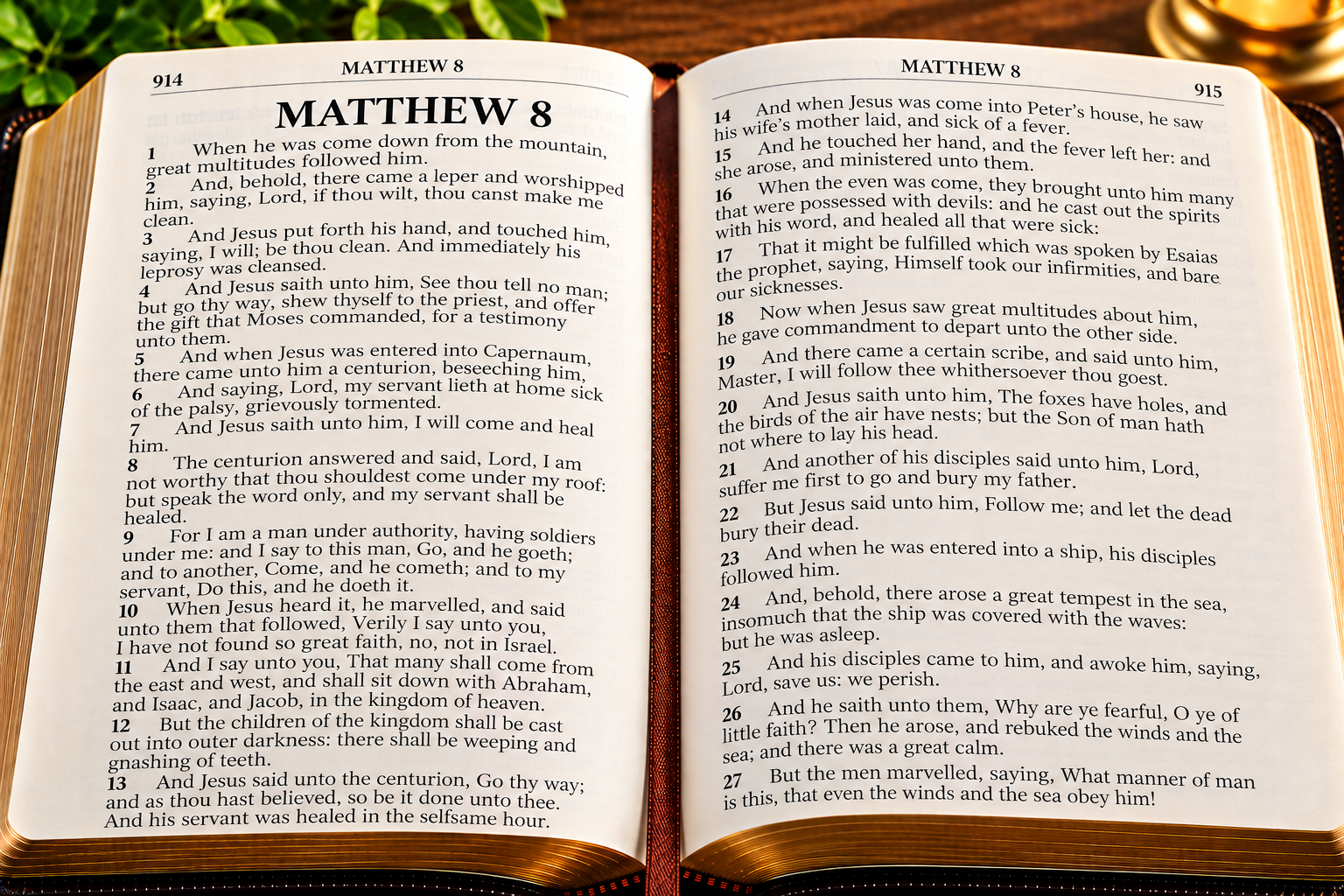
Matthew Chapter 8 begins a series of accounts demonstrating the authority of Jesus Christ through His miracles. Following the Sermon on the Mount in Matthew chapters 5–7, Matthew now shows Jesus putting His teaching into action through healing, deliverance, and demonstrations of power over nature.
Jesus cleanses a man with leprosy, heals a Roman centurion’s servant, restores Peter’s mother-in-law, and heals many others. He then challenges those who want to follow Him to understand the cost of discipleship.
The chapter continues with Jesus calming a violent storm on the Sea of Galilee and delivering two demon-possessed men in the region of the Gadarenes.
Throughout these events, Matthew emphasizes that Jesus possesses authority over physical sickness, social exclusion, natural forces, and demonic powers. The chapter also explores faith, compassion, the cost of following Christ, and the different responses people make to His authority.
Central theme: Jesus Christ demonstrates divine authority through healing, deliverance, and power over nature, while calling people to respond with faith, humility, and committed discipleship.
Main Sections of Matthew Chapter 8
- Jesus Cleanses a Man With Leprosy — Matthew 8:1–4
- The Faith of the Roman Centurion — Matthew 8:5–13
- Jesus Heals Peter’s Mother-in-Law and Many Others — Matthew 8:14–17
- The Cost of Following Jesus — Matthew 8:18–22
- Jesus Calms the Storm — Matthew 8:23–27
- Jesus Delivers Two Demon-Possessed Men — Matthew 8:28–34
1. Jesus Cleanses a Man With Leprosy
Matthew 8:1–4
After Jesus comes down from the mountain, large crowds follow Him. A man with leprosy approaches Jesus, kneels before Him, and declares:
“Lord, if thou wilt, thou canst make me clean.” — Matthew 8:2, KJV
The man’s words express confidence in Jesus’ ability to heal while submitting to His will.
Jesus responds by reaching out and touching him, saying:
“I will; be thou clean.” — Matthew 8:3, KJV
Immediately, the man is cleansed.
Jesus then instructs him to tell no one but to show himself to the priest and offer the gift Moses commanded as a testimony to them. This instruction reflects the requirements associated with the restoration of a person who had been declared ceremonially unclean.
In the biblical world, a skin disease could carry significant social and religious consequences. A person might experience separation from the community and restrictions on participation in worship.
Jesus’ healing therefore restores more than physical health. It also opens the way for the man’s reintegration into community life.
Key Lessons
- Jesus has authority to heal and restore.
- Faith can express confidence in God’s power while submitting to His will.
- Compassion can cross social barriers.
- Restoration may involve both physical healing and renewed community participation.
- Jesus respects the significance of the Mosaic instructions concerning ceremonial cleansing.
Bible study reflection: How can you demonstrate compassion toward people who are isolated, rejected, or overlooked?
2. The Faith of the Roman Centurion
Matthew 8:5–13
When Jesus enters Capernaum, a Roman centurion approaches Him and asks for help because his servant is suffering terribly and is paralyzed.
Jesus offers to come and heal him. However, the centurion responds with remarkable humility:
“Lord, I am not worthy that thou shouldest come under my roof: but speak the word only, and my servant shall be healed.” — Matthew 8:8, KJV
The centurion understands authority through his own military experience. Just as his commands are obeyed by those under his authority, he believes Jesus can heal through His command without being physically present.
Jesus marvels at this response and tells those following Him that He has not found such great faith in Israel.
He then speaks about people coming from east and west to participate in the kingdom of heaven, while warning that ancestry alone does not guarantee participation in God’s kingdom.
Jesus tells the centurion that his servant will be healed according to his faith. The servant is healed at that very hour.
Key Lessons
- Genuine faith recognizes Jesus’ authority.
- Humility can accompany great confidence in God.
- Compassion extends beyond ethnic and social boundaries.
- Religious background does not replace personal faith.
- Jesus’ authority is not limited by physical distance.
Bible study reflection: Do you trust Jesus’ authority even when you cannot see how He will work?
3. Jesus Heals Peter’s Mother-in-Law and Many Others
Matthew 8:14–17
Jesus enters Peter’s house and sees Peter’s mother-in-law lying sick with a fever. He touches her hand, and the fever leaves her. She rises and begins serving Him.
Later that evening, people bring Jesus many who are suffering from demonic oppression and various diseases. He drives out the spirits with a word and heals the sick.
Matthew connects these healings with Isaiah 53:4:
“Himself took our infirmities, and bare our sicknesses.” — Matthew 8:17, KJV
This quotation presents Jesus’ healing ministry in light of the prophetic portrait of the suffering servant.
The passage emphasizes Jesus’ compassion and authority over human suffering. His actions demonstrate the arrival of God’s restorative work.
The reference to Isaiah should be understood within the broader biblical context of the servant’s suffering and saving mission. It should not be used to conclude that every faithful believer is guaranteed immediate physical healing.
Key Lessons
- Jesus responds to suffering with compassion.
- Healing can restore people to participation in ordinary life and service.
- Jesus’ ministry reveals God’s concern for human weakness.
- The Gospel presents Jesus as the fulfillment of God’s redemptive purposes.
- Christians can pray for healing while recognizing that physical healing does not occur in every circumstance.
Bible study reflection: How can you respond to the needs of sick and suffering people with practical compassion?
4. The Cost of Following Jesus
Matthew 8:18–22
As crowds gather around Jesus, He gives instructions to cross to the other side of the lake. During this time, two individuals express interest in following Him.
A scribe tells Jesus that he will follow Him wherever He goes. Jesus responds by explaining that the Son of Man has nowhere to lay His head.
Jesus is emphasizing that discipleship does not guarantee comfort, security, or social prestige.
Another disciple asks permission to bury his father before following Jesus. Jesus replies:
“Follow me; and let the dead bury their dead.” — Matthew 8:22, KJV
This difficult saying emphasizes the urgency and priority of following Jesus. It should not be interpreted as a universal prohibition against caring for parents or attending funerals. Rather, Jesus challenges the disciple to recognize that the call of God’s kingdom cannot always be postponed until circumstances become convenient.
Key Lessons
- Discipleship requires commitment and sacrifice.
- Following Jesus does not guarantee an easy life.
- God’s call may challenge familiar priorities and expectations.
- Jesus must take priority over competing loyalties.
- Faithful discipleship requires discernment about how to respond to His call.
Bible study reflection: What comfort, habit, or competing priority might be preventing you from following Jesus more faithfully?
5. Jesus Calms the Storm
Matthew 8:23–27
Jesus enters a boat, and His disciples follow Him. While they are crossing the lake, a violent storm arises, and waves begin to overwhelm the boat.
Jesus is asleep during the storm. The disciples awaken Him, crying:
“Lord, save us: we perish.” — Matthew 8:25, KJV
Jesus responds by asking why they are fearful and why their faith is so little. He then rebukes the winds and the sea, and a great calm follows.
The disciples are astonished and ask:
“What manner of man is this, that even the winds and the sea obey him!” — Matthew 8:27, KJV
Their question highlights the central significance of the event. Jesus possesses authority over forces that human beings cannot control.
In the Old Testament, God’s power over the sea is an important sign of His sovereignty over creation. Matthew’s account invites readers to recognize the extraordinary authority displayed by Jesus.
Key Lessons
- Jesus has authority over nature.
- Fear can challenge a person’s ability to trust.
- Faith does not mean that storms will never arise.
- Jesus’ authority exceeds human limitations.
- The disciples are learning who Jesus truly is through their experiences with Him.
Bible study reflection: How can you maintain trust in God when circumstances feel beyond your control?
6. Jesus Delivers Two Demon-Possessed Men
Matthew 8:28–34
When Jesus reaches the region of the Gadarenes, two men who are described as demon-possessed come out from the tombs. They are extremely violent, and the surrounding area is dangerous because of them.
The demons recognize Jesus and cry out, asking whether He has come to torment them before the appointed time.
A herd of pigs is feeding nearby. The demons ask permission to enter the pigs, and Jesus permits them to do so. The herd then rushes down a steep place into the sea and perishes in the water.
The people tending the pigs flee to the city and report what happened. The townspeople then come out and ask Jesus to leave their region.
The account demonstrates Jesus’ authority over demonic powers. It also reveals a striking contrast: the men are delivered, but the people respond by asking Jesus to depart.
The text does not explain every detail of the economic or social consequences of the event. However, it clearly portrays Jesus’ authority and highlights the community’s reaction to His presence.
Key Lessons
- Jesus possesses authority over demonic powers.
- His ministry brings deliverance to people experiencing severe bondage.
- Powerful demonstrations of God’s work do not guarantee that everyone will respond with faith.
- People may resist God’s work when it disrupts their priorities or expectations.
- A community’s response to Jesus reveals what it values.
Bible study reflection: How should people respond when the work of God challenges their comfort, expectations, or material interests?
Major Themes in Matthew Chapter 8
1. The Authority of Jesus Christ
Jesus demonstrates authority over sickness, ceremonial uncleanness, demonic powers, and the natural world. The miracles reveal His unique identity and messianic mission.
2. Faith and Humility
The leper and the centurion approach Jesus with humility. Their responses demonstrate trust in His power without presuming to control His actions.
3. Compassion and Restoration
Jesus responds to people who are sick, excluded, and afflicted. His ministry demonstrates concern for human suffering and the restoration of people to meaningful life.
4. The Cost of Discipleship
Jesus teaches that following Him requires commitment and may involve discomfort, sacrifice, and difficult decisions.
5. Faith in Times of Fear
The calming of the storm reveals the disciples’ struggle to trust Jesus in dangerous circumstances. Their experience becomes an opportunity to recognize His authority more fully.
6. Spiritual Conflict
The deliverance of the two men reveals Jesus’ authority over demonic powers and the reality of opposition to His work.
7. Different Responses to Jesus
Some people approach Jesus in faith, while others become afraid or ask Him to leave. Matthew shows that witnessing Jesus’ works does not automatically produce a faithful response.
Biblical Interpretation Note
Matthew Chapter 8 should be interpreted within the broader context of Matthew’s presentation of Jesus as the promised Messiah and authoritative Son of God. After presenting Jesus’ teaching in the Sermon on the Mount, Matthew records a series of miracles that demonstrate the authority behind His words.
The chapter is not merely a collection of supernatural events. Its narratives reveal Jesus’ identity, His compassion toward suffering people, the nature of faith, and the demands of discipleship.
1. Jesus’ Authority Over Sickness and Ceremonial Uncleanness
The cleansing of the man with leprosy demonstrates Jesus’ power to restore someone who was physically afflicted and socially marginalized.
In the biblical context, the term translated as leprosy could refer to several serious skin conditions rather than only the modern disease known as Hansen’s disease.
The man’s request emphasizes both faith and submission: he believes Jesus can cleanse him but leaves the decision to Jesus’ will.
Jesus’ touch is significant because the man was considered ceremonially unclean. Rather than becoming defiled in the encounter, Jesus cleanses the man.
His instruction to show himself to the priest reflects the restoration process established in the Mosaic Law.
2. The Centurion’s Faith and the Scope of the Kingdom
The centurion’s confidence in Jesus’ authority is especially important because he is a Gentile and a representative of Roman military power.
His understanding of authority leads him to believe that Jesus can heal simply by speaking. Jesus commends his faith and uses the occasion to point toward the inclusion of people from east and west in the kingdom of heaven.
This teaching challenges the assumption that ethnic ancestry or religious heritage automatically guarantees participation in God’s kingdom.
The passage emphasizes that faith and response to Jesus matter more than relying on status or background.
3. Healing and Isaiah 53:4
Matthew connects Jesus’ healing ministry with Isaiah 53:4, which describes the servant bearing infirmities and carrying sorrows.
This quotation places Jesus’ healing activity within the broader story of God’s redemptive work.
Interpreters differ on how the relationship between this verse and the atoning significance of Jesus’ death should be understood. The immediate context of Matthew 8 emphasizes the healing of the sick and the removal of affliction.
The passage therefore supports the conclusion that Jesus’ ministry confronts human suffering, but it does not establish that every Christian is guaranteed physical healing in this life.
4. The Cost of Discipleship
Matthew 8:18–22 interrupts the miracle narratives to address the demands of following Jesus.
The two brief encounters expose different obstacles: the expectation of comfort and the desire to postpone commitment.
Jesus does not present discipleship as a path guaranteed to produce wealth, ease, or social status. He calls His followers to place loyalty to Him above competing priorities.
The statement about letting the dead bury their dead is intentionally challenging and emphasizes urgency. It should be interpreted within the passage’s focus on discipleship rather than used to dismiss family responsibility or the dignity of mourning.
5. Jesus’ Authority Over the Sea
The calming of the storm is more than a demonstration of Jesus’ ability to perform a miracle.
In the Old Testament, God’s authority over the sea is associated with His sovereignty over creation and the forces that threaten human life. By calming the storm with a command, Jesus demonstrates an authority that astonishes even His disciples.
Their question—“What manner of man is this?”—invites the reader to consider Jesus’ identity.
The passage also addresses fear and faith. The disciples’ fear is understandable in a life-threatening storm, but their experience reveals how difficult it can be to trust Jesus when circumstances appear overwhelming.
6. The Deliverance of the Two Men
The final account presents Jesus’ authority over demonic powers. The demons recognize Him and acknowledge that their power is limited in the presence of His authority.
The drowning of the pigs and the community’s response introduce questions about loss, fear, and the social consequences of Jesus’ work. Matthew does not provide a complete explanation of every aspect of the event.
The central emphasis is the authority of Jesus and the contrast between the deliverance of the men and the community’s request that Jesus leave.
The narrative warns that people may reject the presence of God’s kingdom when they perceive its effects as threatening their interests or disrupting their familiar way of life.
Key Interpretive Principle
Matthew Chapter 8 reveals Jesus Christ as the Messiah who exercises authority over sickness, ceremonial uncleanness, nature, and demonic powers. His miracles demonstrate compassion and restoration, while His teaching challenges people to respond with faith and committed discipleship.
The chapter calls readers not merely to admire Jesus’ power but to consider who He is, trust His authority, show compassion toward those who suffer, and place following Him above competing priorities.
Key Questions for Bible Study
These questions are designed for personal devotion, family Bible study, small-group discussion, or church teaching.
A. Observation Questions: What Does the Text Say?
- What request did the man with leprosy make to Jesus? (Matthew 8:1–3)
- What did Jesus instruct the cleansed man to do after healing him? (Matthew 8:4)
- Why did the Roman centurion believe Jesus could heal his servant from a distance? (Matthew 8:5–10)
- What did Jesus say about the faith of the centurion? (Matthew 8:10–13)
- Whom did Jesus heal at Peter’s house? (Matthew 8:14–15)
- What prophecy did Matthew connect with Jesus’ healing ministry? (Matthew 8:16–17)
- What did Jesus teach the individuals who expressed a desire to follow Him? (Matthew 8:18–22)
- How did Jesus respond when the disciples awakened Him during the storm? (Matthew 8:23–27)
- What happened when Jesus encountered the two demon-possessed men? (Matthew 8:28–32)
- How did the people of the region respond after the herd of pigs rushed into the sea? (Matthew 8:33–34)
B. Interpretation Questions: What Does the Passage Mean?
- What does the leper’s request reveal about faith and submission to Jesus?
- Why is Jesus’ willingness to touch the leper significant?
- What made the centurion’s faith remarkable in the context of the passage?
- What does the healing of Peter’s mother-in-law reveal about Jesus’ response to ordinary human suffering?
- How does Matthew use Isaiah 53:4 to interpret Jesus’ healing ministry?
- What do the two encounters about discipleship teach about the cost of following Jesus?
- Why were the disciples afraid during the storm, and what did the miracle reveal about Jesus?
- What is the significance of the disciples asking who Jesus is after He calms the sea?
- What does the deliverance of the two men reveal about Jesus’ authority?
- Why might people respond negatively when confronted with the work or authority of Jesus?
C. Application Questions: How Should We Respond?
- How can you approach Jesus with both confidence in His power and humility concerning His will?
- What can you learn from the centurion about trusting Jesus when you cannot control the circumstances?
- How can you show compassion to people who are isolated, sick, or socially rejected?
- What comfort or competing priority might be making it difficult for you to follow Jesus faithfully?
- How can you maintain faith when life presents circumstances that feel overwhelming?
- What practical steps can help you respond to fear through prayer, wise action, and trust in God?
- How should Christians support people experiencing illness or suffering without making promises about outcomes the Bible does not guarantee?
- Are there areas where material interests or personal comfort might be competing with your commitment to Christ?
- How can you demonstrate the authority and compassion of Jesus through your service to others?
- What is one lesson from Matthew Chapter 8 that you can put into practice this week?
D. Reflection and Group Discussion
- Which miracle in Matthew Chapter 8 most deepens your understanding of Jesus, and why?
- What is the difference between faith in Jesus’ authority and the assumption that He must act according to our expectations?
- How does Matthew 8 connect Jesus’ teaching in the Sermon on the Mount with His actions?
- What does this chapter teach about the relationship between faith, fear, and discipleship?
- Why is it important to consider both the miracles and the teaching about discipleship when interpreting this chapter?
- How can a church reflect Jesus’ compassion while remaining honest about the realities of suffering?
- What do the different responses to Jesus in this chapter reveal about the human heart?
- How can Matthew Chapter 8 strengthen your understanding of Jesus’ identity as the Messiah?
Memory Verse
Matthew 8:27 (KJV)
“But the men marvelled, saying, What manner of man is this, that even the winds and the sea obey him!”
Closing Reflection
Matthew Chapter 8 demonstrates the authority of Jesus Christ through His healing of the sick, cleansing of the unclean, calming of the storm, and deliverance of the demon-possessed.
The chapter also makes clear that following Jesus involves more than witnessing His power. It requires faith, humility, and a willingness to place His call above competing priorities.
Some people approach Jesus in trust, while others respond with fear or rejection. Their responses challenge readers to consider not only what Jesus can do but also who He is and what it means to follow Him.
Central Message: Matthew Chapter 8 reveals Jesus Christ as the authoritative and compassionate Messiah who restores the suffering, commands nature, defeats demonic powers, and calls His followers to trust Him and embrace the demands of discipleship.