

Introduction
Giving to God is an important theme throughout the Bible. From the offerings presented in the Old Testament to the generosity taught by Jesus and the apostles, Scripture encourages believers to honor God with their resources and care for others.
But what does it really mean to give to God? Is giving limited to money, and does the Bible require every Christian to give exactly ten percent of their income?
The Bible teaches that giving involves more than the amount a person contributes. It includes the heart, attitude, faith, gratitude, and willingness behind the gift. God calls His people to recognize Him as the source of their blessings, support the work of ministry, help those in need, and give with sincerity.
This article explores what the Bible says about giving to God and how Christians can apply these teachings in everyday life.
1. Giving to God Begins With Recognizing That Everything Belongs to Him
Key Scripture: Psalm 24:1 (KJV)
“The earth is the LORD’S, and the fulness thereof; the world, and they that dwell therein.”
The Bible teaches that God is the Creator and rightful owner of everything. Our lives, abilities, opportunities, possessions, and resources ultimately come from Him.
Giving to God is therefore not simply transferring something that belongs exclusively to us. It is an act of acknowledging His ownership and expressing gratitude for what He has entrusted to us.
First Chronicles 29:14 records David’s recognition of this truth when the people contributed materials for the temple. David acknowledged that everything came from God and that they were giving back what they had received from Him.
How to apply this principle
Christians can honor God by:
- Recognizing Him as the source of their provision.
- Managing their money and possessions responsibly.
- Using their abilities to serve others.
- Giving generously according to their circumstances.
- Avoiding the belief that material possessions are the ultimate measure of success.
Giving becomes an act of worship when it flows from gratitude and recognition of God’s provision.
2. God Desires Giving From a Willing Heart
Key Scripture: 2 Corinthians 9:7 (KJV)
“Every man according as he purposeth in his heart, so let him give; not grudgingly, or of necessity: for God loveth a cheerful giver.”
The apostle Paul teaches that Christians should give according to what they have decided in their hearts, rather than giving reluctantly or under compulsion.
This passage emphasizes the giver’s attitude. God is not interested only in the size of a contribution; the willingness and sincerity behind it also matter.
Giving should not be driven by manipulation, public pressure, or fear that God will reject or punish someone who cannot afford to give a particular amount.
A cheerful giver is someone who gives willingly, with gratitude and a desire to honor God.
What willing giving looks like
- Giving freely rather than out of resentment.
- Planning contributions thoughtfully.
- Giving according to one’s financial circumstances.
- Avoiding pressure to impress other people.
- Giving with gratitude rather than expecting a guaranteed financial return.
A willing heart does not mean that giving must always feel easy. It means that the decision to give is sincere rather than forced.
3. Giving to God Is an Act of Worship
Key Scripture: Proverbs 3:9 (KJV)
“Honour the LORD with thy substance, and with the firstfruits of all thine increase.”
In the Bible, giving is connected with honoring God. The Israelites brought offerings and firstfruits as expressions of gratitude, obedience, and recognition of God’s provision.
Proverbs 3:9 encourages God’s people to honor Him with their possessions and increase. The principle is that worship should influence how people use their resources, not merely what they say or sing.
Giving can become part of a believer’s worship when it is offered with a sincere desire to please God.
However, financial giving is not the only way to worship. Scripture also describes praise, prayer, obedience, service, and acts of mercy as ways to honor God.
Giving as worship today
A Christian may give to support a local church, contribute to a ministry, help a family in need, or support work that serves the community. The specific form of giving may vary, but the intention should be to honor God and serve others faithfully.
4. The Old Testament Teaches About Tithes and Offerings
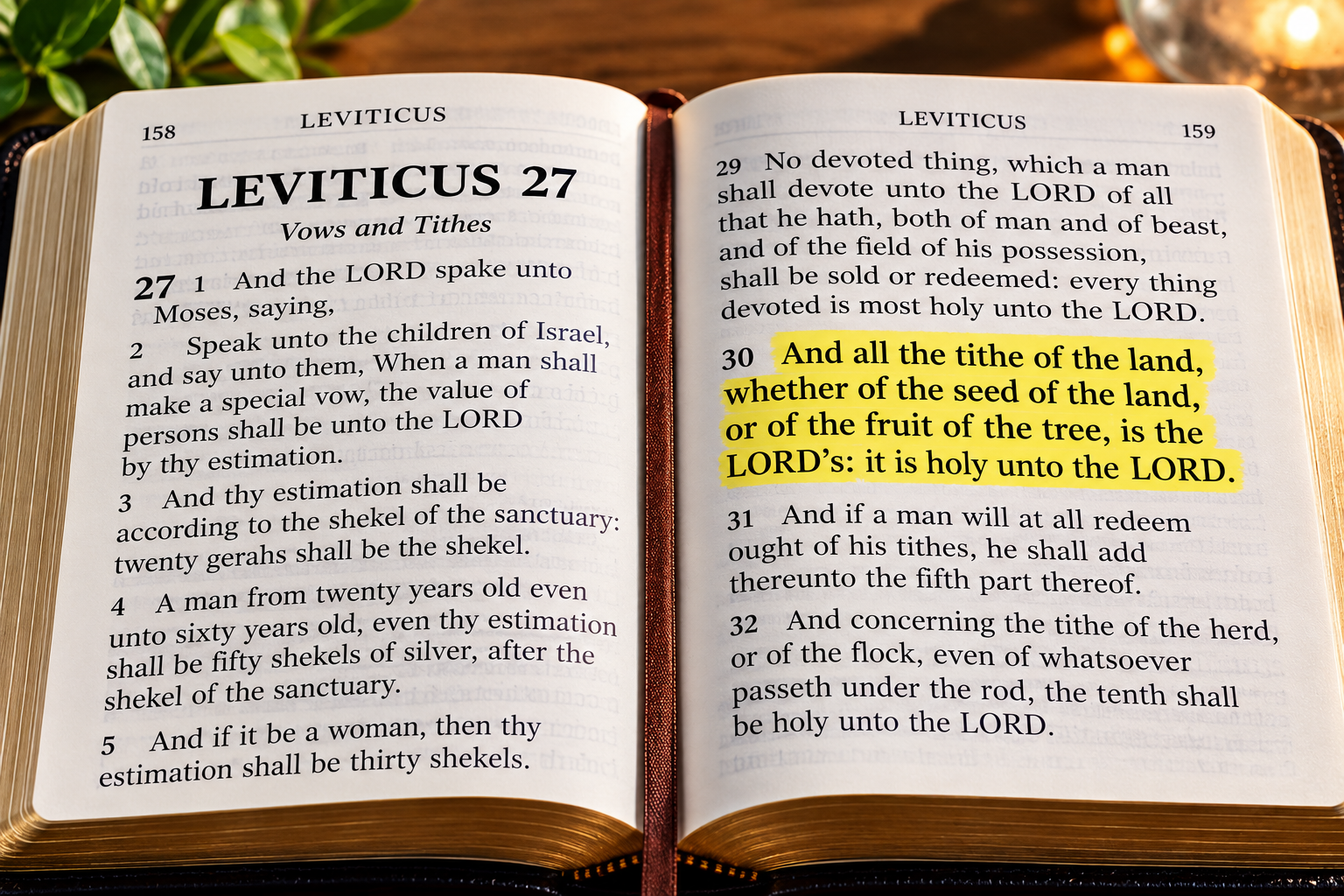
Key Scripture: Leviticus 27:30 (KJV)
“And all the tithe of the land, whether of the seed of the land, or of the fruit of the tree, is the LORD’S: it is holy unto the LORD.”
In the Old Testament, a tithe generally referred to a tenth. Tithes and offerings were part of Israel’s religious and community life under the Mosaic covenant.
The biblical instructions about tithing were connected to Israel’s agricultural produce, livestock, worship, and responsibilities toward the Levites and people in need.
Numbers 18:21–24 describes tithes given to the Levites in connection with their service at the tabernacle. Deuteronomy 14:28–29 also connects a tithe with providing for the Levites, foreigners, orphans, and widows.
Malachi 3:10 calls Israel to bring the full tithe into the storehouse. This passage is often discussed in Christian teaching about tithing, but its original setting is God’s covenant relationship with Israel.
Does the Bible require Christians to give exactly ten percent?
Christians interpret this question differently.
Some churches teach that the tithe remains a standard for Christian giving and encourage believers to give ten percent of their income. Other Christians understand the Old Testament tithe as part of Israel’s covenant law and emphasize the New Testament’s teaching on generous, willing, regular, and proportionate giving.
The New Testament does not explicitly restate a universal ten-percent minimum for every Christian. Instead, passages such as 2 Corinthians 8–9 emphasize willingness, generosity, responsibility, and giving according to one’s means.
Christians should study these passages in context and understand how their church teaches about tithes and offerings.
Whatever position a believer holds, giving should not be used to exploit people financially or to promise that a specific contribution will automatically produce wealth.
5. The New Testament Emphasizes Generosity and Cheerful Giving
Key Scripture: 2 Corinthians 9:6–8
Paul encourages the Corinthian church to give generously and willingly. He explains that giving should be purposeful rather than reluctant or compelled.
In 2 Corinthians 8, Paul also describes believers who contributed despite experiencing severe poverty. Their example highlights the sincerity of their generosity, not a requirement for people to neglect essential needs or put themselves in financial danger.
The New Testament’s teaching on giving includes several principles:
- Willingness: Give freely, without coercion.
- Proportion: Give in keeping with what you have.
- Generosity: Be ready to share with others.
- Planning: Set aside resources intentionally.
- Integrity: Handle contributions honestly.
- Compassion: Respond to genuine needs.
In 1 Corinthians 16:1–2, Paul instructs believers to set aside contributions regularly in connection with a collection for Christians in need. This demonstrates that Christian generosity can be both heartfelt and organized.
6. Giving Includes Supporting Those Who Serve in Ministry
Key Scripture: 1 Corinthians 9:13–14
Paul explains that those who proclaim the gospel may receive their living from the work of the gospel.
Throughout the Bible, God’s people are encouraged to support those who serve in religious ministry. In the Old Testament, the Levites received support connected with their tabernacle service. In the New Testament, Paul discusses the legitimacy of material support for those who preach and teach.
Today, Christians may give to support:
- Their local church.
- Pastors and other ministry workers.
- Missionaries and evangelists.
- Bible teaching and discipleship.
- Outreach and community service.
- Charitable work carried out by trustworthy ministries.
Churches and ministries also have a responsibility to handle donations transparently and use them for their stated purposes. Giving should be accompanied by wisdom, accountability, and responsible stewardship.
7. God Values Giving That Helps People in Need
Key Scripture: Proverbs 19:17 (KJV)
“He that hath pity upon the poor lendeth unto the LORD; and that which he hath given will he pay him again.”
The Bible repeatedly connects devotion to God with compassion for vulnerable people. Giving is not limited to supporting religious institutions; it also includes meeting practical needs.
Deuteronomy 15:7–11 instructs the Israelites not to harden their hearts against poor members of their community. In the New Testament, Jesus teaches His followers to care for people who are hungry, thirsty, sick, or otherwise vulnerable (Matthew 25:31–46).
Acts 4:34–35 describes believers sharing resources so that people in need could receive assistance.
These passages show that biblical generosity has a practical purpose. It should help people, relieve suffering, and express love through action.
Practical ways to give to people in need
Christians can:
- Provide food or essential supplies to families facing hardship.
- Support reputable charities and relief organizations.
- Help widows, orphans, and vulnerable neighbors.
- Assist people affected by disasters.
- Offer time, skills, transportation, or other practical support.
- Give financial help while respecting people’s dignity.
Giving to those in need is not separate from Christian faith. It is one way faith becomes visible through love and service.
8. Giving Should Be Done With Humility, Not for Recognition
Key Scripture: Matthew 6:1–4
In the Sermon on the Mount, Jesus warns against performing acts of righteousness merely to receive attention and praise from other people.
His teaching includes giving to the needy. Jesus does not condemn generosity; He challenges the desire to turn generosity into a public performance.
The central issue is motivation. A person can give a large amount and still seek personal glory. Another person can give a modest amount with sincere compassion and humility.
Jesus teaches that giving should not be used to build a reputation or make others feel inferior.
What this means for Christians
- Give without needing public praise.
- Respect the privacy of people receiving assistance.
- Avoid comparing contributions with those of others.
- Do not use donations to control or shame recipients.
- Remember that God sees motives that other people cannot see.
Public reporting may sometimes be appropriate for accountability, fundraising, or organizational transparency. Jesus’ warning concerns giving for personal glory rather than responsible communication about legitimate needs.
9. Giving Must Be Accompanied by Justice, Mercy, and Faithfulness
Key Scripture: Matthew 23:23 (KJV)
Jesus rebuked religious leaders who carefully observed certain tithing practices while neglecting “the weightier matters of the law, judgment, mercy, and faith.”
In this passage, Jesus did not treat justice, mercy, and faithfulness as optional. He challenged the religious leaders for emphasizing detailed religious observance while neglecting more fundamental responsibilities.
The lesson is important: giving money does not excuse dishonesty, cruelty, exploitation, or neglect of others.
A person should not assume that financial contributions compensate for mistreating employees, cheating customers, ignoring family responsibilities, or refusing to help someone in genuine need.
Biblical giving requires a life of integrity
Giving should be part of a broader commitment to follow God’s ways. Christians should seek to be honest in business, fair in their relationships, compassionate toward others, and faithful in their responsibilities.
Financial generosity is meaningful, but it should not replace obedience, justice, mercy, or love.
10. Give According to What You Have, Not What You Do Not Have
Key Scripture: 2 Corinthians 8:12 (KJV)
“For if there be first a willing mind, it is accepted according to that a man hath, and not according to that he hath not.”
Paul teaches that a willing gift is evaluated in relation to what the giver actually has, rather than what the giver does not possess.
This principle is especially important for people experiencing financial hardship. Scripture does not teach that every person must give the same amount regardless of income, essential expenses, dependents, or circumstances.
Giving should be thoughtful and responsible. Christians can plan their generosity while also meeting legitimate obligations and caring for their households.
How to practice responsible giving
- Review your income and essential expenses.
- Decide what you can give without neglecting important responsibilities.
- Set a realistic giving goal.
- Consider both financial contributions and practical service.
- Revisit your plan when your circumstances change.
The purpose is not to find an excuse to avoid generosity. It is to practice generosity honestly, without pretending to have resources that are not available.
11. Giving Is About More Than Money
Although financial giving is an important biblical theme, generosity includes other resources as well.
Romans 12:6–8 describes different gifts and forms of service within the Christian community. First Peter 4:10 encourages believers to use their gifts to serve one another.
Christians can give through their time, abilities, encouragement, hospitality, knowledge, and practical assistance.
For example, someone may help an elderly neighbor with groceries, volunteer at a food pantry, mentor a young person, visit someone who is lonely, or use a professional skill to serve a ministry.
These actions do not mean financial giving is unimportant. They demonstrate that a generous life involves more than money.
Biblical generosity is a pattern of using what God has entrusted to you to honor Him and serve others.
12. God Does Not Promise That Every Gift Will Make You Wealthy
Some teachings about giving suggest that a particular financial contribution will guarantee a specific financial return. However, the Bible does not promise that every gift will make every giver wealthy.
In 2 Corinthians 9:6–11, Paul discusses God’s provision and the ability of believers to continue doing good works. The passage connects God’s provision with generosity, service, and thanksgiving; it should not be reduced to a formula for becoming rich.
The Bible includes faithful people who experienced poverty, persecution, suffering, and loss. Jesus Himself warned against making earthly wealth the center of one’s life (Matthew 6:19–21).
Christians may trust God to provide for their needs while recognizing that financial outcomes vary. Giving should be an expression of faith, gratitude, and love—not an attempt to purchase a guaranteed blessing.
A responsible understanding of giving avoids exploiting vulnerable people with promises that God will multiply a donation by a fixed amount.
13. How Can Christians Give to God Today?
The Bible provides principles that Christians can use to develop a thoughtful approach to giving. The details may differ among churches and Christian traditions, but the following practices reflect important biblical themes.
Step 1: Begin with gratitude
Remember that your abilities, opportunities, and resources are gifts to be managed responsibly. Let gratitude shape your attitude toward giving.
Step 2: Study the Scriptures
Read passages about tithes, offerings, generosity, ministry support, and care for the poor. Consider their original context and how the New Testament applies these principles to Christian life.
Step 3: Make a thoughtful plan
Decide how you will support your church, ministries, charitable causes, and people in need. Regular planning can help you give consistently instead of acting only when you feel pressured.
Step 4: Give willingly and proportionately
Consider your financial circumstances and give according to what you have. If your church teaches a particular standard for tithing, study the biblical reasoning behind that teaching and consider how to apply it responsibly.
Step 5: Choose trustworthy recipients
Look for accountability, financial transparency, and a clear purpose for donations. Responsible stewardship matters for both the giver and the organization receiving the gift.
Step 6: Practice generosity beyond financial contributions
Use your time, skills, and resources to serve people. Look for practical ways to demonstrate compassion in your family, church, workplace, and community.
Step 7: Examine your motives
Ask yourself whether you are giving out of gratitude and love or because of fear, pressure, competition, or a desire for recognition.
These practices can help make giving a meaningful expression of Christian faith.
Frequently Asked Questions About Giving to God
1. What does the Bible say about giving to God?
The Bible teaches that giving is an expression of worship, gratitude, generosity, and care for others. It encourages believers to give willingly, responsibly, and according to their means. Giving can support ministry and help people in need.
2. What Bible verse says God loves a cheerful giver?
Second Corinthians 9:7 says that each person should give as decided in the heart, not reluctantly or under compulsion, because God loves a cheerful giver. The verse emphasizes willing and sincere generosity.
3. Does God require Christians to give ten percent?
Christians differ in their interpretation of tithing. Some understand ten percent as a continuing standard for Christian giving. Others believe the Old Testament tithe belonged to Israel’s covenant law and that the New Testament emphasizes willing, generous, regular, and proportionate giving. The New Testament does not explicitly establish a universal ten-percent minimum for every Christian.
4. What is the difference between tithes and offerings?
A tithe generally refers to a tenth in biblical usage. Offerings are contributions given for various purposes, including worship, ministry, or assistance to people in need. The precise categories and obligations depend on the biblical passage and the Christian tradition interpreting it.
5. Can I give directly to people in need instead of giving to a church?
The Bible clearly encourages helping people in need, and Jesus teaches compassion toward vulnerable people. Churches differ in how they understand the relationship between church contributions and charitable giving. Christians can study Scripture and their church’s teaching while making thoughtful decisions about both.
6. Should I give if I am struggling financially?
Second Corinthians 8:12 teaches that a gift is accepted according to what a person has, not what the person does not have. Someone experiencing hardship can practice generosity in ways appropriate to their circumstances, including service and practical assistance. Giving should not be coerced or require neglecting essential needs.
7. Does God bless people who give?
The Bible connects generosity with God’s care, spiritual growth, thanksgiving, and the ability to continue doing good. However, it does not promise that every gift will produce wealth or a specific financial return. Biblical giving should be motivated by faith and love rather than a guaranteed financial reward.
8. Is giving money the only way to give to God?
No. Scripture also encourages believers to give their time, talents, hospitality, encouragement, and practical help. Financial generosity is important, but serving others is also a meaningful expression of faith.
Conclusion: Give to God With Gratitude, Wisdom, and Love
The Bible presents giving as more than a financial obligation. It is an expression of worship, gratitude, generosity, and responsibility toward others.
From the Old Testament teachings about tithes and offerings to the New Testament emphasis on cheerful and proportionate giving, Scripture encourages God’s people to use their resources faithfully.
Christians should remember that giving does not replace justice, mercy, obedience, or love. Nor should it be driven by manipulation or the promise of guaranteed wealth.
Whether you are supporting your church, helping a family in need, contributing to a ministry, or serving your community, seek to give with a sincere heart and a responsible spirit.
The central principle is this: Honor God with what He has entrusted to you, give willingly according to your means, and let your generosity reflect your love for Him and for others.
Key Bible Verses About Giving to God
- Psalm 24:1 — Everything belongs to the Lord.
- Proverbs 3:9 — Honor the Lord with your possessions and firstfruits.
- Leviticus 27:30 — The tithe is described as holy to the Lord.
- Deuteronomy 15:7–11 — Do not harden your heart against people in need.
- Malachi 3:10 — God’s instruction to Israel concerning the full tithe.
- Matthew 6:1–4 — Give without seeking human praise.
- Matthew 23:23 — Do not neglect justice, mercy, and faithfulness.
- 1 Corinthians 9:13–14 — Support for those who proclaim the gospel.
- 1 Corinthians 16:1–2 — Set aside contributions regularly.
- 2 Corinthians 8:12 — Give according to what you have.
- 2 Corinthians 9:6–8 — Give willingly and cheerfully.
- 1 Peter 4:10 — Use your gifts to serve others.