

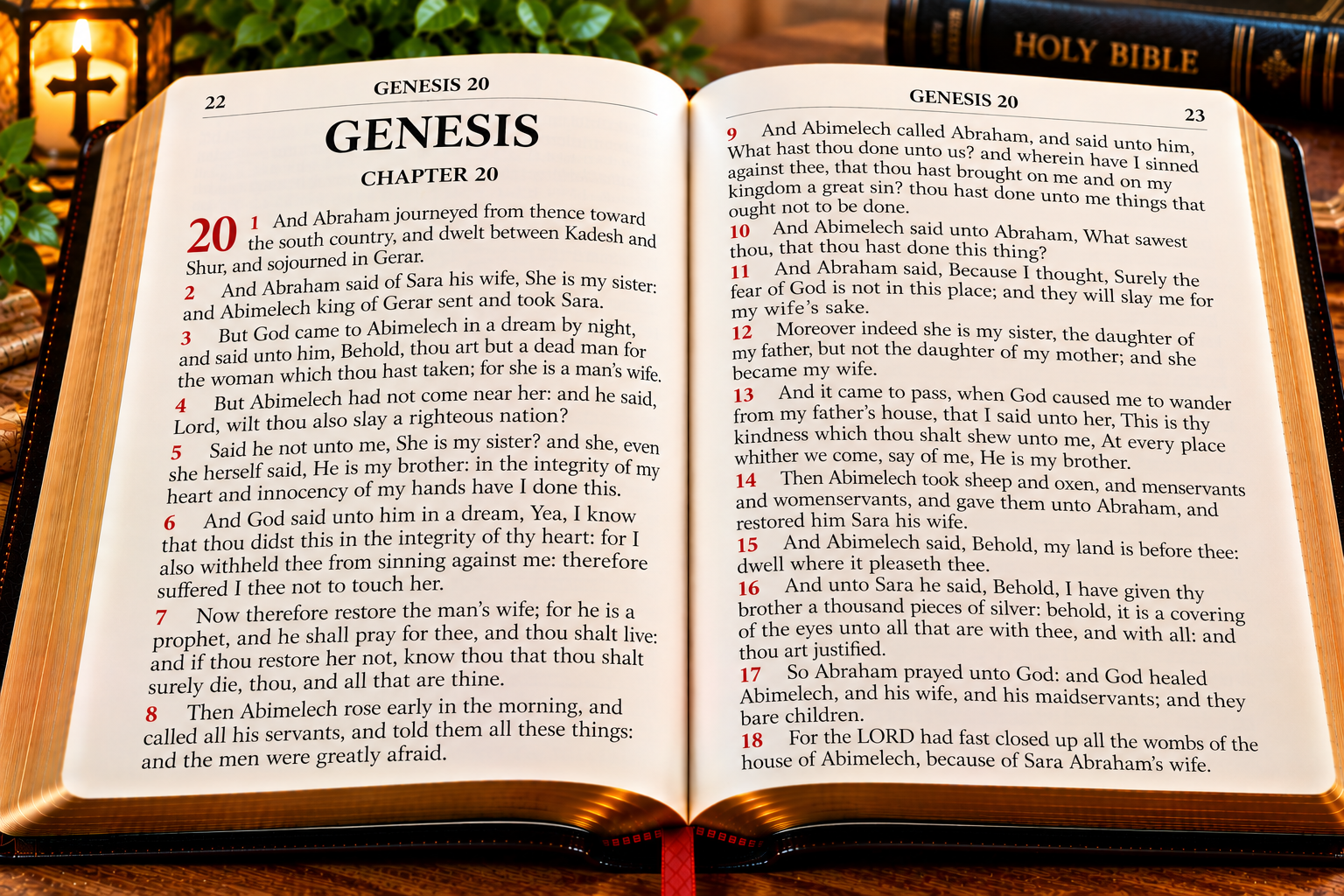
Book: Genesis Chapter: 20 Content Category: Bible Chapter Study Content Type: Chapter Overview, Biblical Interpretation, and Bible Study Questions Primary Scripture: Genesis 20:1–18 Key Theme: God’s protection of Sarah and the covenant promise, the consequences of Abraham’s deception, and the importance of integrity, repentance, and divine intervention.
Introduction
Genesis 20 recounts an episode in Abraham’s life in which he travels to the region of Gerar and once again identifies Sarah as his sister rather than openly acknowledging her as his wife. This resembles an earlier event in Genesis 12, when Abraham went to Egypt during a famine and presented Sarah as his sister to Pharaoh.
In Gerar, King Abimelech takes Sarah into his household after Abraham’s statement leads him to believe that she is not married. However, God intervenes by appearing to Abimelech in a dream and warning him that Sarah is another man’s wife. Abimelech protests that he acted in ignorance and had not intended to commit wrongdoing. God acknowledges that Abimelech acted with integrity in this matter and tells him to return Sarah to Abraham, who is identified as a prophet and instructed to pray for the king.
Abimelech confronts Abraham about his deception, and Abraham explains that he feared he might be killed because of Sarah. He also explains that Sarah is his half-sister, a statement that supplies additional information about their family relationship but does not make his concealment of their marriage harmless.
Abimelech returns Sarah to Abraham, provides gifts and compensation, and allows Abraham to settle in the land. Abraham then prays for Abimelech and his household, and God heals the women whose ability to bear children had been affected during the incident.
Genesis 20 demonstrates that God’s covenant purposes do not depend on the flawless behavior of the people He calls. At the same time, the chapter does not excuse Abraham’s deception. It portrays God’s intervention, Abimelech’s response, and Abraham’s responsibility to pray for the household he has placed at risk.
Key Verse — Genesis 20:7 (KJV)
“Now therefore restore the man his wife; for he is a prophet, and he shall pray for thee, and thou shalt live: and if thou restore her not, know thou that thou shalt surely die, thou, and all that are thine.”
This verse highlights God’s command to restore Sarah to Abraham and introduces Abraham’s role as a prophet who is to pray for Abimelech.
Chapter Overview: Genesis 20
A. Abraham Travels to Gerar — Genesis 20:1–2
After the events surrounding Sodom and Gomorrah, Abraham travels toward the southern region and settles between Kadesh and Shur, dwelling for a time in Gerar. While there, he tells people that Sarah is his sister. Abimelech, the king of Gerar, consequently takes Sarah into his household.
This event is striking because Abraham has already experienced a similar situation in Egypt in Genesis 12:10–20. Despite his earlier experience of God’s protection, Abraham again uses the same strategy of concealing his marriage to Sarah.
His action creates a serious problem because Sarah is the woman through whom God has promised to establish the covenant line. The events of Genesis 20 occur before the birth of Isaac, which is recorded in Genesis 21. Therefore, the preservation of Sarah is important to the continuation of the promise.
The narrative does not state every detail of Abimelech’s intentions when he takes Sarah. What it does establish is that he acts on the information he has received and that God intervenes before the situation proceeds further.
Lessons from Genesis 20:1–2
- Past experiences of God’s faithfulness do not mean that a person will never struggle with fear again.
- Deception can create consequences for people beyond the person who tells the lie.
- God’s covenant purposes remain central to the story, even when Abraham acts unwisely.
- Faithfulness requires more than remembering God’s promises; it also involves acting with honesty.
B. God Warns Abimelech in a Dream — Genesis 20:3–7
God comes to Abimelech in a dream and tells him that he is a dead man because the woman he has taken is married. Abimelech has not yet approached Sarah sexually, and he responds by questioning how he could be held responsible for an offense he did not knowingly commit.
Abimelech explains that Abraham said Sarah was his sister and that Sarah herself confirmed the family relationship. He appeals to the integrity of his heart and the innocence of his hands.
God acknowledges that Abimelech acted with integrity in this specific matter and explains that He prevented him from sinning against Him. God then commands Abimelech to return Sarah to Abraham, identifying Abraham as a prophet who will pray for him.
This exchange is important because it distinguishes between wrongdoing committed knowingly and conduct undertaken without the knowledge that would make the situation clear. Abimelech’s ignorance does not mean the situation is harmless, but God acknowledges his stated integrity and intervenes to prevent further wrongdoing.
The passage also introduces Abraham’s prophetic role. In this context, being a prophet is associated with his relationship with God and his responsibility to intercede for Abimelech.
Lessons from Genesis 20:3–7
- God can intervene to prevent wrongdoing and protect people from harm.
- Honest intentions and accurate knowledge matter when evaluating responsibility.
- A person can be affected by another person’s deception without having intended to do wrong.
- Abraham’s calling includes responsibility to pray for others, even after his own poor decisions have contributed to a crisis.
C. Abimelech Confronts Abraham — Genesis 20:8–13
Early the next morning, Abimelech calls his servants and tells them what has happened. They respond with fear. Abimelech then summons Abraham and challenges him about the deception.
He asks Abraham what he has done and what offense he or his kingdom has committed to deserve such a situation. Abimelech’s questions reveal that Abraham’s conduct has placed the king and his household in danger.
Abraham explains that he feared there was no fear of God in the place and that he might be killed because of Sarah. He also says that Sarah is indeed his half-sister, sharing the same father but not the same mother, and that she became his wife.
Abraham then describes an arrangement he and Sarah had made when they traveled. Wherever they went, Sarah was to say that Abraham was her brother.
This explanation reveals that the deception was not simply an isolated statement made in a moment of confusion. It was a deliberate strategy Abraham had developed because of his fear.
Although his concern for his life may explain his decision, it does not make the deception morally sound. Abraham’s actions expose Sarah and Abimelech to a serious situation and undermine the trust that should characterize his dealings with others.
Lessons from Genesis 20:8–13
- Fear can lead people to develop patterns of dishonest behavior.
- Explaining why a person acted wrongly is not the same as justifying the action.
- Deception can damage relationships and place innocent people at risk.
- Honest confrontation can expose wrongdoing and create an opportunity for accountability.
- God’s people are not exempt from the need to examine their own conduct.
D. Abimelech Restores Sarah and Provides Compensation — Genesis 20:14–16
Abimelech takes sheep, oxen, servants, and female servants and gives them to Abraham. He also returns Sarah to him. Abimelech then tells Abraham that the land is available to him and that he may dwell wherever he chooses.
Abimelech further addresses Sarah and gives her a substantial amount of silver. The wording of Genesis 20:16 has been interpreted in different ways, but the statement is connected with the restoration of Sarah’s honor and the public clarification of the situation.
The king’s actions are significant because he does not simply return Sarah quietly. He provides material gifts, makes the restoration explicit, and gives Abraham permission to settle in the land.
The passage presents Abimelech as taking steps to resolve the crisis once he understands the truth. It also emphasizes that Sarah is returned to Abraham before the covenant promise concerning her son is fulfilled.
Lessons from Genesis 20:14–16
- Resolving a serious wrong may require more than verbal acknowledgment; practical steps can also be necessary.
- Restoring a person’s dignity and setting the record straight can be important parts of resolving conflict.
- Material compensation in the narrative should not be treated as proof that every harm can be repaired through money alone.
- Abimelech’s response contrasts with Abraham’s earlier deception.
E. Abraham Prays, and God Heals Abimelech’s Household — Genesis 20:17–18
After Sarah is returned, Abraham prays to God, and God heals Abimelech, his wife, and his female servants so that they can bear children again. Genesis explains that the LORD had closed the wombs of the women in Abimelech’s household because of Sarah, Abraham’s wife.
The chapter concludes with a clear resolution: Sarah is restored to Abraham, Abraham intercedes for Abimelech’s household, and the women are healed.
The account demonstrates the significance of prayer in the relationship between Abraham and God. However, it should not be interpreted to mean that every illness or reproductive difficulty in modern life is the result of a specific sin. The text describes a particular event within the biblical narrative.
The conclusion also prepares the reader for Genesis 21, where Sarah gives birth to Isaac, fulfilling the promise God made to Abraham and Sarah.
Lessons from Genesis 20:17–18
- Intercessory prayer is an important part of Abraham’s relationship with God.
- The resolution of the crisis includes the healing of Abimelech’s household.
- God’s intervention preserves the circumstances necessary for the promised birth of Isaac.
- Specific biblical accounts of divine judgment or healing should not be generalized carelessly to every modern situation.
Major Themes in Genesis 20
| Theme | Scripture | Meaning |
|---|---|---|
| Fear and deception | Genesis 20:1–2, 11–13 | Abraham’s fear leads him to conceal his marriage to Sarah. |
| Divine intervention | Genesis 20:3–7 | God warns Abimelech and prevents further wrongdoing. |
| Integrity and responsibility | Genesis 20:4–6 | Abimelech explains his lack of knowledge and appeals to his integrity. |
| Covenant preservation | Genesis 20:3, 7, 18 | God’s intervention protects Sarah before Isaac’s birth. |
| Prophetic calling | Genesis 20:7 | Abraham is identified as a prophet and instructed to pray for Abimelech. |
| Accountability | Genesis 20:9–13 | Abimelech confronts Abraham about the consequences of his deception. |
| Restoration | Genesis 20:14–16 | Sarah is returned, and Abimelech takes steps to resolve the crisis. |
| Intercessory prayer | Genesis 20:17 | Abraham prays for Abimelech and his household. |
| Healing | Genesis 20:17–18 | God heals the women in Abimelech’s household. |
Biblical Interpretation Note: Understanding Genesis 20
1. Why Did Abraham Say Sarah Was His Sister?
Scripture: Genesis 12:10–20; Genesis 20:1–13
Abraham explains that he feared he would be killed because of Sarah. He believed that the people in the region might not fear God and might take Sarah while killing him.
Genesis 20:12 adds that Sarah was Abraham’s half-sister: they shared the same father but had different mothers. Abraham’s statement was therefore partly true, but it concealed the more important fact that Sarah was also his wife.
This distinction matters. A statement can contain a technically true element while still misleading another person. Abraham’s explanation reveals the fear behind his decision, but the narrative does not present his deception as a commendable strategy.
The repetition of this episode after Genesis 12 also shows that Abraham’s faith did not make him immune to fear or poor judgment.
Interpretive principle: A person’s fear may explain dishonest conduct, but it does not automatically justify the deception or the harm it causes.
2. Why Did God Warn Abimelech in a Dream?
Scripture: Genesis 20:3–7; Job 33:14–18
God warns Abimelech that Sarah is a married woman and that the situation presents a serious danger. Abimelech responds that he acted without knowing the truth, and God acknowledges his integrity in this particular matter.
The dream serves as a means of divine communication within this narrative. God uses it to reveal information that Abimelech did not possess and to prevent him from proceeding further.
The passage does not teach that every dream carries a divine message or that every dream should be interpreted as a direct warning from God. Its significance comes from the explicit way the biblical narrative identifies God’s communication and explains its purpose.
Interpretive principle: Interpret the dream according to the role it plays in Genesis 20 rather than treating the account as a universal method for interpreting modern dreams.
3. Was Abimelech Innocent?
Scripture: Genesis 20:4–7, 9–10
Abimelech states that he acted with an honest heart and innocent hands because he did not know Sarah was married. God acknowledges that He prevented Abimelech from sinning against Him in this matter.
This is a specific statement about Abimelech’s knowledge and intentions in the incident. It does not establish that Abimelech was sinless in every aspect of his life or that all his actions as king were righteous.
The narrative also shows that Abimelech takes the situation seriously after God reveals the truth. He confronts Abraham, returns Sarah, and takes steps to resolve the crisis.
Interpretive principle: Recognize the text’s acknowledgment of Abimelech’s integrity in this incident without extending that judgment beyond what the passage supports.
4. What Does Genesis 20 Teach About God’s Protection of Sarah?
Scripture: Genesis 20:3–7, 14–18; Genesis 17:15–21; Genesis 21:1–7
God’s intervention prevents the situation involving Sarah from proceeding further. This is important because God has already promised that Sarah will bear Isaac, the son through whom the covenant promise will continue.
The chapter therefore links God’s protection of Sarah with the fulfillment of His promise. Abraham’s actions create a crisis, but they do not defeat God’s purpose.
This does not mean that believers will never face danger or that every person will be protected from every form of harm in the same way. Genesis 20 recounts a particular event in the history of the Abrahamic covenant.
Interpretive principle: The passage emphasizes God’s faithfulness to His covenant promise without guaranteeing that every believer will experience identical protection in every circumstance.
5. What Does It Mean That Abraham Was a Prophet?
Scripture: Genesis 20:7; Deuteronomy 18:18; Exodus 7:1
God calls Abraham a prophet and tells Abimelech that Abraham will pray for him so that he may live.
In this context, Abraham’s prophetic identity is connected with his special relationship with God and his role in intercession. The passage does not provide a complete definition of the prophetic office, but it clearly identifies Abraham as someone who can pray for Abimelech under God’s instruction.
The description is particularly significant because Abraham is not presented as morally flawless. Although he has contributed to the crisis through deception, he is still called to pray for the king.
Interpretive principle: God’s calling involves responsibility and service; it should not be confused with a claim that the person called is incapable of error.
6. Why Did Abimelech Confront Abraham?
Scripture: Genesis 20:9–13
Abimelech asks Abraham what he has done and what offense the king’s kingdom has committed to deserve such a situation. His response shows that Abraham’s deception has endangered people who were not given the truth about Sarah’s marriage.
The confrontation makes an important ethical point: private fear can produce public consequences. Abraham’s attempt to protect himself creates danger for Sarah and Abimelech’s household.
The passage also demonstrates that being a person of faith does not exempt someone from accountability. Abraham is challenged directly about his conduct, and the narrative preserves the confrontation rather than hiding his failure.
Interpretive principle: Faithfulness includes honesty and accountability. Religious status does not make deceptive conduct harmless or immune from criticism.
7. What Is the Significance of Sarah’s Half-Sister Relationship to Abraham?
Scripture: Genesis 20:12; Genesis 11:27–29
Abraham states that Sarah is his half-sister, sharing the same father but not the same mother. This additional detail explains the family relationship behind his statement.
The information does not resolve the moral problem in the narrative. Abraham uses a partial truth to conceal his marriage, and Abimelech acts on incomplete information.
The passage should be read within its ancient family and social context. It is not a general instruction about how people should represent marriage relationships or what forms of family relationship are acceptable in every legal or cultural setting.
Interpretive principle: Historical background can clarify a biblical statement without turning the character’s behavior into a moral rule for later generations.
8. Why Did God Close the Wombs of the Women in Abimelech’s Household?
Scripture: Genesis 20:17–18
The chapter explains that the LORD had closed the wombs of the women in Abimelech’s household because of Sarah. After Abraham prays, God heals them.
This is presented as a specific divine act within the narrative. The text links the condition to the crisis involving Sarah and describes its resolution after Abraham’s prayer.
Readers should not generalize this account into a claim that infertility or difficulty conceiving is always caused by personal sin or divine punishment. The passage does not authorize such a conclusion about people today.
Interpretive principle: Respect the specific explanation provided in Genesis 20 while avoiding unsupported claims about the causes of reproductive difficulties in other circumstances.
9. How Does Genesis 20 Connect with Genesis 12 and Genesis 21?
Scripture: Genesis 12:10–20; Genesis 20:1–18; Genesis 21:1–7
Genesis 12 and Genesis 20 contain similar episodes in which Abraham identifies Sarah as his sister while staying in a foreign region. In both cases, a ruler takes Sarah into his household, and God intervenes.
The repetition reveals a recurring weakness in Abraham’s conduct: fear leads him to conceal the marriage. It also demonstrates that God’s promise continues despite Abraham’s failures.
Genesis 21 then records the birth of Isaac. Read together, these chapters show that the covenant story includes both human weakness and divine faithfulness.
Interpretive principle: The repeated episode should not be used to excuse Abraham’s deception. Its importance lies partly in showing that God’s faithfulness persists even when the people involved act imperfectly.
Key Questions for Bible Study: Genesis 20
These questions are suitable for personal Bible study, family devotion, small-group discussion, or church teaching.
A. Observation Questions
- Where did Abraham travel at the beginning of Genesis 20? (Genesis 20:1)
- What did Abraham tell the people about Sarah? (Genesis 20:2)
- Who took Sarah into his household? (Genesis 20:2)
- How did God communicate with Abimelech? (Genesis 20:3)
- What warning did God give Abimelech? (Genesis 20:3–7)
- How did Abimelech explain his actions to God? (Genesis 20:4–5)
- What did God say about Abimelech’s heart and hands? (Genesis 20:6)
- What did God tell Abimelech to do concerning Sarah? (Genesis 20:7)
- How did Abimelech respond after waking from the dream? (Genesis 20:8)
- What questions did Abimelech ask Abraham? (Genesis 20:9–10)
- Why did Abraham say he had acted as he did? (Genesis 20:11)
- What additional information did Abraham provide about his relationship with Sarah? (Genesis 20:12)
- What did Abimelech give Abraham when Sarah was returned? (Genesis 20:14–16)
- What did Abraham do after Sarah was restored? (Genesis 20:17)
- What happened to the women in Abimelech’s household? (Genesis 20:17–18)
B. Interpretation Questions
- Why did Abraham repeat the strategy he had used in Egypt?
- What is the difference between a statement that is partly true and a statement that communicates the whole truth?
- Why did God intervene before Abimelech proceeded further with Sarah?
- What does God’s response to Abimelech reveal about the importance of knowledge and intention?
- What does Abraham’s designation as a prophet reveal about his relationship with God?
- Why was Abraham’s deception harmful to people beyond himself?
- What does Abimelech’s confrontation teach about accountability?
- How does God’s intervention preserve the covenant promise concerning Isaac?
- What does Abraham’s prayer for Abimelech’s household teach about intercession?
- Why should the healing described in Genesis 20:17–18 not be used to claim that every reproductive difficulty is caused by sin?
C. Application Questions
- Have you ever allowed fear to influence your honesty? What can you learn from Abraham’s experience?
- How can you tell the truth even when you are worried about the possible consequences?
- What should you do when you discover that someone has been harmed by information you concealed or misrepresented?
- How can you accept correction without becoming defensive?
- What does Abimelech’s response teach about taking responsibility once the truth becomes clear?
- How can you distinguish between explaining your behavior and making excuses for it?
- What can Abraham’s role as an intercessor teach you about praying for people with whom you have experienced conflict?
- How can you protect others from the consequences of decisions made out of fear?
- How can you demonstrate integrity in family relationships, work, business, and ministry?
- What practical step can you take to make your communication more truthful and trustworthy?
D. Deeper Reflection Questions
- How does Genesis 20 illustrate the difference between God’s faithfulness and human reliability?
- Why might the Bible preserve accounts of serious failures in the lives of people chosen by God?
- How should Christians understand God’s protection of Sarah without assuming that every faithful person will be protected in exactly the same way?
- What does the passage teach about the relationship between personal intention, knowledge, and moral responsibility?
- How does the repeated sister-wife episode in Genesis 12 and Genesis 20 contribute to the development of Abraham’s character?
- What does Abraham’s intercession for Abimelech reveal about the responsibilities associated with his calling?
- How can believers maintain confidence in God’s promises while still taking personal responsibility for their actions?
- In what ways does Genesis 20 prepare the reader for the birth of Isaac in Genesis 21?
E. Personal Reflection and Prayer
Reflect on these questions after reading the chapter:
- Honesty: Where do I need to be more truthful, even when honesty feels difficult?
- Fear: What fears may be influencing my decisions?
- Accountability: Am I willing to receive correction when my actions harm others?
- Prayer: Who needs my prayers, including people with whom I may have a difficult relationship?
- Faithfulness: How can I trust God’s promises while acting responsibly and ethically?
Related Bible Verses for Further Study
| Bible Passage | Connection to Genesis 20 |
|---|---|
| Genesis 12:10–20 | Abraham’s earlier deception concerning Sarah in Egypt. |
| Genesis 17:15–21 | God’s promise that Sarah will bear Isaac. |
| Genesis 18:14 | God’s declaration that nothing is too difficult for Him. |
| Genesis 21:1–7 | The fulfillment of the promise through Isaac’s birth. |
| Psalm 15:1–2 | The importance of truthfulness and integrity. |
| Proverbs 12:22 | God’s displeasure with lying and His delight in faithful conduct. |
| James 5:16 | The importance of prayer for others. |
| Ephesians 4:25 | The call to speak truthfully to one another. |
Chapter Summary: Genesis 20
Genesis 20 recounts Abraham’s deception concerning Sarah in Gerar, Abimelech’s taking her into his household, and God’s intervention through a dream. God warns Abimelech, commands him to return Sarah, and identifies Abraham as a prophet who will pray for him. Abimelech confronts Abraham, restores Sarah, and provides gifts and compensation. Abraham then prays for Abimelech’s household, and God heals the women whose wombs had been closed.
The chapter exposes the consequences of fear-driven deception while emphasizing God’s intervention and faithfulness to His covenant promise. It also demonstrates that people who serve God remain accountable for their actions and are called to practice honesty, responsibility, and intercessory prayer.
One-sentence summary: Genesis 20 teaches that God’s faithfulness can preserve His promises despite human failures, while reminding believers that fear-driven deception harms others and must be met with honesty, accountability, and responsible action.