An altar is an important symbol throughout the Bible. From the altars built by Noah and Abraham to the altar of sacrifice in the tabernacle and temple, altars played a significant role in worship, sacrifice, prayer, covenant, thanksgiving, and dedication to God.
In the Old Testament, an altar was generally a raised structure made of earth or stone, or constructed according to God’s instructions, where offerings and sacrifices were presented. People also built altars to commemorate encounters with God, remember His promises, and express their gratitude for His protection and provision.
In the New Testament, the meaning of sacrifice becomes closely connected to Jesus Christ, whose death is central to Christian faith. The New Testament also calls believers to offer spiritual sacrifices through praise, generosity, service, and a life dedicated to God.
The meaning of an altar in the Bible is therefore connected to worship, sacrifice, covenant, remembrance, repentance, and devotion to God. However, the significance of an altar depends on its biblical context. Not every altar mentioned in Scripture was used to worship the true God; some were constructed for idolatrous worship and were condemned.
This article explores the biblical meaning of an altar, its purposes, important examples, spiritual lessons, and relevance to Christian living today.
1. What Is an Altar in the Bible?
An altar in the Bible is a place or structure used for presenting offerings and sacrifices, particularly in worship of God. In the Old Testament, altars were often constructed from earth or stones. They could be built by individuals in response to God’s promises or established as part of the tabernacle and temple worship system.
One of the earliest examples appears in Genesis 8:20:
“And Noah builded an altar unto the LORD…” — Genesis 8:20, KJV
After the flood, Noah built an altar and offered burnt offerings to the Lord. This act demonstrated worship and gratitude following God’s deliverance of Noah and his family.
Altars were not merely physical structures. Their significance came from what people did at them and the relationship between worship, obedience, and God’s instructions.
The biblical meaning of an altar includes:
- Worship: A place where people honored God.
- Sacrifice: A place where offerings were presented according to God’s instructions.
- Thanksgiving: A way to express gratitude for God’s goodness and deliverance.
- Covenant: A setting associated with solemn commitments between God and His people.
- Remembrance: A memorial of God’s promises, provision, or intervention.
- Dedication: An expression of commitment to the Lord.
An altar did not give people control over God. Its purpose was to serve the worship and religious practices God had established, not to manipulate Him.
2. The Origin of Altars in the Bible
The Bible records altars early in the book of Genesis. These early examples show how people responded to God’s presence, promises, and deliverance.
Noah’s altar
Bible reference: Genesis 8:20–21
After leaving the ark, Noah built an altar to the Lord and offered burnt offerings. God responded by declaring that He would not again curse the ground in the same manner because of humanity.
Noah’s altar is associated with worship, gratitude, and the events following the flood.
Spiritual lesson: When God brings us through a difficult season, our response should include gratitude, worship, and renewed commitment to Him.
Abraham’s altar at Shechem
Bible reference: Genesis 12:6–7
When Abram arrived in Canaan, God appeared to him and promised the land to his descendants. Abram responded by building an altar to the Lord.
The altar marked a significant moment in Abraham’s relationship with God and His promises.
Spiritual lesson: Faith involves trusting God’s promises, even when their complete fulfillment is still in the future.
Abraham’s altar between Bethel and Ai
Bible reference: Genesis 12:8
Abram moved to the region between Bethel and Ai, built another altar, and called upon the name of the Lord.
This passage connects the altar with prayer and worship.
Spiritual lesson: Worship and prayer should be part of our continuing relationship with God, not only something we practice during emergencies.
Abraham’s altar at Mamre
Bible reference: Genesis 13:18
After separating from Lot, Abram settled near the oaks of Mamre and built an altar to the Lord.
The account illustrates Abraham’s continuing devotion to God as his journey progressed.
Spiritual lesson: Faithfulness to God is a lifelong commitment rather than a single spiritual experience.
3. What Was the Purpose of an Altar in the Old Testament?
Altars served several purposes in biblical worship. Understanding these purposes helps readers interpret passages about sacrifices, offerings, covenants, and religious ceremonies.
A. Altars were used for sacrifice
Sacrifices were central to the worship system God established for Israel. Depending on the type of offering, sacrifices could express worship, thanksgiving, dedication, purification, or atonement.
Leviticus 1 describes the burnt offering, which was presented on the altar according to God’s instructions.
Leviticus 17:11 explains the significance of blood in the system of atonement established for Israel.
These offerings were not interchangeable. The Law of Moses prescribed different offerings for different circumstances.
Spiritual lesson: Worship in the Bible was meant to be approached with reverence and according to God’s instructions.
B. Altars were used for worship
People built altars to honor the Lord and call upon His name.
Genesis 12:8 describes Abram building an altar and calling upon the Lord. This connects the altar with a personal response of worship and devotion.
An altar was not simply a monument. It was associated with an act of honoring God.
Spiritual lesson: True worship involves the heart, our words, and our actions.
C. Altars marked encounters with God
Several biblical figures built altars after significant encounters with God.
In Genesis 26:24–25, God appears to Isaac, reassures him, and repeats His promises. Isaac responds by building an altar and calling upon the Lord.
In Genesis 35:1–7, God instructs Jacob to return to Bethel and build an altar. Jacob obeys and builds the altar where God had revealed Himself to him.
These examples demonstrate that altars could mark significant moments in a person’s spiritual journey.
Spiritual lesson: Remembering God’s faithfulness can strengthen our trust in Him during future challenges.
D. Altars were associated with covenant
An altar could form part of a ceremony that confirmed a covenant or solemn agreement.
In Exodus 24:4–8, Moses builds an altar at Mount Sinai. Sacrificial blood is used in the ceremony in which the covenant between God and Israel is confirmed.
This was a formal covenant ceremony, not merely a private devotional act.
Spiritual lesson: Commitments made before God should be treated with seriousness, faithfulness, and obedience.
4. The Different Types of Altars in the Bible
The Bible describes several kinds of altars. They differed in purpose, location, and the offerings or ceremonies associated with them.
1. The altar of burnt offering
References: Exodus 27:1–8; Leviticus 1:1–17
The altar of burnt offering was located in the courtyard of the tabernacle and later had a counterpart in the temple.
Animal sacrifices were presented there according to the Law of Moses. The burnt offering was distinctive because the offering was burned on the altar according to the prescribed ritual.
This altar was central to Israel’s sacrificial worship.
2. The altar of incense
References: Exodus 30:1–10; Luke 1:8–11
The altar of incense stood inside the tabernacle’s Holy Place, near the veil separating the Holy Place from the Most Holy Place.
Incense was burned on it according to God’s instructions. In biblical imagery, incense is also associated with prayer, as illustrated in Psalm 141:2 and Revelation 8:3–4.
The altar of incense should not be confused with the altar of burnt offering. They had different locations and purposes.
3. The altar built by the patriarchs
References: Genesis 8:20; Genesis 12:7–8; Genesis 26:25
Noah, Abraham, and Isaac built altars in connection with worship and significant events in their lives.
These accounts show that altars existed before Israel’s tabernacle and temple worship system was established.
4. The altar of memorial
References: Joshua 22:26–29
The tribes of Reuben, Gad, and the half-tribe of Manasseh built a large altar near the Jordan River. The other Israelites initially feared that it represented rebellion against God.
The eastern tribes explained that the altar was intended as a witness between the tribes, not as a place for unauthorized sacrifices.
This account illustrates how an altar could serve as a memorial of shared identity and commitment to the Lord.
5. Idolatrous altars
References: 1 Kings 18:26–30; 2 Kings 23:15
Not every altar in the Bible was pleasing to God.
The prophets of Baal used an altar in their attempt to call upon their false god in 1 Kings 18. In 2 Kings 23, King Josiah destroyed an altar associated with idolatrous worship at Bethel.
These passages show that an altar’s presence did not automatically make the worship associated with it acceptable.
Important lesson: The Bible evaluates worship according to the true God and His revealed will, not merely according to the presence of a religious structure.
5. What Does Building an Altar to God Mean?
In the Old Testament, building an altar often represented a deliberate act of worship, thanksgiving, dedication, or remembrance.
Abraham built altars in response to God’s promises
Genesis 12:7 records Abraham building an altar after God promised the land to his descendants.
Abraham’s response connected the promise with worship. He did not build the altar because he had already received everything God promised. He built it while trusting God’s word.
Isaac built an altar after receiving reassurance from God
In Genesis 26:24–25, God reassures Isaac that He is with him. Isaac responds by building an altar, calling upon the Lord, and pitching his tent.
His response combines worship with the practical circumstances of his life.
Jacob built an altar at Bethel
Genesis 35:1–7 describes Jacob returning to Bethel in obedience to God’s instruction. He builds an altar there and names the place El-Bethel.
The account follows Jacob’s command to his household to put away foreign gods and purify themselves.
This makes the passage especially significant for studying worship, repentance, and renewed commitment.
Application today: Christians can respond to God’s faithfulness through prayer, worship, gratitude, obedience, and dedication. These actions do not require constructing a physical altar.
6. What Does the Bible Say About the Altar of Sacrifice?
The altar of sacrifice was an important part of the tabernacle and temple worship system.
In the Old Testament, God gave Israel specific instructions about sacrifices, offerings, priests, and the altar. These instructions served the covenant relationship between God and Israel.
Leviticus 6:12–13 explains that the altar fire was to be maintained continually. This instruction belonged to Israel’s prescribed sacrificial worship.
The sacrifices included different offerings with different purposes. For example, burnt offerings, peace offerings, and sin offerings were not identical rituals.
The sacrificial system also pointed to the seriousness of sin and the need for atonement within the covenant God established with Israel.
How Christians understand the altar of sacrifice
The New Testament presents Jesus Christ’s death as central to the fulfillment of God’s redemptive purpose.
Hebrews 10:10 teaches that believers are sanctified through the offering of Jesus Christ’s body once for all.
Hebrews 10:11–14 contrasts the repeated sacrifices performed by priests with Christ’s single offering, which has enduring significance.
Therefore, Christian teaching does not require the reconstruction of the Old Testament sacrificial system or the offering of animal sacrifices for sin.
Key lesson: The Old Testament altar helps readers understand the biblical history of sacrifice, while the New Testament directs attention to the saving work of Jesus Christ.
7. What Does Rebuilding an Altar Mean in the Bible?
Rebuilding an altar can symbolize restoring worship when God’s people have turned away from Him. One of the clearest examples is Elijah’s confrontation with the prophets of Baal.
Elijah repairs the Lord’s altar
Bible reference: 1 Kings 18:30–39
During the contest on Mount Carmel, Elijah calls the people near and repairs the altar of the Lord that had been broken down.
He uses twelve stones, representing the tribes of Israel, and prepares the sacrifice according to the account.
Elijah then prays to God. Fire from the Lord consumes the offering, wood, stones, dust, and water in the trench.
The event demonstrates God’s power and challenges Israel’s divided worship.
Elijah’s action was not simply about repairing a physical structure. In the narrative, it was part of a confrontation over whom Israel would worship.
Spiritual lessons from Elijah’s altar
1. Return to the true God. The people had become involved in worship associated with Baal. Elijah called them back to the Lord.
2. Restore what has been neglected. The broken altar symbolized a serious problem in Israel’s worship.
3. Reject divided loyalty. Elijah challenges the people to stop wavering between the Lord and Baal.
4. Pray in dependence on God. Elijah asks God to answer so the people will recognize the Lord’s identity and turn their hearts back to Him.
What does rebuilding an altar mean for Christians today?
In Christian application, rebuilding an altar can be used as a metaphor for renewing one’s commitment to God. It may involve returning to prayer, reading Scripture, confessing sin, forgiving others, or restoring neglected responsibilities.
However, Christians should distinguish this modern metaphor from the historical altar Elijah physically repaired. The passage does not command every Christian to construct a special altar or perform a particular ritual to obtain God’s favor.
8. What Is the Spiritual Meaning of an Altar Today?
Christians sometimes use the word altar to describe a place of prayer, surrender, repentance, or commitment. This is often metaphorical language drawn from biblical accounts.
The New Testament emphasizes the believer’s relationship with God through Jesus Christ rather than prescribing a physical altar for every Christian household or congregation.
A. An altar can represent a life dedicated to God
Romans 12:1 says:
“Present your bodies a living sacrifice, holy, acceptable unto God…” — Romans 12:1, KJV
Paul uses the language of sacrifice to describe the Christian life. Believers are called to dedicate their bodies and conduct to God.
This means that worship extends beyond a church service. It includes everyday choices, relationships, work, and service.
B. An altar can represent prayer
Prayer is central to biblical worship. Matthew 6:6 teaches believers to pray privately to the Father, while Philippians 4:6 encourages prayer and thanksgiving.
A person may choose a quiet place in a home for prayer and Bible study. Such a place can support a consistent devotional routine, but Scripture does not require a dedicated physical altar for prayer to be heard.
C. An altar can represent repentance
Psalm 51:17 teaches that God does not despise a broken and contrite heart.
Genuine repentance involves acknowledging sin, turning away from wrongdoing, and seeking to live in obedience to God. It is not achieved by placing an object on a table or performing a ritual without a changed heart.
D. An altar can represent praise and generosity
Hebrews 13:15–16 describes praise, doing good, and sharing with others as sacrifices pleasing to God.
This teaches that spiritual sacrifice includes practical expressions of faith. Worship is reflected in how believers treat others and use what God has entrusted to them.
9. Does Every Christian Need a Physical Altar?
No. The New Testament does not command every Christian to build a physical altar at home.
In the Old Testament, altars were part of specific forms of worship established under the covenant with Israel. In the New Testament, the emphasis is on Christ’s sacrifice and the believer’s life of worship, prayer, faith, and obedience.
A Christian may choose to create a quiet devotional area containing a Bible, notebook, or other useful study materials. This can be helpful for maintaining a regular prayer routine.
However, these objects do not possess automatic spiritual power. A physical space or object cannot replace faith in God, obedience to Scripture, or the saving work of Jesus Christ.
Christians should avoid treating an altar as a mechanism for forcing God to provide money, healing, protection, or other desired outcomes. Biblical prayer is an expression of trust and dependence on God, not a technique for controlling Him.
10. What Is the Difference Between a Biblical Altar and a Modern Prayer Altar?
The distinction depends on how the terms are being used.
| Biblical altar | Modern prayer altar |
|---|---|
| Often a physical structure used for prescribed sacrifices and offerings. | Often a designated place for personal or congregational prayer. |
| Could be part of a covenant ceremony or a memorial. | May symbolize commitment, repentance, or devotion. |
| In Israel’s worship system, it was governed by specific instructions in the Law of Moses. | Its form and use vary among Christian traditions. |
| Some altars were associated with idolatry and were condemned. | A prayer space should direct attention to God rather than to objects or rituals. |
The word altar is used differently across Christian traditions. Some churches use the term for the front of the sanctuary, a communion table, or a place where people come forward for prayer. Others use it primarily when discussing biblical sacrifice.
The most important point is to understand the biblical passage in its original context before drawing spiritual applications from it.
11. Important Bible Verses About Altars and Their Meanings
Here are ten key passages for further study:
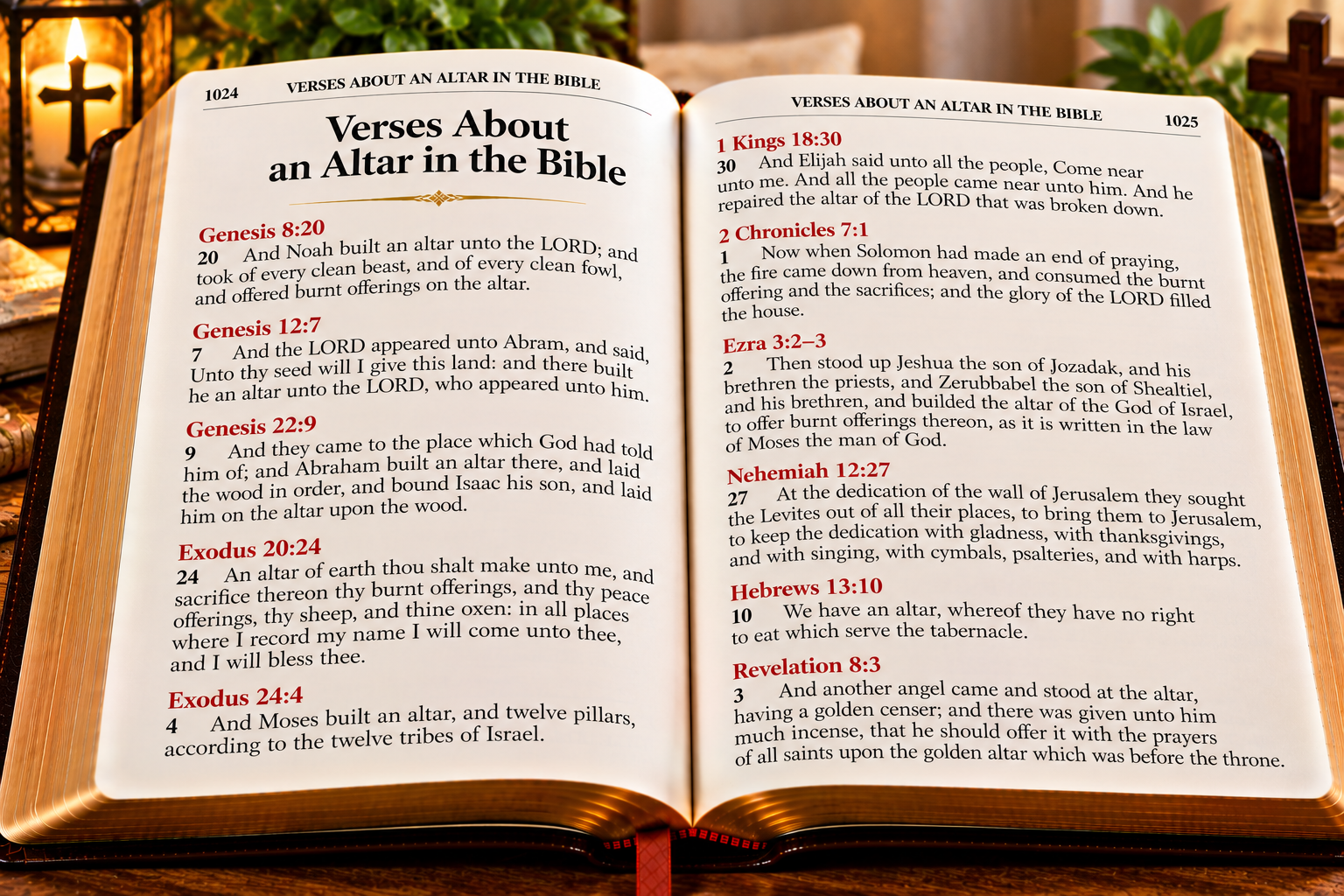
- Genesis 8:20 — Noah builds an altar in response to deliverance from the flood.
- Genesis 12:7 — Abraham builds an altar after receiving God’s promise.
- Genesis 26:25 — Isaac builds an altar, calls upon the Lord, and establishes his camp.
- Exodus 20:24 — God gives instructions concerning altars used in His worship.
- Exodus 30:1–10 — God gives instructions for the altar of incense.
- 1 Kings 18:30–39 — Elijah repairs the Lord’s altar during the confrontation on Mount Carmel.
- Psalm 51:17 — God values a broken and contrite heart.
- Matthew 5:23–24 — Jesus teaches the importance of reconciliation before presenting a gift at the altar.
- Romans 12:1 — Believers are urged to present themselves as living sacrifices.
- Hebrews 10:10 — Christ’s offering is described as once for all.
These passages provide a foundation for understanding the historical, religious, and spiritual significance of altars in Scripture.
12. Lessons Christians Can Learn From Altars in the Bible
Lesson 1: Remember God’s faithfulness
Abraham, Isaac, Jacob, and Noah built altars in response to significant events in their relationships with God. Their stories encourage believers to remember God’s faithfulness and respond with gratitude.
Lesson 2: Worship must be sincere
The prophets repeatedly warned against religious practices disconnected from obedience and justice. Isaiah 1:11–17 is an important example.
God does not accept outward religious activity as a substitute for genuine faithfulness.
Lesson 3: Repentance requires a sincere heart
Psalm 51:17 emphasizes a broken and contrite heart. Repentance is not merely a ceremony; it involves a sincere response to God’s holiness and mercy.
Lesson 4: Jesus Christ is central to Christian worship
Hebrews 10:10 teaches that Christ’s offering was made once for all. Christians should understand Old Testament sacrifices in light of the New Testament’s teaching about Jesus.
Lesson 5: Offer your life to God
Romans 12:1 calls believers to live as sacrifices dedicated to God. This includes worship, integrity, service, generosity, and love for others.
Lesson 6: Seek reconciliation
In Matthew 5:23–24, Jesus emphasizes reconciliation with another person in connection with worship. Christians should not use religious practices to ignore unresolved wrongdoing or mistreatment.
13. Frequently Asked Questions About Altars in the Bible
1. What does an altar symbolize in the Bible?
An altar can symbolize worship, sacrifice, thanksgiving, covenant, dedication, or remembrance. Its exact meaning depends on the passage and the purpose for which the altar was used.
2. Who built the first altar in the Bible?
Genesis 8:20 records Noah building an altar to the Lord after leaving the ark. This is the first altar explicitly described in the biblical narrative.
3. Why did Abraham build altars?
Abraham built altars in connection with God’s appearances and promises. Genesis 12:7–8 records him building altars and calling upon the name of the Lord.
4. What does rebuilding an altar mean spiritually?
In Christian teaching, rebuilding an altar can serve as a metaphor for restoring neglected worship, prayer, repentance, and commitment to God. Elijah’s repair of the Lord’s altar in 1 Kings 18 is a central biblical example.
5. Is an altar necessary for prayer?
No. Matthew 6:6 teaches that believers can pray privately to God without a physical altar. A designated prayer space may be helpful, but it is not a biblical requirement.
6. What is the altar of incense?
The altar of incense was a gold-covered altar inside the tabernacle’s Holy Place. Incense was burned on it according to God’s instructions (Exodus 30:1–10). Revelation 8:3–4 later uses incense imagery in connection with the prayers of God’s people.
7. What is the difference between the altar of incense and the altar of burnt offering?
The altar of burnt offering stood in the tabernacle courtyard and was used for prescribed sacrifices. The altar of incense stood inside the Holy Place and was used for burning incense. Their locations and functions were different.
8. What does the New Testament say about altars?
The New Testament discusses altars in connection with Israel’s worship, Christ’s sacrifice, and biblical imagery. It also emphasizes spiritual sacrifices, including praise, generosity, and a life dedicated to God (Hebrews 13:15–16; Romans 12:1).
9. Should Christians build altars in their homes?
The New Testament does not require Christians to build physical altars in their homes. Believers may establish a quiet place for prayer and Bible study, but physical objects and rituals do not automatically bring God’s favor or protection.
10. What is a good Bible verse about altars?
First Kings 18:30 is an important verse about repairing the Lord’s altar. Romans 12:1 is particularly useful for teaching about dedicating one’s life to God as a living sacrifice.
Conclusion
The meaning of an altar in the Bible is closely connected to worship, sacrifice, covenant, remembrance, and devotion to God. In the Old Testament, altars served important purposes in the worship and covenant life of God’s people. Some marked encounters with God, while others were used in the sacrificial system established under the Law of Moses.
The account of Elijah rebuilding the Lord’s altar illustrates the importance of returning to the true God when worship has been corrupted. The New Testament develops the theme of sacrifice through Jesus Christ and calls believers to offer their lives in faithful service.
For Christians today, the central lesson is not that a physical altar must be built to gain God’s attention. Rather, believers are called to worship sincerely, pray faithfully, repent genuinely, love others, and dedicate their lives to God.
Romans 12:1 summarizes this application: present yourself to God as a living sacrifice, holy and pleasing to Him. A life of faithful worship and obedience is a meaningful response to God’s grace.
Prayer for a Life Dedicated to God
Heavenly Father, thank You for Your faithfulness throughout the Bible and for the salvation offered through Jesus Christ. Teach me to worship You with a sincere heart and to remember Your goodness in every season of life. Help me turn away from sin, restore neglected spiritual disciplines, and dedicate my thoughts, words, and actions to Your will. May my life reflect genuine worship, faithful service, generosity, and love. In Jesus’ name, Amen.