Altars play an important role throughout the Bible. In the Old Testament, people built altars to worship God, offer sacrifices, remember His promises, and mark significant encounters with Him. Noah, Abraham, Isaac, Jacob, Moses, Joshua, and other biblical figures are associated with altars.
Altars also appear in the tabernacle and temple, where sacrifices and offerings were presented according to God’s instructions. In the New Testament, the meaning of sacrifice is understood in light of Jesus Christ, whose sacrifice is central to Christian faith.
This collection presents 50 Bible passages about altars, organized by theme for personal Bible study, sermons, devotionals, and Christian website content. Each entry includes a short explanation of its significance.
1. Bible Verses About the First Altars and Worship
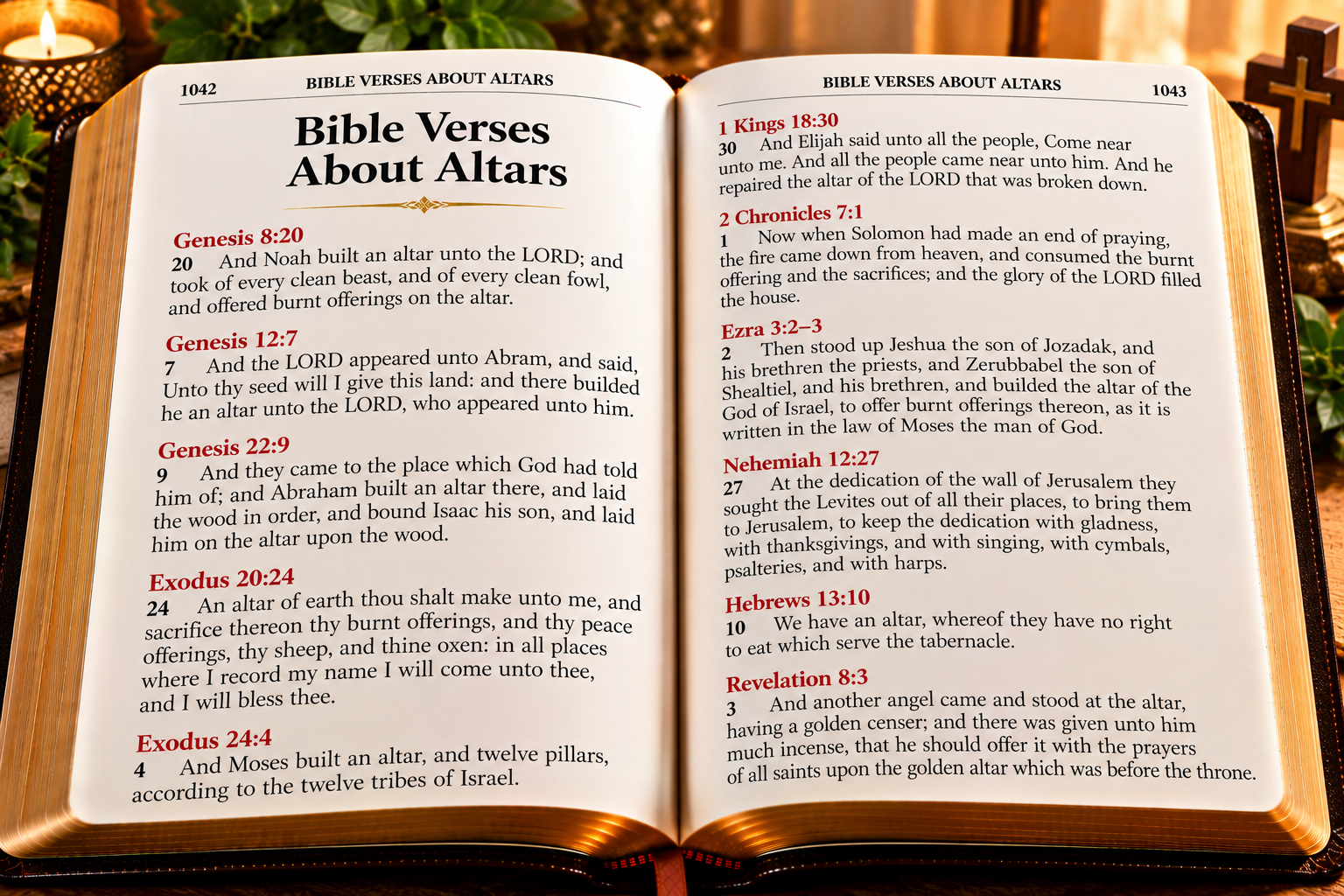
- Genesis 8:20 — Noah builds an altar to the Lord after leaving the ark and offers burnt offerings from clean animals and birds.
- Genesis 12:7 — Abram builds an altar to the Lord after God appears to him and promises the land to his descendants.
- Genesis 12:8 — Abram builds another altar between Bethel and Ai and calls upon the name of the Lord.
- Genesis 13:4 — Abram returns to the place where he had built an altar and calls upon the Lord.
- Genesis 13:18 — Abram settles near the oaks of Mamre and builds an altar to the Lord.
- Genesis 22:9 — Abraham builds an altar and prepares the wood when God tests his faith through the command concerning Isaac.
- Genesis 26:25 — Isaac builds an altar at Beersheba, calls upon the Lord, and establishes his camp there.
- Genesis 33:20 — Jacob erects an altar and names it El-Elohe-Israel.
- Genesis 35:1 — God commands Jacob to go to Bethel, live there, and build an altar to the God who appeared to him.
- Genesis 35:7 — Jacob builds an altar at Bethel because God had revealed Himself to him there.
2. Bible Verses About Altars and Covenant with God
11. Exodus 17:15 — Moses builds an altar and names it “The LORD Is My Banner” after Israel’s victory over Amalek.
12. Exodus 20:24 — God instructs the Israelites to make an altar of earth and promises to come to the places where His name is remembered.
13. Exodus 20:25 — God gives instructions for constructing a stone altar, emphasizing that it should not be made from hewn stones.
14. Exodus 24:4 — Moses builds an altar at the foot of Mount Sinai and establishes twelve pillars representing the twelve tribes of Israel.
15. Exodus 24:6 — Moses uses the blood of sacrifices in the covenant ceremony between God and Israel.
16. Exodus 27:1 — God gives Moses instructions for constructing the bronze altar for the tabernacle.
17. Exodus 29:36 — The instructions for consecrating the altar include making atonement for it and purifying it.
18. Exodus 30:1 — God commands the construction of an altar of incense for worship in the tabernacle.
19. Leviticus 6:13 — The fire on the altar must be kept burning continually and must not go out.
20. Deuteronomy 27:5 — Israel is commanded to build an altar of stones to the Lord without using iron tools on them.
3. Bible Verses About Altars, Sacrifice, and Atonement
21. Leviticus 1:9 — The burnt offering is presented on the altar as an offering made by fire, described as a pleasing aroma to the Lord.
22. Leviticus 4:7 — The priest places some of the sacrificial blood on the altar of incense before the Lord as part of the prescribed sin offering.
23. Leviticus 6:12 — The priest maintains the altar fire and adds wood each morning before arranging the burnt offering.
24. Leviticus 17:11 — God explains the significance of blood in making atonement for life.
25. Numbers 7:84 — The passage records the dedication offerings for the altar presented by Israel’s leaders.
26. Numbers 16:46 — Aaron takes a censer, puts fire from the altar in it, and makes atonement for the people during a plague.
27. Deuteronomy 12:27 — Israel is instructed to offer burnt offerings on God’s altar and handle sacrificial blood according to His commands.
28. 2 Chronicles 7:1 — Fire comes down from heaven and consumes the burnt offering and sacrifices when Solomon finishes praying at the dedication of the temple.
29. Hebrews 9:14 — Christ’s blood cleanses the conscience from dead works so believers may serve the living God.
30. Hebrews 10:10 — Believers are sanctified through the offering of the body of Jesus Christ once for all.
4. Bible Verses About Restoring and Rebuilding Altars
31. Judges 6:24 — Gideon builds an altar to the Lord and names it “The LORD Is Peace.”
32. Judges 6:26 — God commands Gideon to build an altar on a designated place and offer a sacrifice using the wood of an Asherah pole.
33. 1 Samuel 7:17 — Samuel builds an altar to the Lord at Ramah, where he lives and judges Israel.
34. 1 Kings 18:30 — Elijah calls the people near and repairs the altar of the Lord that had been broken down.
35. 1 Kings 18:32 — Elijah uses twelve stones to rebuild the altar, representing the tribes descended from Jacob.
36. 2 Kings 23:15 — King Josiah destroys the altar at Bethel as part of his reforms against idolatrous worship.
37. 2 Chronicles 33:16 — After his repentance, Manasseh restores the altar of the Lord and commands Judah to worship God there.
38. Ezra 3:2 — Jeshua and Zerubbabel rebuild the altar of the God of Israel to offer sacrifices according to the Law of Moses.
39. Ezra 3:3 — The people establish the altar on its former site and resume burnt offerings despite their fear of surrounding peoples.
40. Nehemiah 10:34 — The community makes arrangements for the regular supply of wood for the altar, following the requirements of the Law.
5. Bible Verses About Spiritual Altars, Prayer, and Worship
41. Psalm 26:6 — David describes washing his hands in innocence and approaching God’s altar to worship.
42. Psalm 43:4 — The psalmist looks forward to approaching God’s altar and praising Him with joy.
43. Isaiah 56:7 — God declares that His house will be called a house of prayer for all nations, where acceptable offerings are brought to His altar.
44. Matthew 5:23–24 — Jesus teaches that reconciliation with another person should be pursued before presenting a gift at the altar.
45. Romans 12:1 — Paul urges believers to present their bodies as living sacrifices, holy and pleasing to God.
46. 1 Corinthians 10:18 — Paul refers to those who eat sacrifices as sharing in the altar, illustrating the connection between sacrifice and participation in worship.
47. Hebrews 13:10 — The writer speaks of an altar from which those serving the tabernacle have no right to eat, in a discussion of Christ’s sacrifice.
48. Revelation 6:9 — John sees the souls of those killed because of God’s word beneath the altar in a heavenly vision.
49. Revelation 8:3 — An angel stands at the heavenly altar with incense to offer alongside the prayers of God’s people.
50. Revelation 9:13 — A voice comes from the horns of the golden altar before God, introducing a scene in John’s prophetic vision.
Key Lessons About Altars in the Bible
The biblical accounts of altars teach several important lessons:
- Altars can commemorate encounters with God. Abraham, Isaac, Jacob, and Noah built altars in response to significant experiences of God’s presence, promises, or deliverance.
- Worship must honor God’s instructions. The Old Testament explains that sacrifices and altars were subject to God’s commands.
- Repentance involves returning to God. The rebuilding of altars during periods of spiritual reform illustrates a renewed commitment to worship the Lord.
- Prayer is central to worship. Isaiah 56:7 and Revelation 8:3 connect God’s worship with prayer.
- Jesus is central to Christian understanding of sacrifice. Hebrews 10:10 emphasizes Christ’s once-for-all offering, while Romans 12:1 calls believers to live in faithful service to God.
A Prayer for True Worship
Heavenly Father, help me to worship You with a sincere heart and a life devoted to Your will. Teach me to turn away from anything that competes with Your place in my life. Restore my faith where it has grown weak, strengthen my prayer life, and help me obey Your Word. Thank You for the sacrifice of Jesus Christ and the grace You offer through Him. May my life become an offering of gratitude, obedience, and love. In Jesus’ name, Amen.
Frequently Asked Questions
1. What does an altar represent in the Bible?
In the Old Testament, an altar was a place where offerings and sacrifices were presented to God. Altars could also commemorate God’s promises, deliverance, or a significant encounter with Him.
2. Who built the first altar mentioned in the Bible?
Genesis 8:20 records Noah building an altar to the Lord after leaving the ark. It is the first altar explicitly described in the biblical narrative.
3. What does rebuilding an altar mean in the Bible?
Rebuilding an altar can represent restoring worship and renewing a commitment to God. For example, Elijah repairs the Lord’s broken altar in 1 Kings 18:30 before confronting the prophets of Baal.
4. Does the New Testament teach Christians to build physical altars?
The New Testament does not command Christians to construct physical altars for animal sacrifices. Instead, it emphasizes Christ’s sacrifice and calls believers to offer their lives to God in worship and service (Hebrews 10:10; Romans 12:1).
5. What is a good Bible verse about altars for a sermon?
1 Kings 18:30 is a strong choice for a sermon about restoring worship because Elijah repairs the Lord’s broken altar. Romans 12:1 is especially useful for teaching about dedicating one’s life to God.