

A Biblical Guide to Building a Personal Relationship with God
Prayer is one of the most important practices in Christian living. It is a way for believers to communicate with God, express their love and gratitude, confess their sins, seek guidance, and find strength during difficult times. Through prayer, Christians develop a deeper relationship with their heavenly Father and learn to depend on Him in every area of life.
Although corporate prayer and public worship are important parts of the Christian faith, private prayer also holds a special place in a believer’s spiritual journey. Private prayer provides an opportunity to meet with God personally, away from distractions, public attention, and the expectations of others.
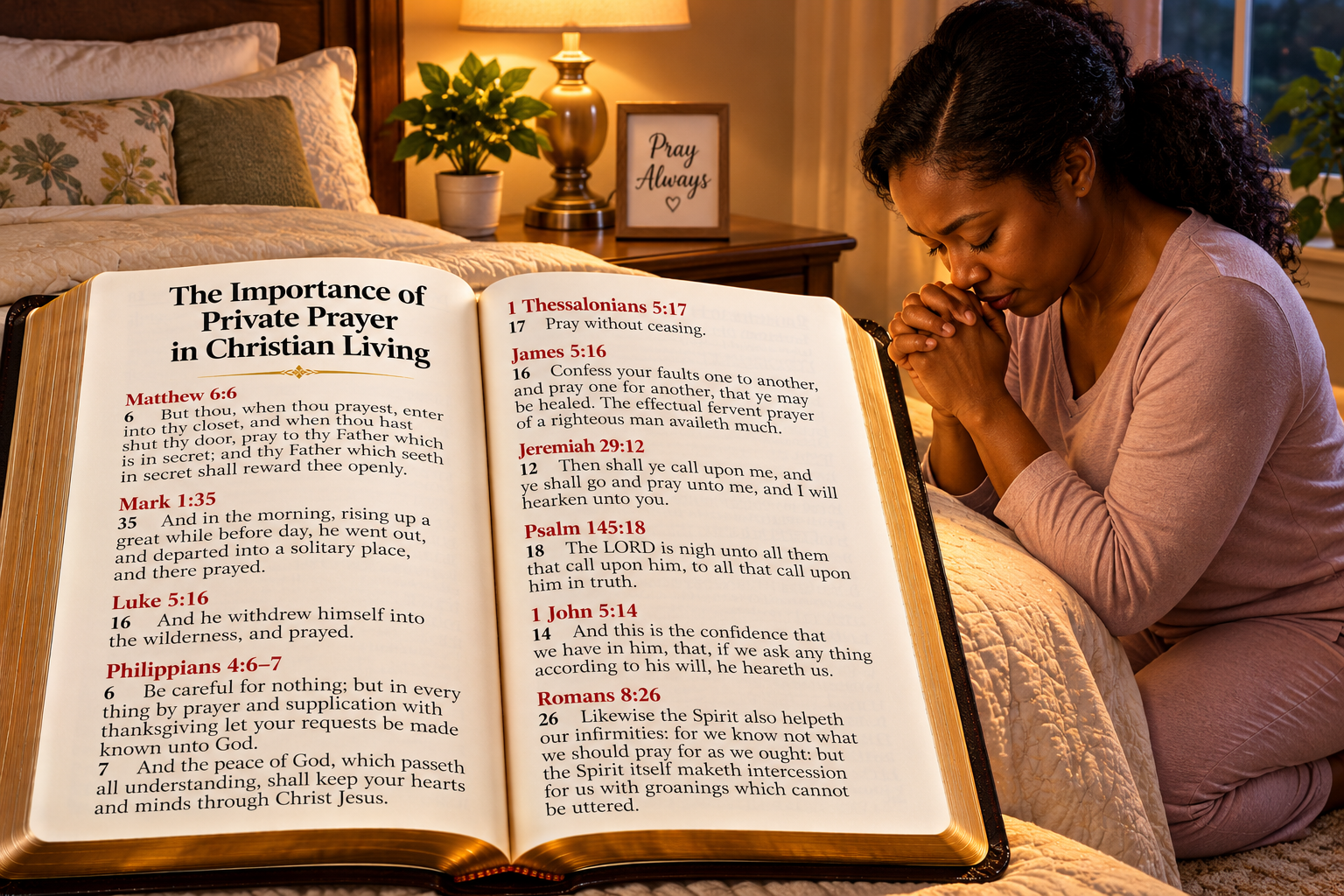
Jesus Christ emphasized the importance of private prayer in Matthew 6:6, where He instructed His followers to enter their rooms, close the door, and pray to their Father in secret. His teaching reminds Christians that prayer is not about impressing other people but about sincerely seeking God.
Private prayer is more than a religious routine. It is an opportunity to develop faith, strengthen spiritual discipline, receive wisdom, experience God’s comfort, and grow in obedience to His Word.
In this article, we will explore the biblical meaning of private prayer, its importance in Christian living, examples of people who prayed privately in the Bible, and practical ways to establish a consistent personal prayer life.
1. What Is Private Prayer?
Private prayer is personal communication with God in a quiet or secluded setting, where a believer can focus on Him without unnecessary distractions or the desire to impress others.
It involves bringing personal concerns, needs, struggles, hopes, and thanksgiving before God. Private prayer may include worship, confession, intercession, meditation on Scripture, and silent reflection.
Unlike public prayer, which takes place in a gathering of believers, private prayer allows Christians to express their thoughts and feelings to God personally.
Private prayer does not necessarily require a particular location. A Christian may pray in a bedroom, a quiet room, a garden, a parked car, or another suitable place. What matters most is the sincerity of the heart and the believer’s desire to seek God.
Key Bible Verse About Private Prayer
Matthew 6:6 (KJV)
“But thou, when thou prayest, enter into thy closet, and when thou hast shut thy door, pray to thy Father which is in secret; and thy Father which seeth in secret shall reward thee openly.”
This verse teaches that private prayer should be sincere rather than performed to gain human recognition. Jesus directed His followers toward a personal relationship with God that does not depend on public approval.
The instruction to enter a private place emphasizes the value of withdrawing from distractions to concentrate on God.
2. What Does the Bible Say About Private Prayer?
The Bible presents private prayer as an important part of a believer’s relationship with God. Throughout Scripture, God’s people sought Him in solitude, brought their concerns before Him, and depended on His wisdom and strength.
Jesus Himself regularly withdrew from crowds to pray. His example demonstrates that private prayer is not merely an activity for new Christians or people experiencing difficulties. It is an essential spiritual discipline for believers who desire to grow in their faith.
Jesus Taught His Followers to Pray in Secret
In Matthew 6:5–6, Jesus warned against praying primarily to receive praise from other people. He contrasted outward religious performance with sincere devotion to God.
His teaching does not prohibit all public prayer. Scripture contains many examples of faithful public prayer. Instead, Jesus challenged the motivation behind prayer.
Private prayer allows believers to seek God without making human recognition the primary goal.
Related Scripture: Matthew 6:5–6.
Jesus Regularly Withdrew to Pray
Luke 5:16 says that Jesus often withdrew to lonely places and prayed.
Even though Jesus had a demanding ministry, He made time to seek His Father in prayer. He ministered to crowds, healed the sick, taught His disciples, and responded to people in need, yet He also withdrew from the demands of public ministry.
His example teaches Christians that spiritual growth requires intentional time with God.
Related Scriptures: Luke 5:16; Mark 1:35.
The Bible Encourages Continual Prayer
First Thessalonians 5:17 instructs believers to “Pray without ceasing.”
This command encourages an ongoing attitude of dependence on God. It does not mean Christians must remain in a secluded room all day. Rather, believers can maintain a prayerful relationship with God throughout their daily activities while also setting aside specific times for private prayer.
Related Scripture: 1 Thessalonians 5:16–18.
3. Why Is Private Prayer Important in Christian Living?
Private prayer is important because it helps Christians cultivate a personal relationship with God, strengthen their faith, seek wisdom, and remain spiritually grounded.
The following are some of the major benefits of private prayer in Christian living.
1. Private Prayer Strengthens Your Relationship with God
The foundation of Christian living is a personal relationship with God through Jesus Christ. Prayer gives believers an opportunity to communicate with their heavenly Father and express their dependence on Him.
Just as meaningful human relationships require communication, a growing relationship with God involves prayer, listening to His Word, worship, and obedience.
Private prayer creates space for believers to bring their hearts before God without being concerned about how others perceive them.
During private prayer, Christians can express gratitude, admit their weaknesses, confess their sins, and seek God’s help with personal struggles.
Bible Verse: James 4:8
“Draw nigh to God, and he will draw nigh to you.”
This verse encourages believers to approach God sincerely. Private prayer is one way Christians respond to this invitation and cultivate a deeper life of faith.
2. Private Prayer Helps You Develop a Stronger Faith
Faith is central to Christian living. However, believers may experience seasons of uncertainty, disappointment, fear, or spiritual weakness.
Private prayer provides an opportunity to bring these struggles before God and remember His promises.
Through prayer and reflection on Scripture, Christians can strengthen their trust in God’s character, wisdom, and faithfulness. Prayer does not mean that every difficulty will immediately disappear. Instead, it helps believers depend on God while facing their circumstances.
Bible Verse: Mark 11:24
“Therefore I say unto you, What things soever ye desire, when ye pray, believe that ye receive them, and ye shall have them.”
This verse encourages faith in prayer. It should be understood alongside the broader biblical teaching that prayer is offered in submission to God’s will rather than as a guarantee that every personal desire will be fulfilled exactly as requested.
Private prayer teaches believers to trust God even when they do not yet understand His answers.
3. Private Prayer Provides Strength During Difficult Times
Life brings challenges such as grief, financial pressure, family conflicts, disappointment, and uncertainty about the future.
During these seasons, private prayer allows Christians to express their pain honestly before God and seek His comfort and strength.
Believers do not need to hide their fears or pretend that everything is well. Scripture contains many prayers in which God’s people expressed sorrow, confusion, and deep distress.
Bible Verse: Psalm 34:17
“The righteous cry, and the LORD heareth, and delivereth them out of all their troubles.”
This passage offers encouragement to those who call upon God during difficult circumstances.
Private prayer may not remove every hardship immediately, but it can help Christians face difficulties with renewed hope, patience, and confidence in God’s presence.
4. Private Prayer Helps You Seek God’s Guidance
Christians frequently face decisions concerning relationships, employment, family responsibilities, ministry, finances, and personal priorities.
Private prayer provides an opportunity to ask God for wisdom and examine decisions in light of biblical principles.
James 1:5 encourages anyone who lacks wisdom to ask God, who gives generously.
Through prayer, believers can slow down, examine their motives, reflect on Scripture, and seek wise counsel rather than acting impulsively.
Bible Verse: Proverbs 3:5–6
“Trust in the LORD with all thine heart; and lean not unto thine own understanding. In all thy ways acknowledge him, and he shall direct thy paths.”
This passage teaches believers to depend on God rather than treating their own understanding as sufficient.
Private prayer does not mean that every thought or feeling received during prayer is automatically a message from God. Christians should evaluate their decisions against Scripture, sound judgment, and wise counsel.
5. Private Prayer Encourages Confession and Repentance
One of the important purposes of prayer is to acknowledge sin and seek God’s forgiveness.
Private prayer provides a personal setting in which believers can examine their hearts honestly before God. They can confess wrongdoing, recognize harmful attitudes, and ask for help in turning away from sinful behavior.
Confession is not about pretending to be perfect. It is about responding to God’s holiness with humility and a willingness to change.
Bible Verse: 1 John 1:9
“If we confess our sins, he is faithful and just to forgive us our sins, and to cleanse us from all unrighteousness.”
This verse offers assurance of God’s forgiveness to those who confess their sins.
Private prayer should lead believers toward genuine repentance, restored relationships where appropriate, and a greater commitment to living according to God’s Word.
6. Private Prayer Brings Peace to the Heart and Mind
Worry and anxiety can make it difficult to concentrate, sleep, or respond wisely to life’s challenges.
The Bible encourages believers to bring their concerns to God through prayer rather than allowing worry to dominate their lives.
Bible Verse: Philippians 4:6–7
“Be careful for nothing; but in every thing by prayer and supplication with thanksgiving let your requests be made known unto God.”
Paul continues by describing the peace of God that guards believers’ hearts and minds through Christ Jesus.
Private prayer gives Christians an opportunity to name their concerns, express gratitude, and entrust their burdens to God.
This does not mean that prayer replaces medical care, counseling, or practical solutions when these are needed. Rather, prayer can be an important source of spiritual support while believers take appropriate steps to address their circumstances.
7. Private Prayer Helps You Resist Temptation
Temptation is a reality of Christian living. Believers may struggle with anger, pride, dishonesty, jealousy, destructive habits, or other behaviors that conflict with God’s Word.
Private prayer provides an opportunity to ask God for strength, examine personal weaknesses, and develop a more disciplined spiritual life.
Bible Verse: Matthew 26:41
“Watch and pray, that ye enter not into temptation: the spirit indeed is willing, but the flesh is weak.”
Jesus spoke these words to His disciples in Gethsemane, warning them to remain spiritually alert.
Private prayer can help Christians recognize areas of vulnerability and seek God’s help before temptation leads to harmful choices.
Prayer should be accompanied by practical action, including avoiding situations that encourage sin, seeking accountability, and choosing behavior consistent with biblical teaching.
8. Private Prayer Deepens Your Understanding of Scripture
Prayer and Bible study complement each other in Christian living.
Through private prayer, believers can ask God for wisdom to understand Scripture, humility to receive correction, and strength to obey what they learn.
Reading the Bible without reflection can become a routine, while praying without considering Scripture may leave believers relying too heavily on their own assumptions.
Combining prayer with Bible study encourages a balanced spiritual life grounded in God’s revealed Word.
Bible Verse: Psalm 119:18
“Open thou mine eyes, that I may behold wondrous things out of thy law.”
This prayer expresses a desire to understand and appreciate God’s instruction.
Christians can use this verse as a model when beginning personal Bible study.
9. Private Prayer Develops Spiritual Discipline
Consistency is important in Christian growth. A believer who prays only during emergencies may miss opportunities to develop a steady habit of seeking God.
Private prayer encourages discipline by helping Christians set aside intentional time for spiritual reflection and communication with God.
Over time, a regular prayer routine can become a meaningful part of daily life.
Bible Verse: Colossians 4:2
“Continue in prayer, and watch in the same with thanksgiving.”
This verse encourages perseverance, attentiveness, and gratitude in prayer.
Developing a consistent prayer life does not require spending several hours in prayer immediately. A beginner can start with five or ten focused minutes each day and gradually establish a sustainable routine.
10. Private Prayer Encourages Humility and Dependence on God
Private prayer reminds believers that they are not self-sufficient. Christians need God’s wisdom, grace, strength, and guidance.
When believers pray privately, they can acknowledge their limitations and surrender their plans to God’s will.
This attitude helps challenge pride and encourages a humble approach to relationships, responsibilities, and spiritual growth.
Bible Verse: Proverbs 16:3
“Commit thy works unto the LORD, and thy thoughts shall be established.”
The verse encourages believers to entrust their plans and actions to God rather than relying exclusively on their own abilities.
11. Private Prayer Strengthens Intercession for Others
Although private prayer is personal, it is not limited to personal needs.
Christians can use their private prayer time to pray for family members, friends, church leaders, missionaries, government officials, people experiencing hardship, and those who do not yet know Christ.
Intercessory prayer encourages believers to look beyond themselves and develop greater compassion for others.
Bible Verse: 1 Timothy 2:1
Paul urges that prayers, intercessions, and thanksgivings be made for all people.
Private prayer can become a regular opportunity to lift the needs of others before God, even when those individuals are unaware that someone is praying for them.
12. Private Prayer Helps You Remain Spiritually Focused
Daily life contains many competing demands. Work, family responsibilities, entertainment, technology, and financial concerns can occupy much of a person’s attention.
Private prayer provides a deliberate opportunity to turn one’s attention toward God.
By setting aside time to pray, believers can remember their spiritual priorities and evaluate whether their choices reflect their faith.
Bible Verse: Psalm 46:10
“Be still, and know that I am God.”
In its biblical context, this verse emphasizes God’s sovereignty. It can also remind believers of the value of pausing, reflecting on God’s character, and placing their confidence in Him.
4. Examples of Private Prayer in the Bible
The Bible contains several examples of people who sought God in personal prayer. Their experiences demonstrate the value of prayer during ordinary responsibilities, emotional distress, important decisions, and demanding seasons of life.
Jesus Christ: The Example of Consistent Private Prayer
Jesus frequently withdrew from crowds to pray.
Luke 5:16 describes His practice of withdrawing to lonely places for prayer. Mark 1:35 also records that Jesus rose early, went to a solitary place, and prayed.
Jesus’ example demonstrates the importance of making time for communion with the Father, even when responsibilities are numerous.
Christians can learn from His commitment to prayer by establishing regular times to seek God rather than allowing daily demands to eliminate personal devotion.
Key Scriptures: Luke 5:16; Mark 1:35.
Daniel: The Example of Faithful Prayer
Daniel maintained a regular practice of prayer even when praying to God became dangerous.
Daniel 6:10 explains that Daniel continued praying three times a day, as he had done previously, despite the decree prohibiting prayer to anyone other than the king.
Daniel’s example illustrates consistency, courage, and faithfulness.
His prayer life was not simply a reaction to a crisis. It was an established spiritual discipline that continued even under pressure.
Key Scripture: Daniel 6:10.
Hannah: The Example of Honest Prayer
Hannah experienced deep sorrow because she was unable to have a child. In 1 Samuel 1, she poured out her heart before the Lord at the tabernacle.
Although this prayer occurred in a place of worship rather than a private room, Hannah’s experience illustrates the personal and heartfelt nature of sincere prayer.
She expressed her anguish honestly and entrusted her desire to God.
Her story reminds Christians that prayer is an appropriate place to bring grief, disappointment, and deeply personal concerns before the Lord.
Key Scripture: 1 Samuel 1:9–18.
David: The Example of Seeking God in Distress
The Psalms contain many prayers in which David expressed fear, sorrow, gratitude, repentance, and confidence in God.
Psalm 63 describes David seeking God earnestly in a dry and weary land.
His prayers demonstrate that believers can approach God with a wide range of emotions while continuing to trust Him.
David’s example also shows that prayer includes praise and thanksgiving, not only requests for help.
Key Scriptures: Psalm 63:1–8; Psalm 51:1–12.
Elijah: The Example of Dependent Prayer
In 1 Kings 19, Elijah experienced fear, exhaustion, and discouragement after a period of intense ministry.
God met Elijah in his distress, providing care and direction.
Although this passage is not primarily an account of private prayer, it demonstrates that God’s servants can experience emotional and physical exhaustion.
Elijah’s experience reminds Christians that spiritual faithfulness does not eliminate human weakness. Believers can bring their struggles to God and also receive rest, nourishment, support, and renewed direction.
Key Scripture: 1 Kings 19:1–18.
Jesus in Gethsemane: The Example of Surrender
Before His crucifixion, Jesus went to Gethsemane and prayed to the Father.
In Matthew 26:36–46, Jesus expressed the anguish of the coming suffering while submitting Himself to the Father’s will.
His prayer demonstrates that sincere prayer does not require believers to hide their distress. It also teaches the importance of surrendering personal desires to God’s purposes.
Key Scripture: Matthew 26:39.
5. What Is the Difference Between Private Prayer and Public Prayer?
Private prayer and public prayer are both biblical practices. They serve related but distinct purposes in Christian living.
| Private Prayer | Public Prayer |
|---|---|
| Takes place in personal devotion or solitude. | Takes place in a gathering or group setting. |
| Emphasizes personal communion with God. | Often expresses the needs and worship of a community. |
| Provides space for personal confession and reflection. | Can unite believers in shared confession, thanksgiving, and intercession. |
| Allows focused prayer away from social distractions. | Encourages corporate faith and mutual support. |
| Does not require an audience. | Is offered in the presence of other people. |
Jesus’ teaching in Matthew 6:5–6 warns against using prayer to seek human praise. It does not condemn praying with other believers.
Acts 2:42 describes the early Christians devoting themselves to fellowship, the breaking of bread, and prayers. The Bible therefore supports both personal devotion and communal worship.
A healthy Christian life includes private prayer as well as participation in the worship and prayer of the church.
6. How to Develop a Consistent Private Prayer Life
Developing a consistent prayer life requires intention, patience, and a willingness to keep returning to God.
The following steps can help Christians establish a meaningful routine.
Step 1: Choose a Quiet Place to Pray
Select a location where you can concentrate without unnecessary interruptions.
This might be your bedroom, a quiet corner of your home, a study, or another suitable space.
You do not need a special room or expensive equipment. A simple, quiet place can help establish a regular habit of personal prayer.
Supporting Scripture: Matthew 6:6.
Step 2: Set a Regular Time for Prayer
Choose a time that fits your daily responsibilities.
Some Christians prefer to pray early in the morning before beginning work. Others find lunchtime, the evening, or the period before bed more suitable.
The important thing is to establish a realistic routine that you can maintain.
Supporting Scripture: Psalm 5:3.
Step 3: Begin With Worship and Thanksgiving
Start your prayer by acknowledging God’s character and thanking Him for His goodness.
You can thank God for life, salvation, family, provision, opportunities, and the strength to face challenges.
Thanksgiving helps direct your attention toward God’s faithfulness rather than focusing exclusively on difficulties.
Supporting Scripture: Psalm 100:4.
Step 4: Confess Your Sins Honestly
Take time to examine your attitudes, words, and actions.
Confess any wrongdoing and ask God to help you turn away from sinful patterns.
Remember that confession should lead to repentance and a willingness to make things right where appropriate.
Supporting Scripture: 1 John 1:9.
Step 5: Read and Reflect on the Bible
Choose a short passage of Scripture and read it carefully.
Ask yourself what the passage teaches about God, what it reveals about faithful living, and how you can apply its message to your circumstances.
You may then pray in response to what you have read.
Supporting Scripture: Psalm 119:105.
Step 6: Present Your Needs and Concerns to God
Bring your worries, decisions, responsibilities, and personal struggles before God.
Be specific about the areas in which you need wisdom, patience, courage, forgiveness, or provision.
You can also ask for help in responding to difficult circumstances according to biblical principles.
Supporting Scripture: Philippians 4:6–7.
Step 7: Pray for Other People
Include the needs of family members, friends, church members, leaders, and people experiencing suffering.
Keeping a prayer list can help you remember those who need encouragement and support.
Supporting Scripture: 1 Timothy 2:1–2.
Step 8: End With Trust and Surrender
Conclude your prayer by entrusting your concerns to God.
You may not receive immediate answers to every request, but you can continue seeking Him while taking wise and responsible steps.
Jesus modeled surrender to the Father’s will in Matthew 26:39.
Step 9: Remain Consistent Without Becoming Legalistic
Some days your prayer time may be longer than others. You may also experience periods when concentration is difficult.
Do not treat prayer as a performance or assume that missing a session means you cannot begin again.
Return to the practice with humility and consistency.
Supporting Scripture: Colossians 4:2.
7. A Simple Daily Private Prayer Routine
The following routine provides a practical starting point for Christians who want to build a consistent personal prayer habit.
| Prayer Activity | Suggested Time |
|---|---|
| Worship and thanksgiving | 2 minutes |
| Confession and repentance | 2 minutes |
| Bible reading and reflection | 3 minutes |
| Personal requests and guidance | 3 minutes |
| Intercession for others | 3 minutes |
| Surrender and closing prayer | 2 minutes |
| Total | 15 minutes |
These times are suggestions, not biblical requirements. You can shorten or lengthen the routine according to your circumstances.
The goal is not to complete a checklist mechanically. The goal is to create regular opportunities to seek God sincerely.
8. A Sample Private Prayer for Daily Christian Living
Heavenly Father,
Thank You for the gift of life and for Your mercy and faithfulness. Thank You for allowing me to come before You in prayer through Jesus Christ.
Please forgive me for my sins, wrong attitudes, unkind words, and actions that do not reflect Your will. Give me a humble heart and help me walk in obedience to Your Word.
Father, strengthen my faith and teach me to trust You in every circumstance. Give me wisdom to make good decisions, courage to face challenges, and patience when I do not understand what is happening in my life.
Help me resist temptation and turn away from anything that separates me from faithful Christian living. Teach me to love others, forgive those who have wronged me, and treat people with kindness and respect.
I pray for my family, friends, church, and everyone experiencing pain, sickness, grief, or uncertainty. Please provide comfort, strength, and the help they need.
Guide my thoughts, words, and actions today. Help me remember Your truth throughout my daily responsibilities and remain faithful to You in private as well as in public.
I surrender my plans and concerns to You. Help me seek Your will and trust Your wisdom.
In the name of Jesus Christ, I pray.
Amen.
9. Bible Verses About the Importance of Private Prayer
The following Scriptures can encourage believers to develop a stronger personal prayer life.
- Matthew 6:6 — Jesus teaches His followers to pray to the Father in secret.
- Mark 1:35 — Jesus rises early to pray in a solitary place.
- Luke 5:16 — Jesus regularly withdraws to lonely places to pray.
- Psalm 5:3 — David describes bringing his prayer before God in the morning.
- Psalm 63:1 — David expresses an earnest desire for God.
- Psalm 91:1–2 — The psalm describes dwelling in the shelter of the Most High.
- Psalm 119:18 — The psalmist asks God for understanding of His law.
- Proverbs 3:5–6 — Believers are encouraged to trust in the Lord and acknowledge Him.
- Jeremiah 29:12–13 — God speaks of His people calling upon Him and seeking Him wholeheartedly in the context of His promise to the exiles.
- Daniel 6:10 — Daniel remains faithful to his regular practice of prayer.
- Matthew 26:41 — Jesus tells His disciples to watch and pray against temptation.
- Mark 6:46 — Jesus goes to a mountain to pray.
- Luke 11:1 — A disciple asks Jesus to teach them to pray.
- Romans 12:12 — Believers are instructed to continue steadfastly in prayer.
- Ephesians 6:18 — Paul encourages prayer at all times in the Spirit.
- Philippians 4:6–7 — Christians are encouraged to present their requests to God with thanksgiving.
- Colossians 4:2 — Believers are told to continue in prayer with watchfulness and thanksgiving.
- 1 Thessalonians 5:17 — Christians are instructed to pray without ceasing.
- James 1:5 — Those who lack wisdom are encouraged to ask God.
- James 4:8 — Believers are invited to draw near to God.
These verses can be used for personal devotion, Bible study, prayer journals, and discussions about spiritual growth.
10. Common Challenges in Private Prayer and How to Overcome Them
Although private prayer is important, many Christians experience difficulties maintaining a consistent routine.
Lack of Time
Busy schedules can make prayer seem difficult to prioritize.
Solution: Begin with five minutes each day. Choose a time that naturally fits your routine, such as after waking up or before going to bed.
Distractions During Prayer
Thoughts about work, family responsibilities, and unfinished tasks may interrupt concentration.
Solution: Put your phone aside, choose a quiet place, and keep a notebook nearby to record distracting thoughts you need to address later.
Not Knowing What to Pray About
Some believers struggle to find words when they begin praying.
Solution: Use the Lord’s Prayer in Matthew 6:9–13 as a model. You can also read a psalm, pray through a passage of Scripture, or follow a simple structure of worship, confession, thanksgiving, and requests.
Feeling That Your Prayers Are Not Answered
Waiting for an answer can lead to discouragement.
Solution: Continue praying while examining your requests in light of Scripture. Remember that God’s answers may not match your preferred timing or outcome. Seek wise Christian counsel when necessary, and continue taking responsible action.
Becoming Discouraged by Inconsistency
Missing several days of prayer can make it difficult to restart.
Solution: Begin again without condemning yourself. Focus on building a sustainable habit rather than achieving perfection.
Feeling Spiritually Dry
There may be periods when prayer feels less meaningful or emotionally rewarding.
Solution: Continue approaching God honestly. Read Scripture, express your feelings truthfully, and remember that a faithful prayer life is not measured solely by emotional experiences.
11. Does Private Prayer Have to Be Long to Be Effective?
No. The Bible does not establish a universal minimum length for private prayer.
Jesus warned against the idea that people would be heard merely because of their many words (Matthew 6:7). His teaching emphasizes sincere dependence on God rather than the length or complexity of a prayer.
Some biblical prayers are brief, while others involve extended periods of seeking God.
The appropriate length of private prayer depends on a person’s circumstances, spiritual maturity, responsibilities, and needs.
A sincere five-minute prayer can be a meaningful beginning for someone establishing a daily routine. As the habit develops, the person may naturally choose to spend more time in prayer and Bible study.
The goal is not to measure spiritual maturity by minutes spent praying. It is to cultivate sincere communion with God and a life shaped by faith and obedience.
12. What Happens When Christians Neglect Private Prayer?
Neglecting private prayer does not mean that God automatically abandons a believer. However, consistently neglecting personal devotion can make it harder to maintain intentional reflection, spiritual discipline, and a regular practice of bringing concerns before God.
Without intentional time for prayer, Christians may become increasingly distracted by daily pressures and less attentive to their spiritual priorities.
They may also miss opportunities to examine their attitudes, seek wisdom, pray for others, and reflect on Scripture.
Prayer is not a substitute for reading the Bible, participating in Christian fellowship, serving others, or obeying God’s commands. Rather, it supports a balanced Christian life in which believers continually seek to know and follow God.
A neglected prayer life can be renewed. Christians can begin again by setting aside a realistic amount of time, returning to Scripture, and approaching God sincerely.
13. How Can Families Encourage Private Prayer?
Although private prayer is personal, families can create an environment that encourages each member to develop a meaningful relationship with God.
Parents can teach children the value of prayer through their own example. They can explain that prayer is not limited to mealtimes, church services, or emergencies.
Family members can also respect one another’s individual prayer time by minimizing unnecessary interruptions when possible.
Practical ways to encourage private prayer include:
- Establishing a quiet prayer space at home.
- Keeping Bibles and prayer journals accessible.
- Encouraging each family member to pray personally.
- Sharing Scripture passages that inspire prayer.
- Discussing the importance of sincerity rather than outward appearances.
- Combining individual prayer with family devotions and corporate worship.
Supporting Scripture: Deuteronomy 6:6–7.
These practices can help children and adults understand that prayer is an ongoing part of Christian living rather than merely a religious activity performed in public.
14. Private Prayer and Spiritual Growth
Spiritual growth involves becoming more mature in faith and increasingly reflecting the character of Jesus Christ.
Private prayer contributes to this process by encouraging believers to seek God’s wisdom, confess sin, practice gratitude, pray for others, and surrender their desires to God’s will.
However, prayer should not be viewed as a technique that automatically produces spiritual maturity. Growth also involves learning Scripture, obeying God’s commands, participating in Christian fellowship, serving others, and allowing one’s beliefs to shape everyday behavior.
Bible Verse: Galatians 5:22–23
Paul describes the fruit of the Spirit, including love, joy, peace, patience, kindness, goodness, faithfulness, gentleness, and self-control.
These qualities provide a useful way to reflect on spiritual development.
A growing prayer life should encourage believers to become more loving, humble, patient, forgiving, and faithful in their relationships and responsibilities.
The value of private prayer is therefore seen not only in the time spent alone with God but also in how believers live when they return to their families, workplaces, churches, and communities.
Conclusion: Make Private Prayer a Priority in Your Christian Life
Private prayer is an important part of Christian living because it provides an opportunity to seek God personally, strengthen faith, confess sin, receive spiritual encouragement, and pray for others.
Jesus Christ modeled the importance of withdrawing from distractions to pray, and His teaching in Matthew 6:6 reminds Christians that prayer should be sincere rather than performed to gain human recognition.
The examples of Jesus, Daniel, David, and other biblical figures demonstrate that prayer can be a consistent practice during both peaceful seasons and difficult circumstances.
Developing a private prayer life does not require a special room, elaborate words, or a particular number of minutes. It begins with a sincere desire to approach God and a willingness to establish a regular habit of prayer.
Start with a few minutes each day. Choose a quiet place, read Scripture, express gratitude, confess your sins, bring your concerns before God, and pray for others.
As you continue, allow your prayer life to be shaped by God’s Word and reflected in your daily choices.
Remember that private prayer is not a way to impress people or guarantee a particular outcome. It is an opportunity to seek God faithfully, depend on His grace, and grow in a life of Christian faith and obedience.
Final Bible Verse: Matthew 6:6
“But thou, when thou prayest, enter into thy closet, and when thou hast shut thy door, pray to thy Father which is in secret.”
May private prayer become a meaningful and consistent part of your Christian life, helping you grow in faith, trust God through every season, and live according to His Word.
Frequently Asked Questions About Private Prayer
1. What is the importance of private prayer in Christian living?
Private prayer helps Christians cultivate a personal relationship with God, strengthen their faith, seek wisdom, confess sin, find spiritual encouragement, and pray for others. It also provides an opportunity to reflect on Scripture and develop consistent spiritual discipline.
2. What does Jesus teach about private prayer?
In Matthew 6:6, Jesus teaches His followers to pray to their Father in secret rather than using prayer to gain public recognition. His teaching emphasizes sincerity, humility, and a personal relationship with God.
3. How often should a Christian pray privately?
Christians are encouraged to maintain an ongoing attitude of prayer. First Thessalonians 5:17 says to pray without ceasing. Many believers establish a daily private prayer routine while also praying throughout their daily activities.
4. Where is the best place to pray privately?
A suitable place is somewhere you can concentrate without unnecessary distractions. This may be a bedroom, a quiet corner of your home, a study, or another peaceful location. A special room is not required.
5. Can I pray privately before going to bed?
Yes. Bedtime can be a useful opportunity to thank God for the day, confess sins, pray for loved ones, reflect on Scripture, and entrust tomorrow’s concerns to Him. Psalm 4:8 is one passage you may reflect on before sleeping.
6. Is private prayer more important than public prayer?
The Bible encourages both private and corporate prayer. Private prayer supports personal devotion, while public prayer allows believers to worship and seek God together. Neither should be treated as a substitute for the other.
7. What should I pray about when I am alone?
You can pray about worship, thanksgiving, confession, spiritual growth, family, relationships, work, decisions, personal struggles, and the needs of others. You can also pray through Scripture and ask God for wisdom to apply His Word.
8. Does God hear private prayers?
Matthew 6:6 presents God as the Father who sees what is done in secret. The passage encourages believers to approach Him sincerely, trusting that their private devotion is not hidden from Him.
9. What should I do when I struggle to pray consistently?
Begin with a realistic routine, such as five minutes each morning. Choose a regular time, use a Bible passage to guide your prayer, and resume the practice when you miss a day. Focus on sincere devotion rather than perfection.
10. What is the best Bible verse about private prayer?
Matthew 6:6 is one of the clearest passages about private prayer because Jesus directly instructs His followers to pray to the Father in secret. Mark 1:35 and Luke 5:16 also provide examples of Jesus withdrawing to pray.