

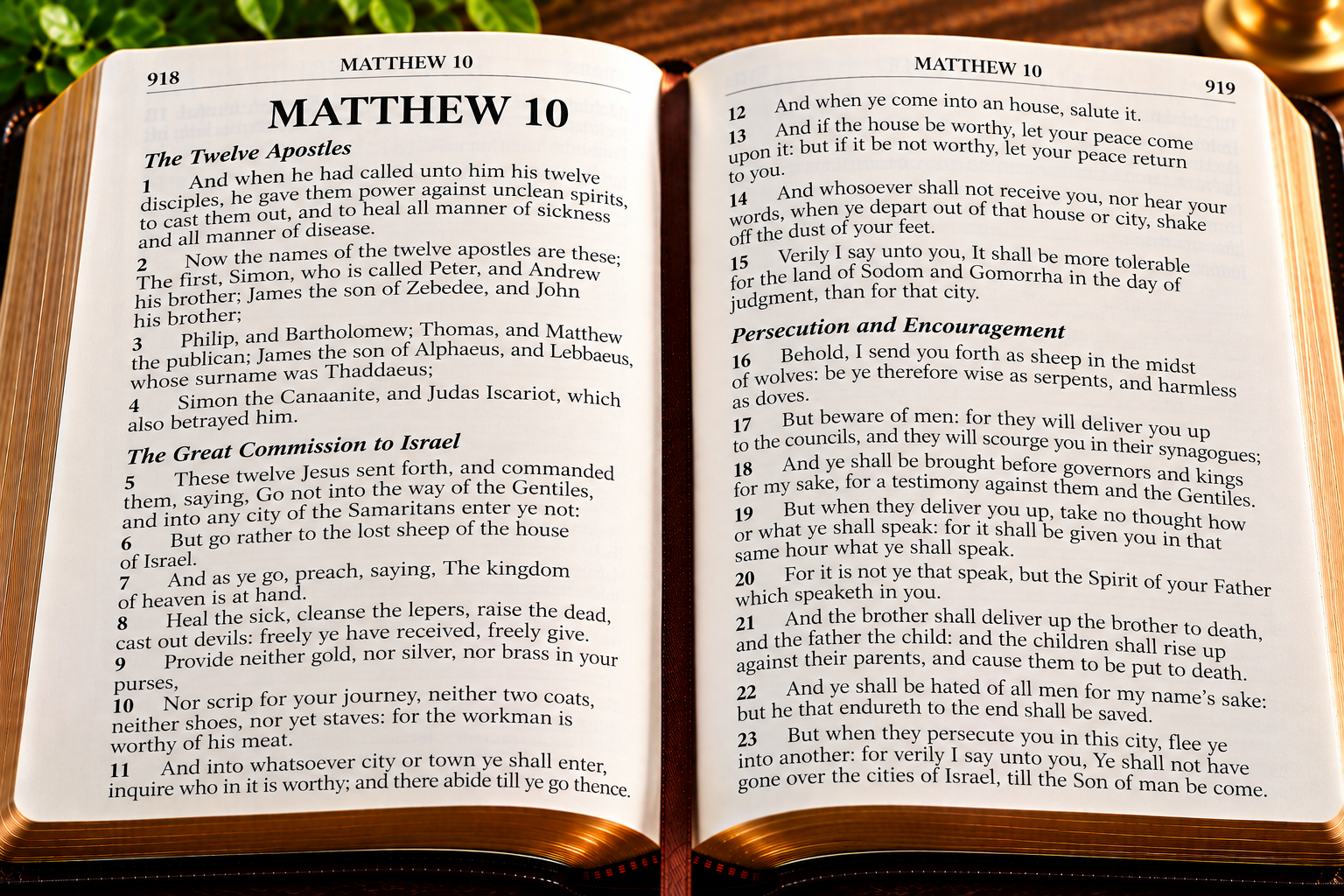
Chapter Overview
Introduction
Matthew Chapter 10 focuses on the calling, commissioning, and responsibilities of Jesus’ twelve disciples. After demonstrating His authority through teaching, healing, and deliverance in the preceding chapters, Jesus now sends His disciples to participate in His ministry.
Jesus gives them authority over unclean spirits and the power to heal diseases and sicknesses. He instructs them to proclaim that the kingdom of heaven is at hand, minister to those in need, and depend on God’s provision. However, He also warns them that their mission will not always be welcomed. They will face opposition, persecution, rejection, and even betrayal.
This chapter contains important teachings about the cost of discipleship, the courage required to proclaim the truth, the importance of fearing God rather than people, and the need to remain faithful to Christ above all other loyalties.
Jesus also explains that following Him requires putting Him first, taking up one’s cross, and being willing to make sacrifices for the sake of the gospel. The chapter concludes by emphasizing the value of receiving Christ’s messengers and caring for those who serve Him.
Central message: Jesus calls His followers to proclaim God’s kingdom, serve others with compassion, depend on God’s provision, and remain faithful even when discipleship brings hardship.
1. Jesus Calls and Empowers the Twelve Disciples (Matthew 10:1–4)
Jesus calls His twelve disciples and gives them authority over unclean spirits, enabling them to cast them out and heal every kind of sickness and disease described in the passage.
Matthew lists the twelve apostles:
- Simon, called Peter
- Andrew, Peter’s brother
- James, the son of Zebedee
- John, James’s brother
- Philip
- Bartholomew
- Thomas
- Matthew the tax collector
- James, the son of Alphaeus
- Lebbaeus, also called Thaddaeus in many translations
- Simon the Canaanite, also called Simon the Zealot
- Judas Iscariot, who later betrayed Jesus
These men came from different backgrounds, yet Jesus called them to work together in His mission.
The title apostle refers to one who is sent. In this passage, Jesus does not merely invite the disciples to observe His ministry; He authorizes them to participate in it.
Key lessons:
- Jesus calls people to participate in His work.
- Christian ministry depends on Christ’s authority rather than personal ambition.
- God can bring people from different backgrounds together for a common purpose.
- Being chosen for service carries responsibility and accountability.
2. Jesus Gives Instructions for the Mission (Matthew 10:5–15)
Jesus sends the twelve out with specific instructions. In this initial mission, He directs them to the lost sheep of the house of Israel rather than to the Gentiles or Samaritans.
He tells them to proclaim:
“The kingdom of heaven is at hand.” — Matthew 10:7, KJV
They are instructed to heal the sick, cleanse lepers, raise the dead, and cast out demons. Jesus tells them that they have received freely and should give freely.
He also instructs them not to accumulate gold, silver, or extra provisions for the journey. They are to rely on appropriate hospitality and God’s provision through the people they encounter.
When entering a town or home, the disciples are to offer peace. Where they are not welcomed, they are to leave and symbolically shake the dust from their feet.
Key lessons:
- The message of God’s kingdom should be central to Christian ministry.
- Spiritual gifts and opportunities for service should be handled with humility.
- Ministry is not meant to be driven by greed or personal gain.
- God’s servants should exercise discernment about where and how they serve.
- Rejection does not mean that a faithful messenger has failed.
Important context: These instructions were given to the twelve for a particular mission during Jesus’ earthly ministry. They should not all be treated as universal travel rules for every Christian in every age. The broader principles of generosity, dependence on God, hospitality, and faithful witness remain important.
3. Jesus Warns of Persecution and Opposition (Matthew 10:16–23)
Jesus prepares His disciples for the difficulties they will face. He describes sending them as sheep among wolves and tells them to be wise as serpents and harmless as doves.
They will face accusations, be brought before authorities, and experience opposition because of their association with Him. Jesus tells them not to be consumed with anxiety about what to say when brought before governing authorities, because the Spirit of their Father will help them speak.
He also warns that family relationships may be strained and that His followers will be hated because of His name.
Jesus says:
“But he that endureth to the end shall be saved.” — Matthew 10:22, KJV
The disciples must remain faithful despite pressure, opposition, and rejection.
Key lessons:
- Faithful service does not guarantee freedom from persecution.
- Christians need both wisdom and integrity.
- Believers can depend on God when facing difficult circumstances.
- Loyalty to Christ may create conflict, even within families.
- Perseverance is an essential part of Christian discipleship.
Jesus’ warning is realistic: His followers must prepare spiritually and practically for opposition rather than assume that obedience will always bring immediate acceptance.
4. Jesus Teaches His Disciples Not to Fear People (Matthew 10:24–33)
Jesus explains that a disciple should not expect to be treated better than the Teacher. If people oppose Him, His followers may also face opposition.
He encourages the disciples to proclaim openly what they have learned from Him. Although people may threaten the body, they cannot ultimately control God’s final judgment over a person’s life.
Jesus teaches them to fear God rather than people and reminds them that the Father knows even when a sparrow falls to the ground. He also says that the hairs of their heads are numbered.
These illustrations communicate God’s detailed knowledge of and care for His people.
Jesus concludes this section by emphasizing the importance of acknowledging Him before others.
Key lessons:
- Courageous faith means obeying God rather than being controlled by human approval.
- God’s knowledge and care extend to the details of His creation.
- Fear should not silence a faithful witness.
- Believers are called to acknowledge Jesus publicly and faithfully.
- Trust in God’s care does not mean that Christians will never experience suffering.
This passage does not promise that faithful Christians will avoid physical harm. Instead, it places earthly suffering within the larger reality of God’s authority and final judgment.
5. Jesus Explains the Cost of Following Him (Matthew 10:34–39)
Jesus teaches that following Him may divide people, even within households. His words about bringing a sword rather than peace are best understood in the context of division caused by people’s different responses to Him, not as a command for His followers to use violence.
Some will accept Jesus, while others will reject Him. As a result, allegiance to Christ may create conflict with family members or other close relationships.
Jesus declares that anyone who loves family members more than Him is not worthy of Him. He also says that those who refuse to take up their cross and follow Him are not worthy of Him.
He concludes:
“He that findeth his life shall lose it: and he that loseth his life for my sake shall find it.” — Matthew 10:39, KJV
Key lessons:
- Jesus must have first place in the believer’s life.
- Faithfulness may involve difficult choices and personal sacrifices.
- Following Christ does not mean seeking conflict, but it does mean remaining loyal when conflict arises.
- True life is found in surrendering selfish ambition and living for Christ.
- Discipleship requires commitment beyond convenience.
Jesus is not teaching that believers should despise their families or intentionally create divisions. He is teaching that no human relationship should take precedence over obedience to God.
6. Jesus Teaches About Receiving His Messengers (Matthew 10:40–42)
Jesus concludes His instructions by teaching that receiving His disciples is connected to receiving Him and the One who sent Him.
He speaks about receiving a prophet, a righteous person, and even giving a cup of cold water to one of His little ones because that person is a disciple.
These examples demonstrate that acts of hospitality and service matter to God, even when they appear small.
Key lessons:
- Receiving Christ’s faithful messengers is an expression of receiving Christ.
- God values hospitality and practical kindness.
- Small acts of service can have spiritual significance.
- Believers should support those who faithfully serve God’s purposes.
- Christian ministry involves both proclaiming the gospel and caring for people.
The chapter closes by reminding readers that faithfulness is not measured only by public achievements. Ordinary acts of kindness, offered for the right reasons, are also meaningful.
Major Themes in Matthew Chapter 10
- The calling of disciples: Jesus calls and commissions people to serve His kingdom.
- The authority of Christ: The disciples’ mission depends on the authority Jesus gives them.
- Proclaiming the kingdom of heaven: The message of God’s reign is central to their mission.
- Dependence on God: Ministry requires trust, humility, and responsible stewardship.
- Persecution and perseverance: Faithfulness may bring rejection, hardship, and suffering.
- Courageous witness: Believers must not allow fear of people to silence their faith.
- God’s care for His people: Jesus reminds His disciples that the Father knows and values them.
- The cost of discipleship: Loyalty to Jesus may require sacrifice and difficult decisions.
- Hospitality and service: Supporting Christ’s messengers and caring for others matter to God.
Biblical Interpretation Note: Understanding Matthew Chapter 10
1. The Twelve Apostles and Their Mission
Matthew 10:1–4 identifies the twelve disciples whom Jesus commissions. Their authority comes from Jesus, and their mission is closely connected to His own ministry.
The passage distinguishes between being a disciple who learns from Jesus and being an apostle who is specifically sent with His authorization. The twelve occupy a particular role in the Gospel narrative.
Interpretive principle: Christian ministry should be rooted in Christ’s authority and teaching, not in self-appointed status or personal ambition.
2. Why Jesus Initially Sends the Disciples to Israel
In Matthew 10:5–6, Jesus directs the twelve to the lost sheep of the house of Israel. This instruction reflects the historical and theological setting of Jesus’ ministry and God’s covenant relationship with Israel.
It does not mean that the gospel is permanently restricted to Israel. Later in Matthew, Jesus commands His followers to make disciples of all nations (Matthew 28:19–20).
Interpretive principle: Read the initial mission in Matthew 10 in its immediate context and alongside the wider Gospel narrative, which ultimately includes all nations.
3. The Kingdom of Heaven Is at Hand
The proclamation in Matthew 10:7 announces that God’s kingdom is near. In Matthew’s Gospel, the kingdom of heaven refers to God’s reign and authority becoming evident through Jesus’ presence, teaching, miracles, and saving mission.
The kingdom is not merely a physical territory. It involves God’s rule, His purposes, and the response of people who receive His message.
Interpretive principle: The disciples’ mission centers on announcing and demonstrating the reality of God’s kingdom, not promoting their own power or status.
4. Instructions About Money and Travel
Jesus’ instructions in Matthew 10:9–15 call the twelve to generosity and dependence on God’s provision during their specific mission.
Because these instructions address a particular assignment, Christians should be careful not to apply every practical detail as an absolute rule for all missionaries or ministers. The passage does not prohibit every form of financial support for ministry.
Interpretive principle: Apply the enduring principles of generosity, contentment, hospitality, and trust in God while respecting the historical setting of the instructions.
5. Wisdom, Innocence, and Persecution
Jesus’ description of His disciples as sheep among wolves communicates vulnerability. His instruction to be wise as serpents and harmless as doves balances prudence with integrity.
Christian courage does not require recklessness. Believers may use sound judgment, lawful protections, and appropriate caution while remaining faithful to Christ.
Jesus’ promises about the Spirit’s help before authorities offer assurance for the mission; they should not be interpreted as permission to neglect preparation or study.
Interpretive principle: Faithful witness combines courage, wisdom, integrity, and dependence on God.
6. Fear God Rather Than People
Matthew 10:26–33 teaches that human opposition does not have the final word. God knows His people intimately, as illustrated by the sparrows and the hairs of their heads.
The passage does not promise immunity from suffering or death. Instead, Jesus calls His disciples to trust God’s ultimate authority and remain faithful even under threat.
Interpretive principle: God’s care gives believers a foundation for courage, but it does not guarantee a life free from hardship.
7. The Meaning of the Sword and Family Division
In Matthew 10:34–36, Jesus says He did not come to bring peace but a sword. This statement must be interpreted alongside His other teachings about peacemaking, love for enemies, and non-retaliation (Matthew 5:9, 5:44, and 5:39).
The sword imagery describes the division that can result when people respond differently to Jesus. It does not authorize physical violence or religious coercion.
Interpretive principle: Loyalty to Christ may produce relational conflict, but believers must still act with love, humility, and integrity.
8. Taking Up the Cross and Losing One’s Life
When Jesus speaks of taking up the cross, He calls His disciples to accept the cost of following Him. In the original setting, crucifixion was a brutal instrument of Roman execution. His language therefore conveys serious commitment, not merely minor inconvenience.
Losing one’s life for Christ can involve surrendering selfish priorities and, in some circumstances, facing persecution or death for faithfulness.
Interpretive principle: Christian discipleship calls for wholehearted allegiance to Jesus, even when obedience is costly.
9. Receiving Prophets and Giving a Cup of Water
Matthew 10:40–42 connects the treatment of Christ’s messengers with the treatment of Christ Himself. The examples of hospitality and a cup of cold water show that God values practical support for those who serve Him.
The passage encourages generosity without implying that every person who claims religious authority must automatically be trusted. Christian hospitality should be exercised with discernment and consistency with Scripture.
Interpretive principle: Support faithful ministry and practice practical kindness, recognizing that even small acts can reflect devotion to Christ.
Central Message of Matthew Chapter 10
Matthew Chapter 10 teaches that Jesus calls and equips His followers to serve, proclaim the kingdom of heaven, and remain faithful through hardship. Discipleship requires courage, wisdom, dependence on God, and loyalty to Christ above every competing allegiance.
The chapter also shows that Christian ministry is not only about preaching or miraculous works. It includes humility, perseverance, hospitality, and care for people. Jesus prepares His disciples for the realities of their mission while assuring them that God knows and values them.
Key Questions for Bible Study: Matthew Chapter 10
A. Observation Questions
- What authority did Jesus give the twelve disciples?
- Who were the twelve apostles named in Matthew 10:2–4?
- To whom did Jesus initially direct the disciples?
- What message were the disciples instructed to proclaim?
- What acts of ministry did Jesus tell the disciples to perform?
- What instructions did Jesus give them about money and provisions?
- How were the disciples to respond when a household welcomed them?
- What did Jesus compare His disciples to when warning them about persecution?
- What did Jesus tell them about being brought before authorities?
- What examples did Jesus use to teach them about God’s care?
- What did Jesus say about acknowledging Him before others?
- What did Jesus teach about receiving His messengers and giving a cup of cold water?
B. Interpretation Questions
- Why did Jesus give the twelve disciples authority before sending them out?
- What does the title apostle communicate about their mission?
- Why did Jesus initially direct the disciples to the people of Israel?
- What does the proclamation that the kingdom of heaven is at hand mean?
- What principles can Christians learn from the instructions about money and hospitality?
- What does it mean to be wise as serpents and harmless as doves?
- How should believers understand Jesus’ warning that His followers will face persecution?
- What does it mean to fear God rather than people?
- How do the sparrows and the numbered hairs illustrate God’s care?
- Why does Jesus warn that following Him may divide families?
- What does it mean to take up one’s cross and follow Jesus?
- How can receiving Christ’s messengers be understood as receiving Christ?
C. Application Questions
- What gifts, abilities, or opportunities might God be calling you to use in service?
- How can you communicate the message of God’s kingdom through your words and actions?
- How can you practice generosity without seeking recognition or personal gain?
- What practical steps can help you prepare for opposition to your Christian beliefs?
- How can you balance wisdom and caution with courage in sharing your faith?
- Are you allowing fear of other people’s opinions to influence your obedience to God?
- What can you do to strengthen your trust in God during uncertain circumstances?
- How can you remain loving toward family members who do not share your beliefs?
- What sacrifices might following Jesus require in your daily life?
- How can you support faithful Christian workers through prayer, hospitality, or practical assistance?
D. Reflection and Personal Growth Questions
- Which instruction in Matthew 10 challenges you the most, and why?
- What does this chapter teach you about the cost of discipleship?
- How can you distinguish genuine Christian courage from recklessness?
- What does it mean to put Jesus first while still loving and honoring your family?
- Who in your church or community could benefit from a practical act of kindness this week?
- What is one specific step you can take to serve God more faithfully after studying this chapter?
Memory Verse
“Fear ye not therefore, ye are of more value than many sparrows.” — Matthew 10:31, KJV
Reflection: Jesus reminds His disciples that God knows and values them. Even when following Christ brings uncertainty, opposition, or hardship, believers can trust in God’s knowledge and care. Courage grows when faith in God’s authority becomes greater than the fear of human rejection.
Conclusion: Living Out the Message of Matthew Chapter 10
Matthew Chapter 10 presents discipleship as both a privilege and a responsibility. Jesus calls His followers to participate in His mission, proclaim the kingdom of heaven, serve others, and trust God’s provision. At the same time, He prepares them for rejection, persecution, and difficult choices.
The chapter challenges Christians to examine their priorities, speak truth with courage and wisdom, and remain faithful when obedience becomes costly. It also reminds believers that God values acts of hospitality and practical kindness, even when those acts seem small.
As you study Matthew 10, consider how you can place Christ first, strengthen your trust in God, and become a more faithful servant. Ask God to give you courage to speak truth, wisdom to respond to opposition, and compassion to serve those who need hope.
Final takeaway: Following Jesus means accepting His call, proclaiming His message, trusting God’s care, and remaining faithful regardless of the cost.