

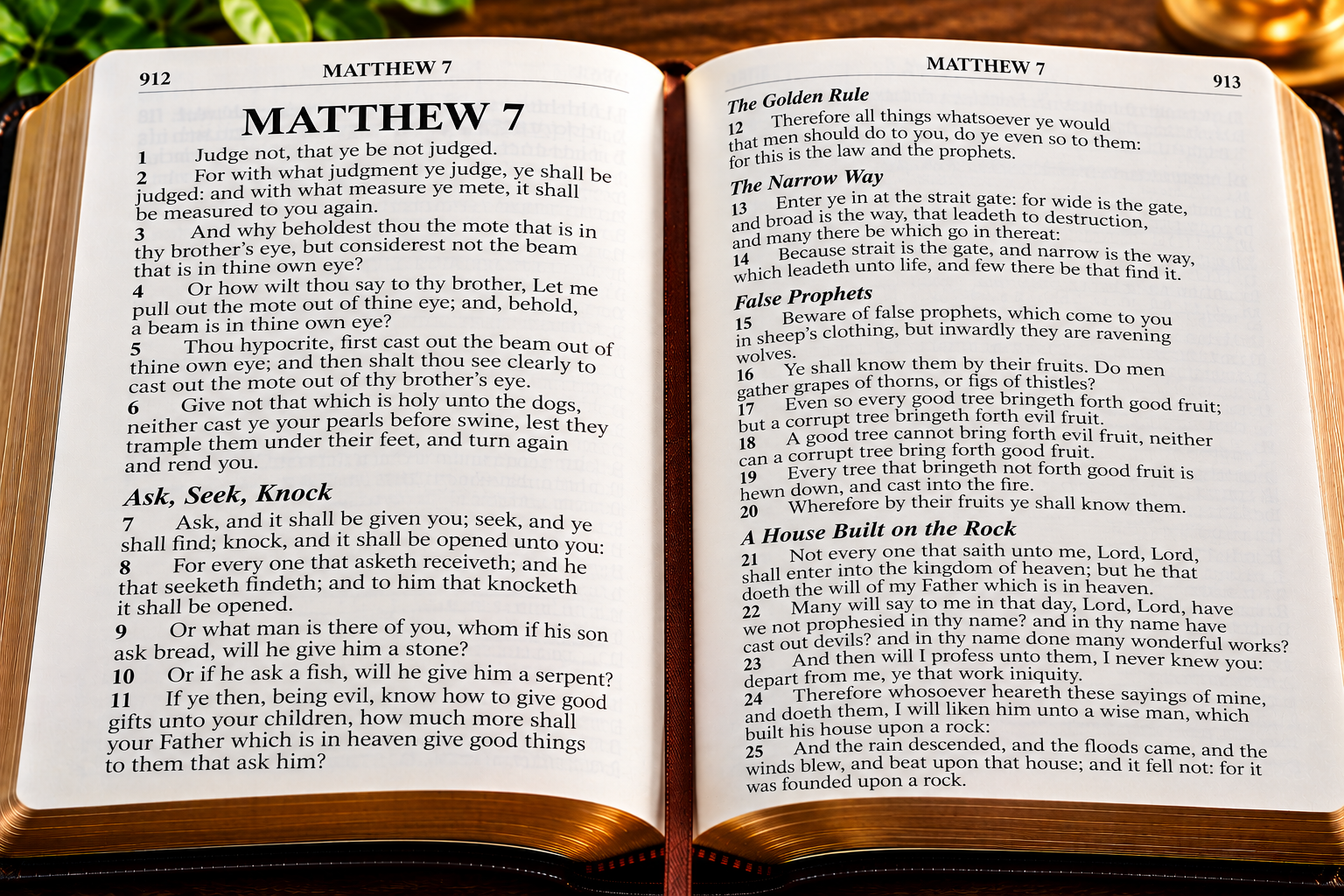
Introduction
Matthew Chapter 7 concludes the Sermon on the Mount, which begins in Matthew Chapter 5. Jesus teaches His followers how to live according to God’s kingdom through humility, discernment, prayer, love, obedience, and a genuine relationship with God.
The chapter opens with Jesus’ warning against hypocritical judgment. He challenges His listeners to examine their own faults before attempting to correct others. He then encourages them to ask, seek, and knock in prayer, assuring them of the Father’s care.
Jesus introduces the Golden Rule, teaching His followers to treat others as they would want to be treated. He warns that the way leading to life is narrow, cautions against false prophets, and explains that genuine discipleship is demonstrated by obedience to God’s will rather than merely using religious words.
The chapter concludes with the parable of the wise and foolish builders. One builds a house on rock, while the other builds on sand. When the storms come, the house built on rock stands firm, while the house built on sand collapses.
Central theme: Genuine discipleship requires humility, discernment, persistent prayer, love for others, obedience to Jesus’ teaching, and a life built on a firm spiritual foundation.
Main Sections of Matthew Chapter 7
- Judging Others and Examining Ourselves — Matthew 7:1–6
- Asking, Seeking, and Knocking — Matthew 7:7–11
- The Golden Rule — Matthew 7:12
- The Narrow Gate — Matthew 7:13–14
- Recognizing False Prophets — Matthew 7:15–20
- True and False Disciples — Matthew 7:21–23
- The Wise and Foolish Builders — Matthew 7:24–27
- The Authority of Jesus’ Teaching — Matthew 7:28–29
1. Judging Others and Examining Ourselves
Matthew 7:1–6
Jesus begins with a well-known instruction:
“Judge not, that ye be not judged.” — Matthew 7:1, KJV
He warns His listeners against condemning others hypocritically while ignoring their own faults. He illustrates this through the contrast between a speck in another person’s eye and a beam in one’s own eye.
The image is intentionally exaggerated. It exposes the absurdity of attempting to correct another person while refusing to acknowledge one’s own serious shortcomings.
Jesus does not prohibit every form of moral evaluation. Later in the same chapter, He tells His followers to recognize false prophets by their fruit. His teaching therefore concerns hypocritical, self-righteous, and condemnatory judgment rather than the responsible discernment necessary to recognize wrongdoing.
In verse 6, Jesus also warns against offering what is holy to those who will respond with contempt. This statement emphasizes the need for wisdom and discernment when sharing sacred truths with people who are hostile to them.
Key Lessons
- Examine your own conduct before criticizing others.
- Correct others with humility rather than self-righteousness.
- Distinguish between discerning wrongdoing and condemning people hypocritically.
- Practice accountability while extending mercy.
- Use wisdom when deciding how and when to address difficult situations.
Bible study reflection: Are you more aware of other people’s faults than your own?
2. Asking, Seeking, and Knocking
Matthew 7:7–11
Jesus encourages His followers to approach God with confidence and persistence.
He teaches:
“Ask, and it shall be given you; seek, and ye shall find; knock, and it shall be opened unto you.” — Matthew 7:7, KJV
These three commands express an active response to God:
- Ask: Bring your needs and requests to God through prayer.
- Seek: Pursue God’s wisdom, truth, and purposes.
- Knock: Continue approaching God with trust and perseverance.
Jesus compares God’s care to that of a human father who seeks to provide good things for his children. If imperfect human parents know how to give good gifts, how much more can believers trust their heavenly Father?
This passage encourages confidence in God’s goodness. It does not mean that every request will be granted exactly as asked or according to the timing a person desires. Rather, prayer takes place within a relationship of trust in God’s wisdom and care.
Key Lessons
- Pray with confidence in God’s goodness.
- Seek God’s wisdom rather than pursuing only personal desires.
- Persevere in prayer during seasons of uncertainty.
- Trust that God knows what is ultimately good.
- Understand prayer as a relationship with the Father, not a formula for controlling outcomes.
Bible study reflection: What do you need to bring to God in prayer while remaining open to His wisdom and direction?
3. The Golden Rule
Matthew 7:12
Jesus summarizes an important principle of relationships:
“Therefore all things whatsoever ye would that men should do to you, do ye even so to them.” — Matthew 7:12, KJV
This teaching is commonly known as the Golden Rule.
Jesus calls His followers not merely to avoid harming others but to take positive action toward them. They should consider how they would want to be treated and then extend that same consideration, fairness, kindness, and respect to others.
He connects this principle with the Law and the Prophets, showing that active love is consistent with the broader purposes of God’s revelation.
The Golden Rule requires more than treating others well when doing so is convenient. It calls for empathy and responsible action in ordinary relationships, disagreements, leadership, and service.
Key Lessons
- Treat others with the respect and fairness you desire for yourself.
- Practice active kindness rather than merely avoiding wrongdoing.
- Consider other people’s needs and circumstances.
- Let love guide your decisions and relationships.
- Apply biblical principles in practical, everyday situations.
Bible study reflection: What would change in one of your relationships if you consistently practiced the Golden Rule?
4. The Narrow Gate
Matthew 7:13–14
Jesus presents two gates and two ways.
The wide gate and broad way lead to destruction, while the narrow gate and difficult way lead to life. He explains that few find the way leading to life.
The image emphasizes that following Jesus requires deliberate commitment. The way of life is not necessarily the easiest or most popular path. It involves accepting Jesus’ authority and living according to His teaching, even when doing so conflicts with popular opinions or personal desires.
The passage challenges people to consider where their choices and loyalties are leading.
Key Lessons
- The path of discipleship requires deliberate commitment.
- Popularity does not necessarily indicate truth.
- Faithfulness may require difficult choices.
- Spiritual decisions have lasting significance.
- Jesus calls people to choose the way that leads to life.
Bible study reflection: Are your daily choices moving you toward greater faithfulness to Jesus or away from His teaching?
5. Recognizing False Prophets
Matthew 7:15–20
Jesus warns His followers to beware of false prophets who come in sheep’s clothing but are inwardly ravenous wolves.
These individuals may appear harmless or spiritually impressive, yet their intentions and teachings can be destructive.
Jesus provides a practical method for recognizing them: examine their fruit.
A good tree produces good fruit, while a corrupt tree produces bad fruit. In the same way, the character, conduct, and results associated with a teacher help reveal the nature of that person’s ministry.
This does not mean that every teacher who makes a mistake is automatically a false prophet. The emphasis is on evaluating the overall pattern of a person’s life and teaching in light of God’s truth.
Key Lessons
- Not everyone who claims spiritual authority is trustworthy.
- Evaluate teaching in light of Scripture.
- Examine character and conduct, not merely public reputation.
- Be cautious of leaders whose actions contradict their message.
- Discernment protects believers from deception.
Bible study reflection: What biblical standards should guide your evaluation of a spiritual teacher or leader?
6. True and False Disciples
Matthew 7:21–23
Jesus makes a serious distinction between calling Him “Lord” and genuinely doing the will of His Father.
He warns that not everyone who professes faith or performs impressive religious acts will enter the kingdom of heaven. Some will claim to have prophesied, cast out demons, and performed mighty works in His name.
Yet Jesus will declare that He never knew them and will tell them to depart from Him because they practiced lawlessness.
This passage emphasizes that outward religious activity cannot substitute for a genuine relationship with Christ and a life shaped by obedience to God.
Jesus is not teaching that people earn salvation through flawless performance. Rather, He exposes the danger of empty profession—claiming allegiance to Him while living in persistent disregard for His authority.
Key Lessons
- Calling Jesus “Lord” must be accompanied by genuine discipleship.
- Religious activity is not a substitute for obedience.
- Spiritual gifts and public recognition do not automatically demonstrate godly character.
- A genuine relationship with Christ affects how a person lives.
- Believers should examine their faith honestly and respond to God’s correction.
Bible study reflection: Does your daily conduct reflect the faith you profess?
7. The Wise and Foolish Builders
Matthew 7:24–27
Jesus concludes His sermon with a parable about two builders.
The wise builder hears Jesus’ words and puts them into practice. He builds his house on rock. When rain falls, floods rise, and winds beat against the house, it remains standing because its foundation is secure.
The foolish builder also hears Jesus’ words but does not obey them. He builds his house on sand. When the storm arrives, the house collapses, and its destruction is great.
Both builders hear the same teaching. Their difference lies in their response.
The rock represents the firm foundation of hearing and obeying Jesus’ words. The sand represents the instability of hearing without putting His teaching into practice.
The storms illustrate the testing circumstances that reveal the strength of a foundation.
Key Lessons
- Hearing God’s Word is not enough; it must be practiced.
- Obedience establishes a firm spiritual foundation.
- Difficult circumstances can reveal the depth of one’s faith.
- Spiritual maturity involves applying biblical truth consistently.
- A life built on Jesus’ teaching can remain grounded through adversity.
Bible study reflection: What teaching of Jesus do you understand but still need to put into practice?
8. The Authority of Jesus’ Teaching
Matthew 7:28–29
Matthew concludes the Sermon on the Mount by describing the crowds’ response. They are astonished because Jesus teaches with authority, unlike their scribes.
Jesus does not merely repeat the opinions of other teachers. He speaks with a distinctive authority that demands a response from His listeners.
The conclusion reinforces the importance of everything taught in Matthew chapters 5–7. The Sermon on the Mount is not merely a collection of inspirational sayings; it is an authoritative description of life under God’s reign.
Key Lessons
- Jesus’ teaching carries divine authority.
- His words demand more than admiration; they call for obedience.
- Christian discipleship requires taking His teachings seriously.
- The proper response to Jesus’ authority is faithful practice.
Major Themes in Matthew Chapter 7
1. Humility and Self-Examination
Jesus challenges hypocrisy and teaches His followers to examine their own conduct before correcting others.
2. Prayer and Trust in God
The commands to ask, seek, and knock encourage persistence and confidence in the Father’s goodness.
3. Love for Others
The Golden Rule makes active consideration for others a central expression of kingdom living.
4. Discernment and Spiritual Wisdom
Jesus calls His followers to recognize false prophets by their fruit and to evaluate spiritual claims carefully.
5. Genuine Discipleship
True discipleship involves more than religious language, public ministry, or impressive spiritual claims. It requires a genuine relationship with Christ and obedience to God’s will.
6. The Two Paths
The narrow gate illustrates the seriousness of choosing the way of life and accepting the demands of following Jesus.
7. Obedience as a Firm Foundation
The parable of the builders emphasizes that hearing and practicing Jesus’ words provides a foundation for a faithful life.
8. The Authority of Christ
The chapter concludes by emphasizing Jesus’ unique authority and the responsibility of His listeners to respond to His teaching.
Biblical Interpretation Note
Matthew Chapter 7 must be interpreted as the conclusion of the Sermon on the Mount. Jesus has described the character of kingdom citizens in Matthew 5 and addressed their spiritual practices and priorities in Matthew 6. In Matthew 7, He explains how kingdom righteousness shapes judgment, prayer, relationships, discernment, and obedience.
The chapter moves from warnings against hypocrisy to the importance of active love and spiritual discernment, ending with a decisive call to put Jesus’ teaching into practice.
1. Understanding “Judge Not”
Matthew 7:1 is often quoted as though Jesus prohibits all moral evaluation. However, the surrounding verses provide a more precise meaning.
Jesus condemns hypocritical judgment in which a person harshly criticizes others while refusing to confront personal wrongdoing. His illustration of the beam and the speck emphasizes the need for self-examination.
At the same time, Matthew 7:6 calls for discernment, and Matthew 7:15–20 requires believers to recognize false prophets by their fruit.
Therefore, the chapter does not prohibit identifying harmful behavior, evaluating teaching, or holding people accountable. It prohibits self-righteous condemnation and calls for humility, fairness, and mercy.
2. Asking, Seeking, and Knocking
Matthew 7:7–11 presents prayer as an expression of trust in the heavenly Father.
The three commands emphasize active dependence on God. Believers are encouraged to ask for help, seek His wisdom, and continue approaching Him.
The comparison with human parents emphasizes God’s goodness, not a guarantee that every request will be granted exactly as desired.
Prayer must be understood within the broader biblical relationship between God’s wisdom, human need, and His purposes. Trusting God means bringing requests honestly while remaining open to His direction and timing.
3. The Golden Rule and the Law
Matthew 7:12 summarizes a central principle of righteous relationships. Jesus tells His followers to treat others as they would want to be treated.
This is more than a prohibition against wrongdoing. It is an active call to demonstrate fairness, kindness, and consideration.
Jesus connects the principle with the Law and the Prophets, showing that His teaching reflects the moral purposes of the Scriptures. The Golden Rule provides a practical way to apply love in everyday interactions.
4. The Narrow Gate and the Way of Life
The imagery of two gates and two roads emphasizes the seriousness of discipleship.
The broad way represents a path that leads away from life, while the narrow way leads to life. In the context of the Sermon on the Mount, the contrast concerns a response to God’s kingdom and the authority of Jesus’ teaching.
The passage does not suggest that people earn salvation through hardship or that difficulty automatically proves a path is right. Rather, it warns that following Jesus requires deliberate commitment and cannot be reduced to convenience or popularity.
5. Recognizing False Prophets by Their Fruit
Matthew 7:15–20 teaches that spiritual claims must be evaluated through evidence.
Jesus uses the image of trees and fruit to show that a person’s character and conduct reveal something important about the nature of their ministry.
Discernment should include evaluating teaching against Scripture, examining patterns of behavior, and considering whether a person’s influence produces faithfulness, integrity, and love—or deception, exploitation, and harm.
The passage calls for careful judgment rather than automatic acceptance of claims based on charisma, popularity, or public religious activity.
6. “Lord, Lord” and Genuine Obedience
Matthew 7:21–23 distinguishes verbal profession from genuine allegiance to Christ.
The people described appeal to their religious accomplishments, yet Jesus identifies their failure to live in accordance with God’s will.
The passage does not teach that good works purchase salvation. Instead, it warns that religious words and impressive deeds cannot substitute for genuine discipleship.
Obedience is the fruit of a life that takes Jesus’ authority seriously. It demonstrates that faith is more than a public identity or a collection of religious experiences.
7. The Wise and Foolish Builders
The closing parable brings the Sermon on the Mount to its conclusion.
Both builders hear Jesus’ words, but only one puts them into practice. The difference between them is not access to teaching but the response to it.
The rock represents the stability associated with hearing and obeying Jesus. The sand represents the vulnerability of hearing without obedience.
The storm reveals the consequences of the foundation each builder has chosen. The parable therefore calls readers to move from understanding Jesus’ teaching to applying it in everyday life.
Key Interpretive Principle
Matthew Chapter 7 teaches that genuine discipleship requires humble self-examination, persistent prayer, active love, spiritual discernment, and obedience to Jesus Christ.
The chapter concludes the Sermon on the Mount by emphasizing that hearing Jesus’ words is not enough. His teaching must shape decisions, relationships, character, and priorities. The decisive question is not simply whether a person knows or admires Jesus’ teaching, but whether that person puts it into practice.
Key Questions for Bible Study
These questions are designed for personal devotion, family Bible study, small-group discussion, or church teaching.
A. Observation Questions: What Does the Text Say?
- What warning does Jesus give about judging others? (Matthew 7:1–2)
- What do the beam and the speck illustrate? (Matthew 7:3–5)
- What three actions does Jesus encourage in prayer? (Matthew 7:7–8)
- How does Jesus describe the Father’s willingness to give good gifts? (Matthew 7:9–11)
- What does the Golden Rule instruct believers to do? (Matthew 7:12)
- What contrast does Jesus make between the narrow gate and the wide gate? (Matthew 7:13–14)
- How can false prophets be recognized? (Matthew 7:15–20)
- What distinction does Jesus make between calling Him Lord and doing the Father’s will? (Matthew 7:21–23)
- How do the wise and foolish builders differ? (Matthew 7:24–27)
- How do the crowds respond to Jesus’ teaching? (Matthew 7:28–29)
B. Interpretation Questions: What Does the Passage Mean?
- Why does Jesus emphasize self-examination before correcting others?
- Does “judge not” mean Christians should never identify wrongdoing? Explain from the chapter.
- What do asking, seeking, and knocking teach about prayer?
- Why does Jesus compare God’s care with the care of human parents?
- How does the Golden Rule summarize important principles of biblical righteousness?
- What does the narrow gate teach about the cost and seriousness of discipleship?
- Why is examining spiritual fruit more reliable than judging a teacher by appearance alone?
- What does Jesus mean by doing the will of the Father?
- Why are religious words and impressive spiritual activities insufficient on their own?
- What does the parable of the builders reveal about the relationship between hearing and obeying Jesus’ teaching?
C. Application Questions: How Should We Respond?
- Are there situations in which you criticize others while overlooking similar problems in yourself?
- How can you correct someone with humility, fairness, and compassion?
- What do you need to ask God for, and how can you continue seeking His wisdom?
- How can you apply the Golden Rule in a difficult relationship?
- What influences might be leading you away from the narrow way of discipleship?
- What biblical standards can help you evaluate the teaching of spiritual leaders?
- Does your daily conduct reflect the faith you profess? What needs to change?
- How can you put Jesus’ teachings into practice when facing conflict, temptation, or pressure?
- What spiritual practices can help you build a stronger foundation in God’s Word?
- What is one teaching from Matthew Chapter 7 that you will intentionally practice this week?
D. Reflection and Group Discussion
- Why is it easier to recognize faults in others than to acknowledge our own?
- How can Christians practice discernment without becoming judgmental?
- What is the difference between religious activity and genuine obedience?
- How can believers offer correction while preserving dignity and compassion?
- What kinds of storms might reveal the strength or weakness of a person’s spiritual foundation?
- How does Matthew Chapter 7 complete the message of the Sermon on the Mount?
- Which teaching in this chapter challenges you the most, and why?
- If you were to build your life more firmly on Jesus’ words, what practical change would you make first?
Memory Verse
Matthew 7:24 (KJV)
“Therefore whosoever heareth these sayings of mine, and doeth them, I will liken him unto a wise man, which built his house upon a rock.”
Closing Reflection
Matthew Chapter 7 concludes Jesus’ Sermon on the Mount with a call to live out the truth He has taught. Jesus challenges His followers to examine themselves before criticizing others, approach God with confidence, treat people with love, and exercise discernment when evaluating spiritual claims.
He also warns that religious language and outward activity cannot replace genuine obedience. The parable of the wise and foolish builders brings the entire sermon to a practical conclusion: the person who hears Jesus’ words and obeys them builds a life on a firm foundation.
Central Message: Matthew Chapter 7 calls believers to practice humble judgment, persistent prayer, active love, spiritual discernment, and faithful obedience. A life built on the teachings of Jesus Christ is founded on more than religious knowledge—it is shaped by putting His words into practice.