

Introduction
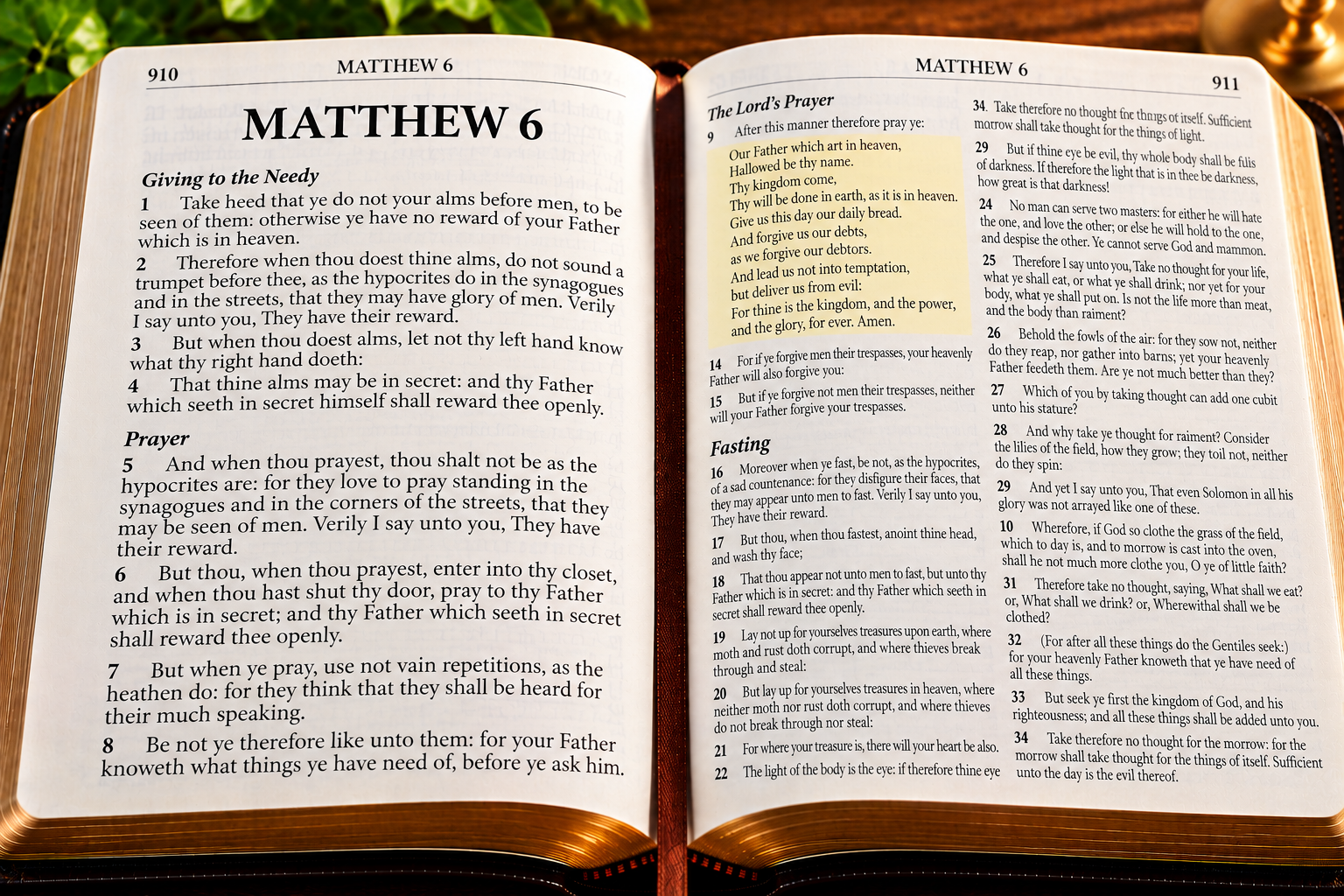
Matthew Chapter 6 continues the Sermon on the Mount, which began in Matthew Chapter 5. Jesus teaches His disciples how to live with genuine devotion to God rather than seeking human recognition or relying on material possessions for security.
The chapter addresses several essential aspects of Christian life, including charitable giving, prayer, fasting, forgiveness, stewardship of wealth, spiritual priorities, and anxiety about daily needs.
Jesus warns against practicing righteousness merely to impress other people. He teaches His followers to give sincerely, pray privately, and fast with humility. He also provides the Lord’s Prayer as a model of worship, submission, forgiveness, and dependence on God.
In the second half of the chapter, Jesus contrasts earthly treasures with heavenly treasures, teaches that the eye affects the whole person, and warns that no one can serve both God and money. He concludes by encouraging His followers not to be consumed by anxiety about food, clothing, or tomorrow, but to seek God’s kingdom and righteousness first.
Central theme: True devotion means putting God first, practicing righteousness sincerely, forgiving others, storing up heavenly treasures, and trusting God’s care rather than being controlled by material concerns and anxiety.
Main Sections of Matthew Chapter 6
- Giving Without Seeking Recognition — Matthew 6:1–4
- Prayer and the Lord’s Prayer — Matthew 6:5–15
- Fasting With Sincerity — Matthew 6:16–18
- Treasures in Heaven — Matthew 6:19–21
- The Eye as the Lamp of the Body — Matthew 6:22–23
- Serving God Rather Than Money — Matthew 6:24
- Overcoming Anxiety and Seeking God’s Kingdom — Matthew 6:25–34
1. Giving Without Seeking Recognition
Matthew 6:1–4
Jesus begins by warning His disciples not to practice righteousness before others merely to be seen by them. He applies this principle to charitable giving.
He describes people who announce their generosity to receive praise and honor. Their desire for recognition becomes the motivation behind their giving.
Jesus contrasts this behavior with giving in secret. His instruction is that charitable acts should arise from sincere devotion to God, not from a desire for public admiration.
He teaches that the Father, who sees what is done in secret, will reward those who give with the right motives.
Key Lessons
- Give to help others and honor God, not to gain applause.
- God values the motives behind charitable actions.
- Genuine generosity does not require public recognition.
- Private acts of kindness can demonstrate sincere faith.
Bible study reflection: When you help someone in need, is your primary concern the person’s welfare or the recognition you might receive?
2. Prayer and the Lord’s Prayer
Matthew 6:5–15
Jesus next addresses prayer. He warns against praying primarily to be noticed by others or using empty repetition as though many words automatically make a prayer effective.
He encourages His disciples to pray sincerely, knowing that their heavenly Father understands their needs.
Jesus then gives them a model prayer traditionally known as the Lord’s Prayer.
The Lord’s Prayer Explained
“Our Father which art in heaven, Hallowed be thy name.” — Matthew 6:9, KJV
1. Our Father in Heaven
Matthew 6:9
Prayer begins with a relationship with God. Addressing Him as Father expresses trust, reverence, and belonging to His family.
2. Hallowed Be Thy Name
Matthew 6:9
This petition asks that God’s name be honored as holy. Worship begins by recognizing God’s holiness and greatness.
3. Thy Kingdom Come
Matthew 6:10
This expresses a desire for God’s reign and purposes to be established in the world and in people’s lives.
4. Thy Will Be Done
Matthew 6:10
This petition expresses submission to God’s will rather than insisting that every circumstance conform to personal desires.
5. Give Us This Day Our Daily Bread
Matthew 6:11
This asks God to provide the necessities of life and teaches daily dependence on His provision.
6. Forgive Us Our Debts
Matthew 6:12
This acknowledges the need for God’s forgiveness and connects receiving forgiveness with extending forgiveness to others.
7. Lead Us Not into Temptation
Matthew 6:13
This expresses dependence on God for guidance, protection, and deliverance from evil.
Jesus emphasizes forgiveness again in Matthew 6:14–15. Those who receive God’s mercy must also be willing to forgive others.
Forgiveness does not mean pretending that wrongdoing never occurred or removing appropriate boundaries against further harm. It means refusing to make personal vengeance the governing principle of one’s response.
Key Lessons
- Prayer is a relationship with God, not a performance for an audience.
- God’s honor and kingdom should come before personal requests.
- Believers should depend on God for daily needs.
- Forgiveness is a central part of Christian discipleship.
- Prayer should express trust, submission, and dependence on God.
Bible study reflection: Which part of the Lord’s Prayer most challenges you to change your priorities?
3. Fasting With Sincerity
Matthew 6:16–18
Jesus addresses fasting, a spiritual practice associated with prayer, repentance, and seeking God.
He warns against making a display of fasting to attract admiration. Instead, He instructs His disciples to maintain their ordinary appearance so that their fasting is not performed for public approval.
The central issue is not whether others ever know that someone is fasting. It is whether the practice is sincerely directed toward God or used to build a religious reputation.
Key Lessons
- Spiritual disciplines should be practiced with sincere motives.
- Fasting is not a performance intended to impress people.
- Humility matters more than outward religious appearance.
- The purpose of fasting should be centered on God.
Bible study reflection: How can you practice spiritual disciplines without becoming focused on how others perceive you?
4. Treasures in Heaven
Matthew 6:19–21
Jesus warns against storing up treasures on earth, where possessions can deteriorate, be destroyed, or be stolen. He encourages His disciples to store up treasures in heaven instead.
Earthly possessions are temporary. Heavenly treasure represents what has lasting significance before God, including faithful obedience, generosity, love, and service.
Jesus then explains the relationship between treasure and the heart:
“For where your treasure is, there will your heart be also.” — Matthew 6:21, KJV
The point is not that owning possessions is inherently sinful. Rather, material possessions become spiritually dangerous when they dominate a person’s affections, priorities, and sense of security.
Key Lessons
- Material possessions are temporary.
- Faithful service to God has lasting significance.
- Financial priorities reveal what a person values most.
- Generosity helps prevent possessions from becoming the center of life.
Bible study reflection: If someone examined how you spend your time, money, and energy, what would those choices reveal about your greatest treasure?
5. The Eye as the Lamp of the Body
Matthew 6:22–23
Jesus describes the eye as the lamp of the body. A healthy eye is associated with light, while an evil or unhealthy eye is associated with darkness.
In this context, the image connects with the surrounding teachings about treasure, generosity, and material possessions. It concerns the way a person’s inner outlook influences the whole of life.
The passage warns that when one’s perspective becomes distorted by greed, envy, or misplaced priorities, spiritual understanding and conduct can become corrupted.
Key Lessons
- Inner attitudes influence outward behavior.
- Greed and envy can distort spiritual judgment.
- A healthy spiritual outlook helps direct life toward God’s purposes.
- Believers should examine what shapes their values and desires.
Bible study reflection: What influences most strongly shape the way you view money, success, and other people?
6. Serving God Rather Than Money
Matthew 6:24
Jesus declares that no one can serve two masters. A person will be devoted to one and reject or neglect the other.
He concludes:
“Ye cannot serve God and mammon.” — Matthew 6:24, KJV
The word mammon refers to wealth or material riches considered as an object of trust or devotion.
Jesus is not saying that money itself is inherently evil. Money can be used to provide for a family, support charitable work, and meet the needs of others. The problem arises when wealth becomes a controlling master.
This teaching requires believers to examine whether their financial decisions are governed by God’s purposes or by greed, fear, and the pursuit of status.
Key Lessons
- God must remain the highest authority in a believer’s life.
- Money is a resource, not a master.
- Wealth becomes spiritually dangerous when it replaces trust in God.
- Financial decisions should reflect faithfulness, stewardship, and generosity.
Bible study reflection: Does money primarily function as a tool you manage, or as a source of security that controls your decisions?
7. Overcoming Anxiety and Seeking God’s Kingdom
Matthew 6:25–34
Jesus concludes the chapter by addressing anxiety about daily necessities, including food, drink, clothing, and the future.
He points to the birds of the air, which do not sow or gather into barns, yet are fed by the heavenly Father. He also points to the lilies of the field, which are clothed with beauty without laboring to produce their own splendor.
These illustrations encourage trust in God’s care for His creation. Jesus reminds His listeners that human life is more valuable than food and the body more valuable than clothing.
He does not encourage laziness or the abandonment of responsibility. Rather, He challenges consuming anxiety that makes material concerns the center of life.
Jesus then gives the chapter’s central instruction:
“But seek ye first the kingdom of God, and his righteousness; and all these things shall be added unto you.” — Matthew 6:33, KJV
He concludes by teaching His disciples not to be consumed by tomorrow’s troubles, because each day has its own challenges.
Key Lessons
- God knows the needs of His people.
- Anxiety should not become the controlling force in life.
- Trusting God does not eliminate the need for responsible planning and work.
- God’s kingdom and righteousness should be our highest priorities.
- Believers should address today’s responsibilities without being overwhelmed by imagined future difficulties.
Bible study reflection: What worry might you need to bring to God while continuing to take responsible steps toward addressing it?
Major Themes in Matthew Chapter 6
1. Sincere Devotion to God
Giving, praying, and fasting should arise from genuine devotion rather than a desire for human approval.
2. Prayer and Dependence on God
The Lord’s Prayer teaches worship, submission, forgiveness, daily dependence, and trust in God’s protection.
3. Forgiveness and Mercy
Jesus connects receiving forgiveness with the responsibility to forgive others. His teaching challenges resentment and personal vengeance.
4. Heavenly Treasures
Earthly possessions are temporary, but a life directed toward God’s purposes has lasting significance.
5. Stewardship and Financial Priorities
Money is a tool that can be used responsibly, but it must not become a rival master to God.
6. Trust Rather Than Consuming Anxiety
Jesus calls His disciples to trust God’s care while remaining responsible for their daily duties.
7. Seeking God’s Kingdom First
The chapter culminates in the priority of God’s kingdom and righteousness above material concerns and personal ambition.
Biblical Interpretation Note
Matthew Chapter 6 should be interpreted within the larger context of the Sermon on the Mount. In Matthew 5, Jesus describes the character and righteousness of kingdom citizens. In Matthew 6, He explains how that righteousness should shape their religious practices, financial priorities, and response to uncertainty.
The chapter repeatedly contrasts outward religious performance with inward sincerity, and dependence on material security with trust in God.
1. The Meaning of Practicing Righteousness in Secret
Matthew 6:1 establishes the principle governing the chapter: acts of righteousness must not be performed merely to receive human recognition.
Jesus applies this principle to giving, prayer, and fasting. He is not prohibiting every public expression of faith. In Matthew 5:16, He has already encouraged disciples to let their good works shine so that others glorify God.
The difference is the purpose of the action. Public good works can honor God, but religious behavior performed to attract admiration redirects attention toward the individual.
The chapter therefore calls for integrity between the outward practice of faith and the inward motive behind it.
2. The Lord’s Prayer as a Model of Christian Prayer
The Lord’s Prayer is more than a formula to recite. It provides a pattern for ordering prayer around God’s character and purposes.
The opening petitions focus on God’s name, kingdom, and will. The remaining petitions address daily provision, forgiveness, and deliverance from evil.
This order is significant: Jesus teaches His followers to place God’s honor and reign at the center of prayer while also bringing their ordinary needs before Him.
The prayer also places individual requests within a communal relationship with God. The repeated use of “our” and “us” reminds believers that prayer concerns the needs and responsibilities of a community, not only the concerns of an individual.
3. Forgiveness and Its Meaning
Matthew 6:14–15 emphasizes the connection between receiving God’s forgiveness and forgiving others.
The passage does not mean that people earn God’s mercy by achieving perfect emotional freedom from resentment. Rather, the willingness to forgive is an essential expression of having received and understood God’s mercy.
Forgiveness does not automatically restore trust, remove consequences, or require a person to return to an unsafe relationship. Reconciliation may require repentance, accountability, and changed behavior.
The passage calls believers to reject a spirit of vengeance while taking wrongdoing seriously.
4. Treasures in Heaven and the Heart
Matthew 6:19–21 challenges the assumption that earthly possessions provide lasting security.
Jesus does not condemn responsible ownership or financial planning. His concern is the spiritual danger of making wealth the foundation of identity, satisfaction, or security.
Treasures in heaven refer to what has enduring value before God. In the context of the Sermon on the Mount, this includes righteousness, mercy, generosity, faithfulness, and obedience.
The statement that the heart follows one’s treasure suggests that priorities shape affections. Repeated choices about money, time, and service can gradually shape what a person loves most.
5. Serving God and Mammon
Matthew 6:24 presents a choice between rival masters.
The issue is not whether Christians may earn money or possess wealth. It is whether material gain controls their loyalties and decisions.
Wealth can support family responsibilities, charitable giving, and useful work. However, when the pursuit of wealth becomes the highest goal, it can compete with obedience to God.
Jesus calls His followers to use material resources faithfully without allowing those resources to define their ultimate purpose.
6. Understanding Jesus’ Teaching on Anxiety
Matthew 6:25–34 should be read as a call to trust, not as a denial of real needs or suffering.
Jesus addresses ordinary necessities such as food and clothing. His examples of birds and flowers emphasize God’s care for creation and encourage His listeners to trust that their needs matter to Him.
The command not to worry does not mean that believers will never experience anxiety or that those who struggle with it lack faith. Nor does it prohibit practical planning, seeking help, or taking action to meet legitimate needs.
Jesus challenges the kind of consuming anxiety that dominates attention and makes material security the central concern of life.
The instruction to seek God’s kingdom first redirects attention toward faithful living in the present. Believers are called to pursue God’s righteousness while entrusting the future to Him.
Key Interpretive Principle
Matthew Chapter 6 teaches that genuine righteousness is motivated by devotion to God rather than the desire for human approval. Prayer, giving, fasting, financial stewardship, forgiveness, and the management of worry should all reflect trust in the heavenly Father and a commitment to His kingdom.
The chapter does not condemn material possessions, responsible planning, or the experience of human concern. Instead, it warns against allowing wealth, public recognition, or anxiety to take the place of God as the primary source of direction and security.
Key Questions for Bible Study
These questions are suitable for personal devotion, family Bible study, small-group discussion, or church teaching.
A. Observation Questions: What Does the Text Say?
- What warning does Jesus give about practicing righteousness before other people? (Matthew 6:1)
- How does Jesus instruct His disciples to give to those in need? (Matthew 6:2–4)
- What does Jesus teach about praying for public recognition? (Matthew 6:5–8)
- What are the main petitions in the Lord’s Prayer? (Matthew 6:9–13)
- What does Jesus teach about forgiving others? (Matthew 6:14–15)
- How should Jesus’ disciples approach fasting? (Matthew 6:16–18)
- What contrast does Jesus make between earthly and heavenly treasures? (Matthew 6:19–21)
- What does Jesus mean when He says that no one can serve God and mammon? (Matthew 6:24)
- What examples from nature does Jesus use to teach about God’s provision? (Matthew 6:25–30)
- What does Jesus command His followers to seek first? (Matthew 6:33)
B. Interpretation Questions: What Does the Passage Mean?
- What is the difference between sincere devotion and religious performance?
- Why does Jesus emphasize the motives behind giving, prayer, and fasting?
- How does the Lord’s Prayer establish priorities for Christian prayer?
- Why does Jesus connect God’s forgiveness with our willingness to forgive others?
- What does it mean to store up treasures in heaven?
- How can a person’s financial priorities reveal the condition of the heart?
- Why does Jesus describe money as a potential rival to God?
- What do the birds and flowers teach about God’s care for creation?
- What is the difference between responsible planning and consuming anxiety?
- What does it mean to seek God’s kingdom and righteousness first?
C. Application Questions: How Should We Respond?
- Do you ever feel tempted to help others primarily to receive recognition? How can you guard against that motive?
- Which part of the Lord’s Prayer most challenges your current priorities?
- Is there someone you need to forgive? What would a wise and faithful response look like?
- How can you practice generosity without becoming focused on recognition?
- What do your spending habits reveal about your values and priorities?
- How can you use money as a resource for serving God and helping others?
- What practical steps can help you trust God while responsibly addressing your daily needs?
- What worry is taking up too much of your attention, and what constructive action can you take today?
- How can you place God’s kingdom first in your work, family life, and relationships?
- What change could help your daily spiritual practices become more sincere and consistent?
D. Reflection and Group Discussion
- Why do you think Jesus places such emphasis on doing good deeds in secret?
- How can churches encourage visible acts of service without promoting pride or self-promotion?
- How should Christians balance trusting God with working, saving, and planning for the future?
- What are some modern examples of serving money rather than God?
- How can Matthew 6 help believers respond to financial uncertainty without becoming overwhelmed by fear?
- What does this chapter teach about the relationship between worship and everyday decisions?
- Which verse in Matthew Chapter 6 is most meaningful to you, and why?
- What is one practical way you can seek God’s kingdom first this week?
Memory Verses
Matthew 6:21 (KJV)
“For where your treasure is, there will your heart be also.”
Matthew 6:33 (KJV)
“But seek ye first the kingdom of God, and his righteousness; and all these things shall be added unto you.”
Closing Reflection
Matthew Chapter 6 challenges believers to examine what motivates their religious practices, what controls their financial decisions, and what occupies their hearts.
Jesus teaches that giving, prayer, and fasting should be expressions of sincere devotion. He calls His followers to forgive others, invest in what has lasting value, and refuse to allow money to become their master.
His teaching on anxiety offers a practical spiritual priority: seek God’s kingdom and righteousness first while addressing today’s responsibilities faithfully.
Central Message: Matthew Chapter 6 calls believers to live with sincere devotion, practice forgiveness, manage possessions faithfully, and trust their heavenly Father. By seeking God’s kingdom and righteousness first, disciples learn to place eternal priorities above human recognition, material wealth, and consuming anxiety.